拜亚尔要塞的历史4 张照片
In 1666, Colbert, France’s finance minister under Louis XIV, established a shipyard near the town of Rochefort, located at the mouth of the Charente River. However, this yard was vulnerable to attacks by enemy ships—it was not difficult for them to navigate into the Charente estuary, bypassing the coastal fortifications on nearby islands.
At that time, France was involved in numerous wars, and leaving such a strategic location undefended would have been sheer madness. Moreover, France’s main adversary was England, which possessed the most powerful navy of the era. Thus, the issue of protecting this shipyard became an urgent concern for the king and his advisors.
Between the two islands near the Charente estuary—Exmouth and Oléron—there was a sandbar called “Baiear Spit.” But as is well known, it is impossible to build a solid structure on sand—let alone a fortress!
Nevertheless, Engineer Clerville, who was working on the fortifications at Ruaiom, proposed building a similar fortress. Sebastian Le Prêtre de Voban, a military engineer and marshal of France, reviewed this proposal and expressed his opinion to the king: “My lord, it would be easier to catch the Moon with our teeth than to complete such a project in this location.” The plan was not approved and was thus abandoned.
In 1763, at the end of the Seven Years’ War (during the reign of Louis XVI), the English managed to land forces on the island of Exmouth, once again highlighting the vulnerability of the region. The idea of building a fort was brought up again, and a plan was drafted—but it was rejected as too costly.
It wasn’t until the next century, in 1801, that the project was revived. In June of that year, a joint committee of military and civilian engineers presented their proposal. On February 7, 1803, the plan was approved by Napoleon Bonaparte, the first consul of France.
Since the sandy foundation at Baiear Spit was unsuitable for such construction, it was decided to build an earthen embankment using stone. Work began in 1804. One can only imagine the immense difficulty of this endeavor—stone blocks were transported from local quarries to the open sea and then dumped onto the unstable sandbar. Construction could only take place during low tide and in seasons when the coastal conditions allowed it. By the third year, it became clear that the heavy stones were gradually sinking deeper into the sand. The task was truly Sisyphean. Moreover, the fierce storms of winter 1807–1808 caused considerable damage to the nearly completed first two layers of the embankment.
England, France’s long-standing enemy, also played a role in undermining this project. Their ships frequently patrolled the area, making what was already a daunting task seem almost impossible. The cost of construction proved prohibitive for the state, and Emperor Napoleon decided to reduce the original size of the fortress.
In 1809, work resumed using the revised plan. However, it didn’t last even a year before construction was halted—first due to the destruction of the Rochefort fleet by the English and then because of financial difficulties. A total of 3,500 cubic meters of stone were used in the construction, costing the French treasury 3.5 million francs.
The project gained new momentum in 1840, during the reign of King Louis-Philippe. The worsening relations with England forced military officials to reconsider how to protect the Rochefort shipyard. By then, the stone foundation had stabilized, and the fortress was no longer as vulnerable as it had initially been.
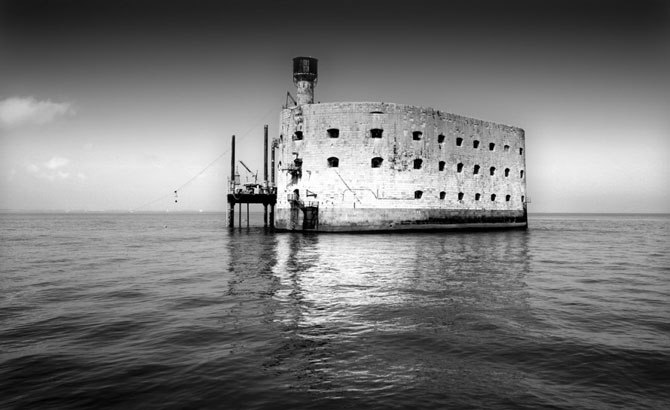
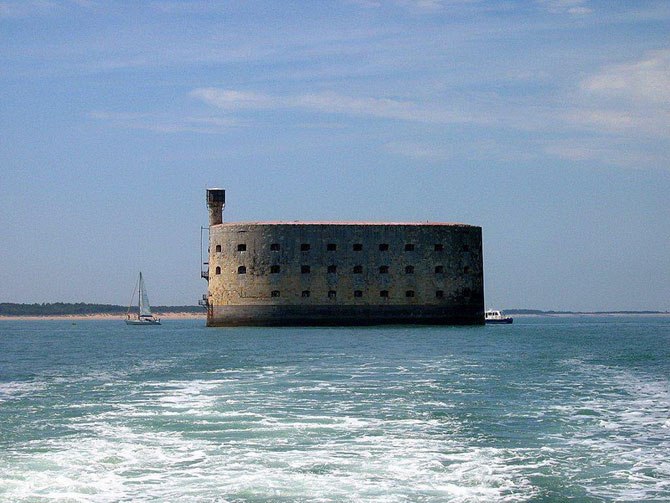
Technological advancements greatly facilitated the construction process—concrete, cement, and hydraulic plaster became available, eliminating the need to transport heavy stones from distant islands. Funds for the project were finally secured in 1847–1848. The foundation was completed in 1848, and by the end of 1852, the ground floor was finished. This level housed storage facilities for ammunition and supplies, water tanks, kitchens, dining rooms, a barracks, and sanitary facilities. The first floor was completed in 1857, and the upper structure and watchtower were finished in 1866. In total, the construction took more than sixty years—of which only a small portion consisted of actual building work.
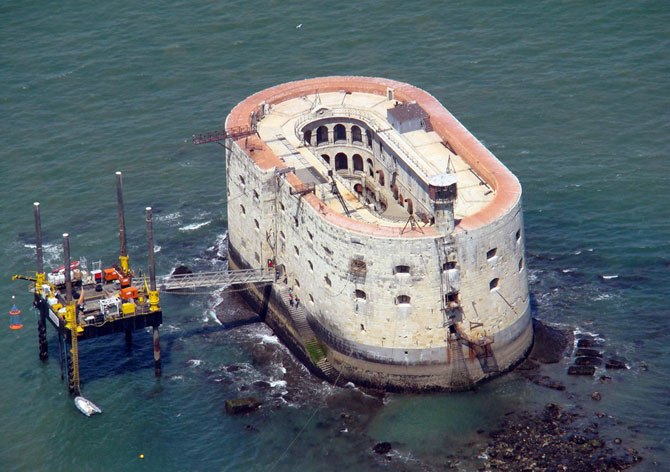
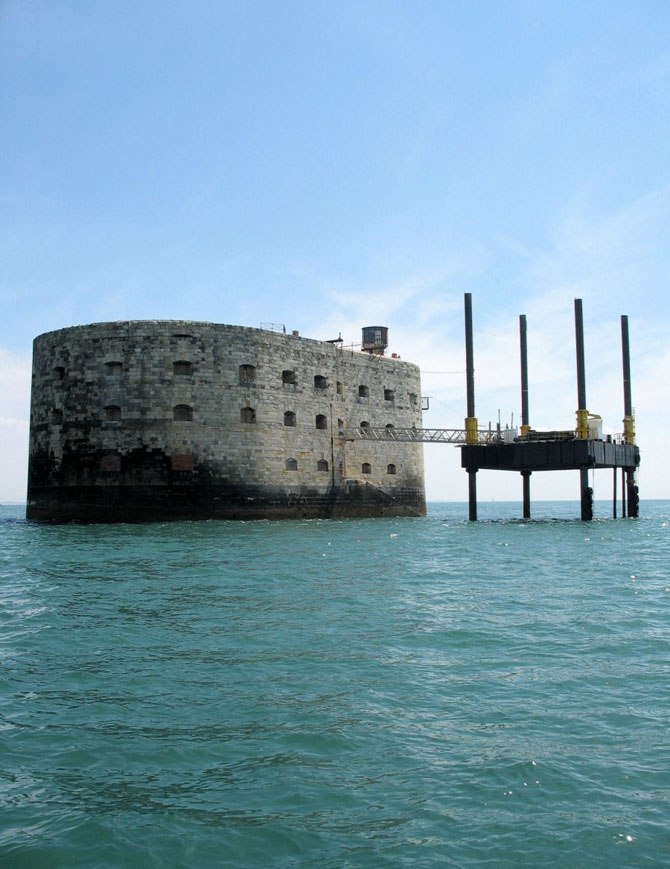
The completed fortress measured 68 meters in length, 31 meters in width, and 20 meters in height. Its 66 gun emplacements could accommodate 74 artillery pieces. The fortress was garrisoned by 260 soldiers, who also had their own butcher, washerwoman, and even two shoemakers—despite the fact that soldiers’ shoes generally didn’t wear out quickly. In the event of a siege, the garrison could survive for two months on its stored supplies of water and food.
One might think that nothing more could be desired after such tremendous efforts—but ironically, by the time the fortress was completed, it was no longer needed. Previously, the limited range of artillery meant that enemy ships could operate freely in the area without fear of detection. However, technological advancements had also improved military weaponry, and new cannons had three times the range of the older models. As a result, only 30 artillery pieces were actually delivered to the fortress instead of the planned 74. In the end, it was decided to convert the fortress into a prison.
However, this use lasted for only a short time. In 1872, the prisoners were relocated to a penal colony in New Caledonia, and the fortress was taken over by the French Navy. It remained a military facility until 1913, when the troops finally left it.
Once abandoned, the fortress became a target for thieves. Everything of value was stolen, and the artillery pieces were sold to scrap metal dealers. These dealers promptly dismantled the cannons using dynamite—this alone speaks volumes about how unnecessary the fortress had become…
The local authorities occasionally tried to make some money from it. In 1931, the fortress was offered for rent to anyone interested at a rate of 300 francs per year—but only two people showed any interest.
During World War II, the fortress, like the whole of France, was occupied by German forces. The invaders used it as a target for training exercises, resulting in the destruction of the docks, breakwaters, and the interior grounds of the fortress. After the war, extensive restoration efforts were carried out in France—yet Baiear Fortress remained damaged, with only dense wild grass covering the ruins. Its designation as a historical monument in 1950 did nothing to change this situation.
In 1961, it was decided to put the fortress up for auction. The starting price was 7,500 francs. About fifty potential buyers emerged, but eventually only two remained: Eric Aert, a Belgian dentist from Anderlecht, and a representative of the Friends of Baiear Fortress Association. Unfortunately, the association could only afford to pay 25,000 francs, so Aert, who offered 28,000 francs, became the new owner.
It seems that Aert had no clear idea what to do with the fortress, as none of his wild ideas—such as turning it into a casino, hotel, or resort—were ever realized. He rarely visited the site, and so Baiear Fortress continued to lie abandoned.
However, in 1966, the fortress gained international attention when Robert Henrico filmed the final scene of his movie “Adventurers” there, featuring two famous French actors, Alain Delon and Lino Ventura.
Several years later, in 1980, the fortress made its comeback on television—in the game show “Treasure Hunt,” hosted by renowned French broadcaster Jacques Antoine. He had discovered the fortress while watching “Adventurers” and decided to use it for filming. Jacques Antoine was deeply impressed by the site: “I came across this fascinating fortress but had no idea where it was located. We quickly found it, and standing there, amidst the seagulls’ cries, in this stone structure surrounded by the sea, I realized that it was the perfect location for my new game.”
Though it had appeared briefly on television before, this time the fortress played a central role in the game. However, since it was privately owned by a Belgian, facilitating the filming process proved challenging. Fortunately, Eric Aert agreed to sell it for 1.5 million francs, and the department council of Charente decided to proceed with the purchase. Jacques Antoine then paid a symbolic sum of 1 franc to become the new owner and began implementing his vision for the fortress.
To make access to the site easier, a special dock was built. The restoration work began by clearing the interior grounds of 50 centimeters of bird droppings and nearly 700 cubic meters of debris. After several months of effort, the first episode of the television game “Keys to Baiear Fortress” was filmed there. Thus began a new chapter in the fortress’s history—now that it was no longer open to the public, it continued to live its own unique existence.
为您的项目寻找最佳专业人士
维修、建设和装修专家随时准备帮助您