消失的行列13 张照片
**Disappeared Row Houses**
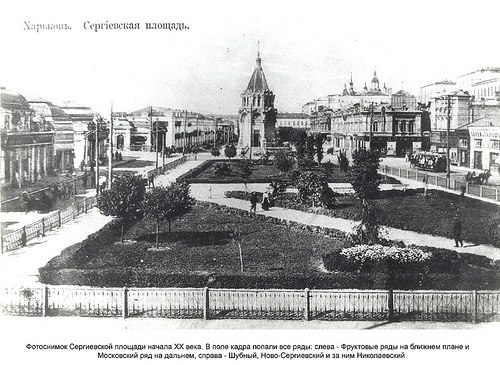
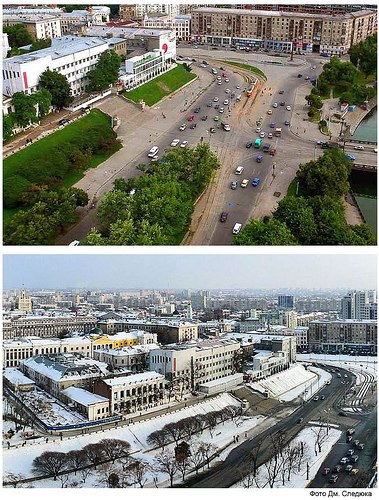
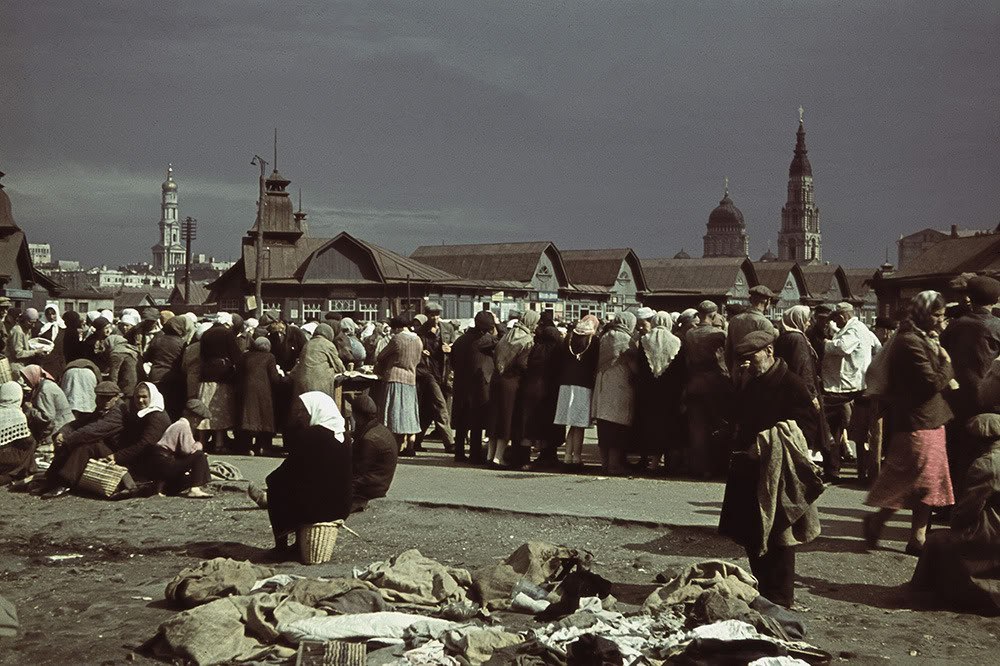
About 100 years ago, this relatively small area located between the river and the University Hill was one of the busiest commercial districts in the city. It was once known as the Market Square. Later, in honor of Governor Sergey Kokoškin’s contributions to the common good, it was renamed Sergievskaya Square.
Unorganized market trading on the Market Square gave way to organized commerce, and this change was largely due to the established system of commercial row houses here. These row houses did not appear all at once; the construction process took several decades. By the end of the 19th century, when the last one of them – the Fruit Row House – was completed, there was no more available space for new constructions.
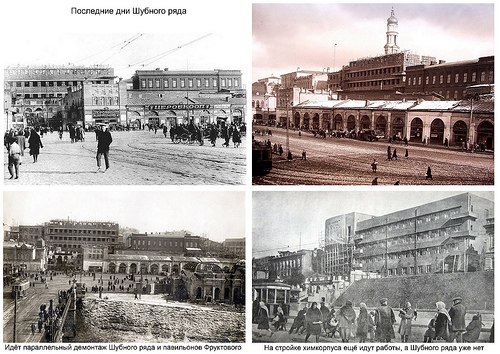
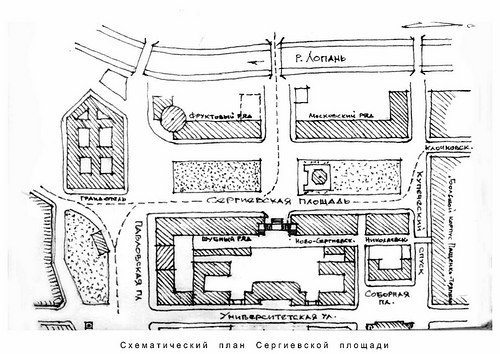
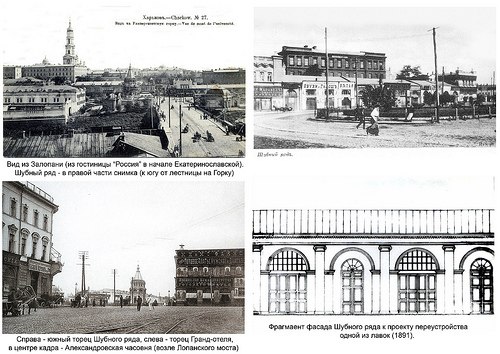
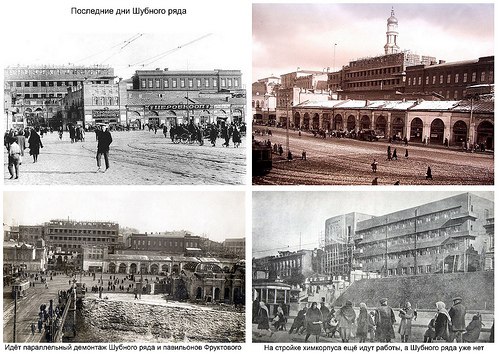
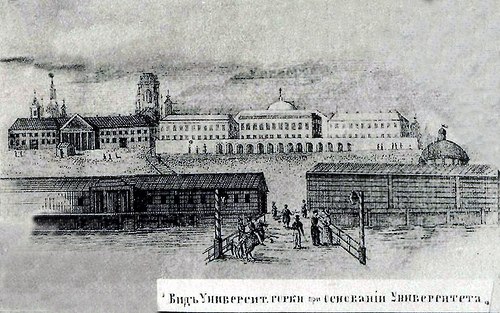
The first row house complex appeared on the Market Square in the late 18th century. It is depicted in the engraving “View of University Hill at the Time of the University’s Establishment.” This was the first stone-built commercial row house in Kharkiv, and it was named the Fur Row House. Designed by architect P.A. Yaroslavskiy, it was demolished during the Soviet era, during the square’s reconstruction in the early 1930s.
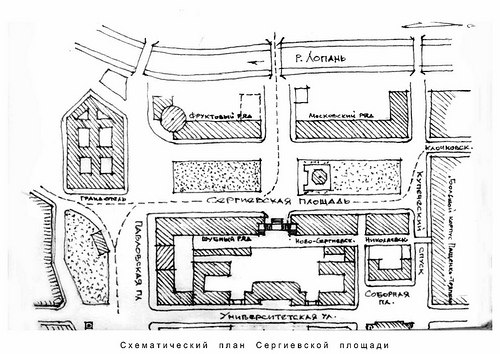
The layout of the Fur Row House on the square can be easily understood by looking at the schematic plan of Sergievskaya Square, which shows its appearance in the early 20th century.
The final days of the Fur Row House also marked the beginning of the construction of the new university chemistry building, which is visible in the background of many photographs from that period. The lower right image comes from the photo album “Kharkiv Is Being Built” published in 1931.
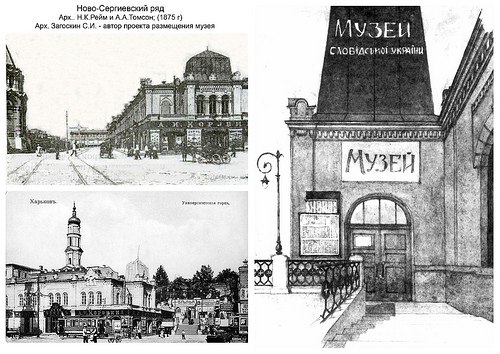
In the 1850s, the Sergievskiy Row House complex was built beneath the University Hill, near the Merchant’s Slope. In 1875, the Novo-Sergievskiy Row House complex appeared on the section of road between the staircase and the Sergievskiy Row House; it was designed by architects N.K. Reim and A.A. Thomson. The second floor of this building was allocated to the city’s Industrial and Art Museum according to a decision of the city council on November 2, 1882. The museum opened in December 1986 and became the second provincial public museum in Russia (after Saratov) and the first in Ukraine. Its facilities were located on the second floor, and access to them was provided through an intermediate landing on the staircase leading to the University Hill. During the Soviet era, the museum was renamed the Museum of the History of Free Ukraine named after G.S. Skovoroda.
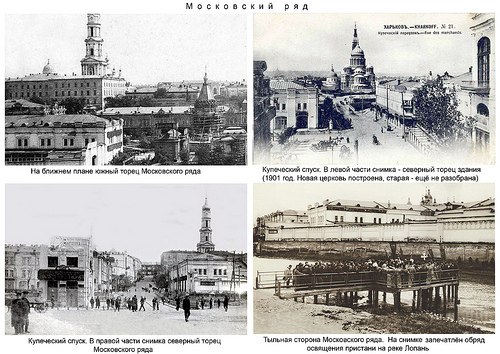
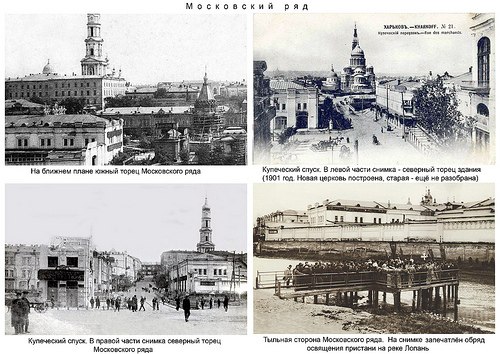
Around the same time, the Moscow Row House complex was built on the western side of the square, along the bank of the Lopan River, between the Merchant’s Bridge and the Lopan Bridge. It was designed by architect B.S. Pokrovsky.
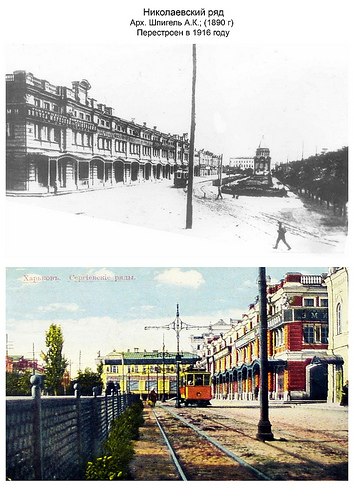
During the development of the square, unfortunately, some existing structures were also demolished. For example, the one-story brick shops of the Fur Row House were soon replaced by a new complex designed by architect P.A. Yaroslavskiy. At the end of the century, a fire destroyed the Sergievskiy Row House; in its place, the Nikolaevskiy Row House was built according to the design of architect A.K. Shipigel. In 1899, four stone pavilions comprising the Fruit Row House were completed and installed between the Lopan Bridge and the Office Bridge.
Several names have been mentioned regarding the authorship of this project. Regarding this topic, E.V. Solovyov wrote on the Mediaport website “Myths about the Development of Kharkiv”:“On many websites, as well as in printed materials, there is a misconception that the Fruit Row House complex on Sergievskaya Square was built in 1896–1898 according to the design of architect A.N. Beketov. To correct this historical inaccuracy, it should be noted that the construction actually took place in 1898–1899, and the true authors of this project are architects M.I. Dashkevich and M.S. Komornitsky.”
A.N. Beketov was indeed involved in this project; his design was approved in June 1896. However, the actual construction was carried out by M.I. Dashkevich, who prepared two cost estimates of 91,000 and 119,700 rubles respectively. The second version of the plan was selected for implementation in a council meeting on September 29, 1897. In 1898, Dashkevich made further adjustments to the design, moving the entire complex closer to the river. Construction began in that same year. Architect Mechislav Silvestrovich Komornitsky supervised the work, and his on-site adjustments were approved at a city council meeting on September 15, 1988. The inauguration of the completed building took place in September 1899, as mentioned in the “Kharkiv Governor’s News” of September 13, 1989.
From an economic perspective, the Fruit Row House complex was not particularly successful. For example, the corner pavilion near the Office Bridge remained unused for a long time, and its basements were constantly damp.
It is worth noting that A.N. Beketov’s initial design plan likely had a significant impact on the final appearance of the building, but this can only be confirmed by examining his original designs if they still exist.
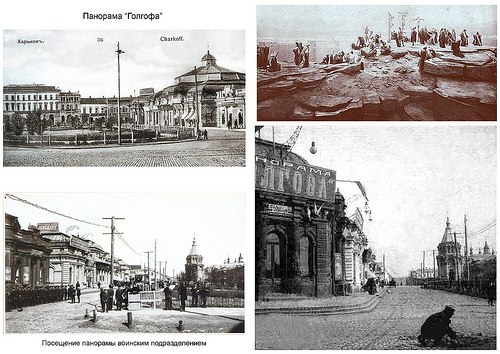
Finally, there was one more structure built on the square during that period – although it was not intended for commercial use. It was a pavilion constructed in 1908 for the “Golgotha” panorama. Although A.N. Beketov’s name is sometimes associated with this project as well, there is no documentary evidence to support this claim.
By the time the “Golgotha” panorama arrived in Kharkiv, its various versions had already been displayed in European countries for over 20 years. The version that eventually was installed in Kharkiv after a year and a half in Kiev had originally been created in Poland. This panorama attracted considerable interest at first, but its commercial viability became an issue shortly thereafter. Due to this, the Kharkov authorities, like other cities that had acquired similar structures, decided to replace it with another panorama. There was no shortage of options available at that time.
“A special building for panoramas will be constructed on Sergievskaya Square, where a new huge painting by the famous Polish artist Jan Stykki entitled ‘The Martyrdom of Christians in Nero’s Circus’ will be displayed. This painting is part of the illustrations for Sienkiewicz’s famous novel ‘Quo Vadis’. Jan Stykki’s panorama is not only an artistic masterpiece but also a historical document of great value – it provides a vivid portrayal of an entire era that left a profound impact on human history. The impact of this painting is immense, both in terms of its dramatic intensity and the beauty of its execution. The scene depicted is the crucifixion of Apostle Peter in 68 AD, when Nero’s cruelty reached its peak. The setting is the Vatican Circus. Apostle Peter is located on the opposite side of the arena, leading his followers. In the Caesar’s loge are various historical figures, such as Burrus, Senecion, Petronia, and in a separate gallery, above the Roman beauties, are the representatives of Polish theatrical art and the literary giants Henryk Sienkiewicz and Modrzewskaja, who inspired Stykki to create this masterpiece. This panorama was exhibited abroad before being displayed in Warsaw and Odessa, where it achieved tremendous success. The talent of the artist, combined with the highly dramatic plot, make this a truly remarkable work of modern art.”
——《Southern Edge》 newspaper, March 8, 1909.
Two years later:
“A huge empty building formerly used as the ‘Golgotha’ panorama venue has been rented for 10 years by a local engineering company. It will be converted into a large skating rink, modeled after those abroad.”
“It is said that approximately 30,000 rubles will be spent on equipment. The floor will be covered with a special material composed of long plates to create a smooth skating surface. The interior will include a luxurious buffet, restrooms, lounges, and other facilities. The entire space will be illuminated by electric light and equipped with various furniture.”
——《Kharkiv News》 newspaper, January 16, 1911.
However, in 1915, the pavilion was converted into a cinema called “Mayak” and continued to serve that purpose after the revolution.
Under the new regime, the commercial row houses did not enjoy a long lifespan. Plans to demolish the Fur Row House and the Fruit Row House complexes during the reconstruction of the central squares in the late 1920s and early 1930s had already been discussed. After the war, it was decided not to restore the other row house complexes either – the Novo-Sergievskiy, Moscow Row House, and Nikolaevskiy Row Houses.
Source: ngeorgij.livejournal.com
#1stolica_history
为您的项目寻找最佳专业人士
维修、建设和装修专家随时准备帮助您
推荐画廊
推荐文章


更多画廊
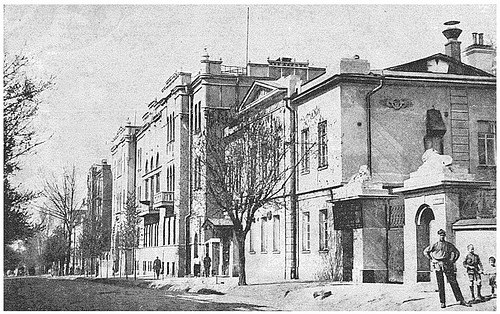
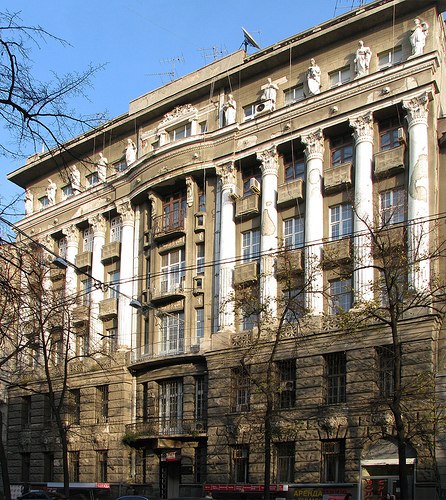 苏姆斯卡亚街82号。莫什克维奇以前的出租公寓楼(建于1914年)。<br>(建筑风格为新文艺复兴式。)
 在教育领域
在教育领域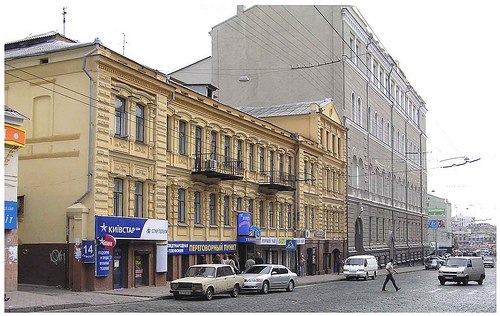 一栋房子的故事:苏姆斯卡亚街14号
 #
#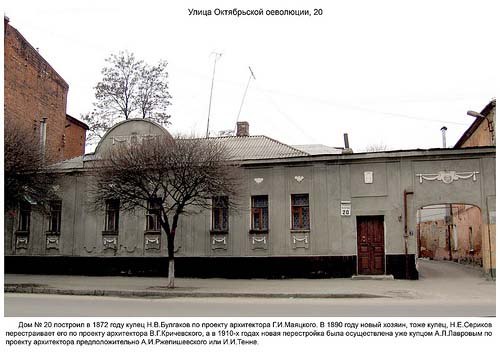 奥克塔布里斯卡亚革命街20号
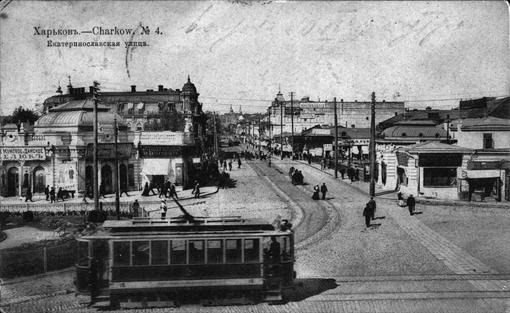 #### Конторская – the sanctuary of old Kharkov<br>(How Zalopan’ in the rural areas turned<br>into a prestigious commercial district.)
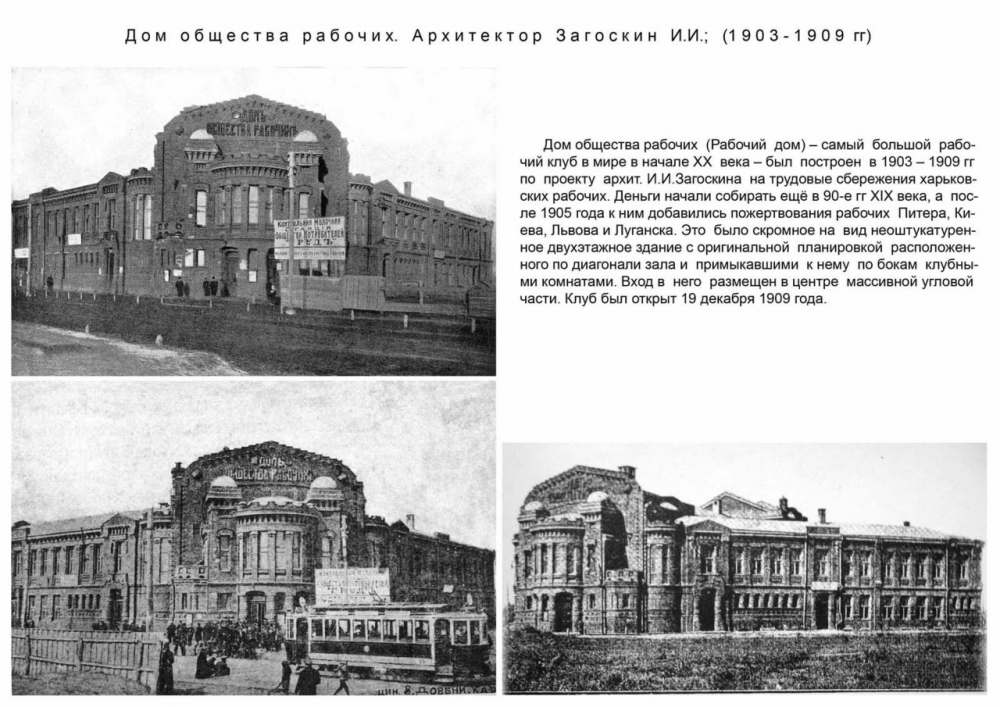 “工人协会之家”
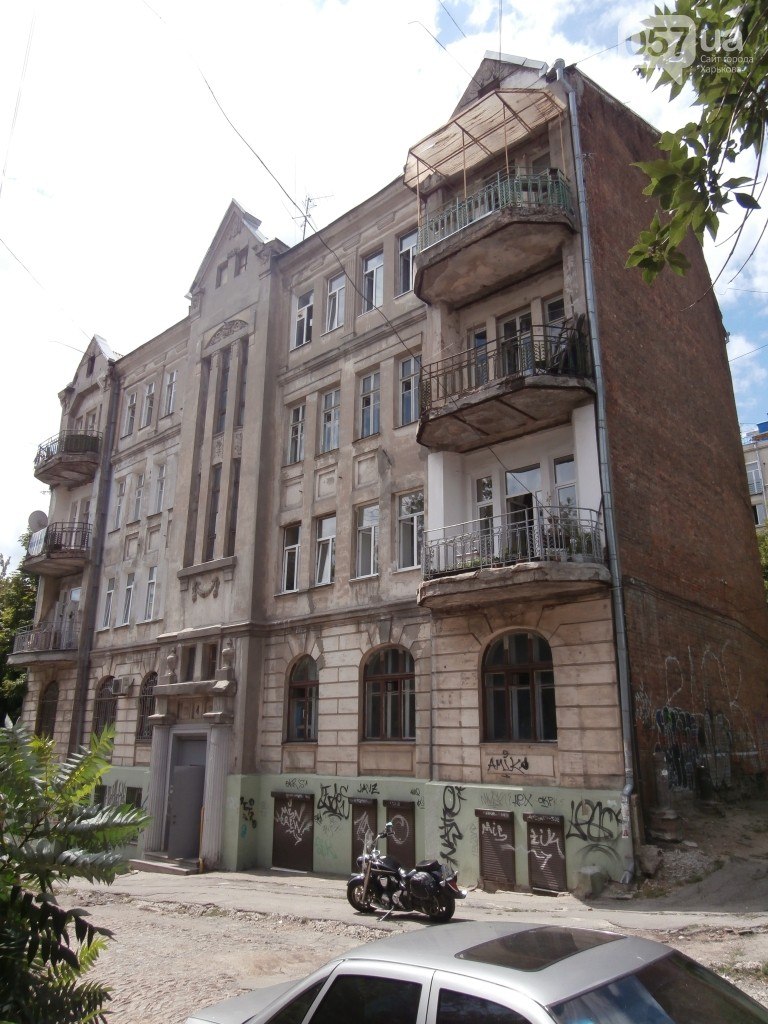 房子里有一间被改造成了迷你监狱的房间。那间房间曾被“利用”<br>(translation by Vorobeyeva, Part 2) --- Return ONLY the house that had a room converted into a mini-prison. That room had been “used” for certain purposes in the past.
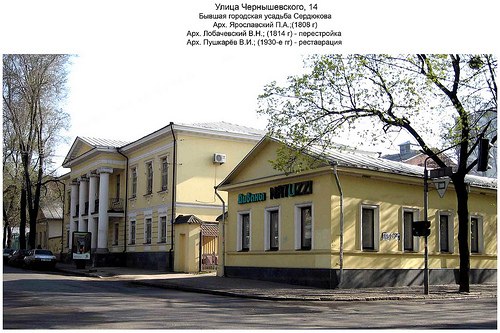 #### Chinese #### 黑尔尼舍夫斯卡亚街14号
 “乌克兰的防御”与尼古拉·米赫诺夫斯基
 市场的开放
市场的开放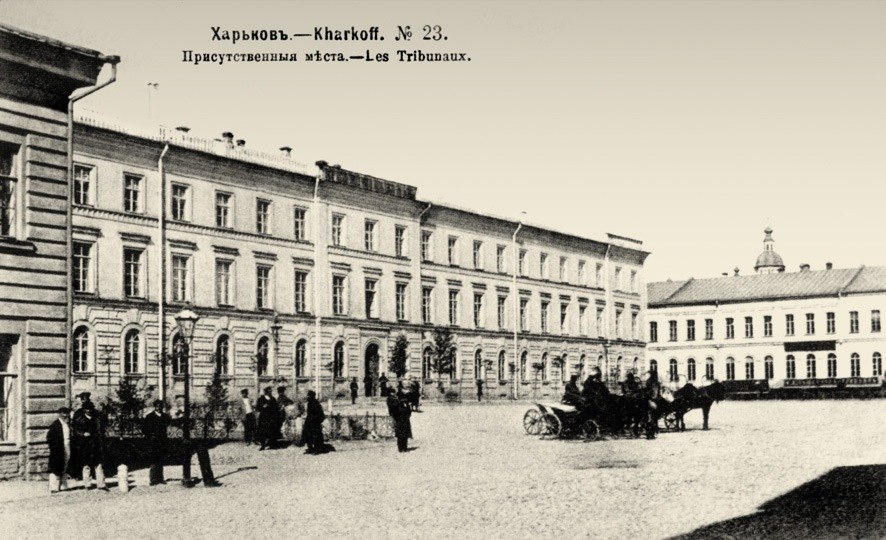 现场座位
现场座位