[club1543502|再次谈到苏姆斯卡亚街,19号……4 张照片
Today, my rather unenviable role is to inform readers that the information contained in Tatyana Viktorovna Tikhomirova’s article about the rental housing complex built by the “Zhizn” insurance company has been proven to be not entirely accurate. What were the reasons for this? Perhaps it was due to a lack of professional expertise—after all, we are amateurs after all—but perhaps it was also caused by an excessive reliance on printed materials rather than original documents. There are many other possible explanations as well... Of course, there is also a compelling reason that could justify many of these issues: the article in question did not actually consist of a fully prepared manuscript for publication, but rather of text that had simply been stored away in an archive folder at the Korolenko Library. If the author had had more time, it is very likely that these details would have been carefully verified before being made public. Once again, we would like to express our gratitude to Tatyana Viktorovna for her dedicated efforts.
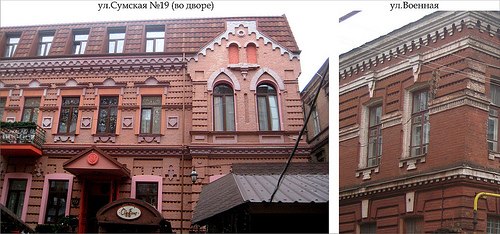
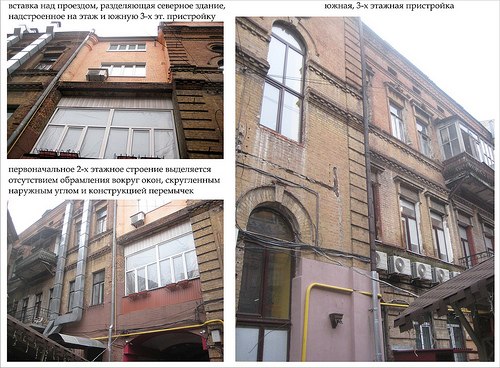
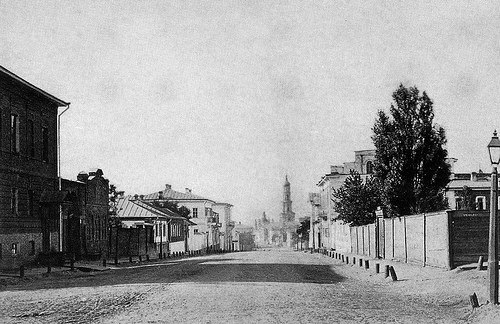
As for the role of OTK in this matter, it was once again played by Evgeny Viktorovich Solovyov. His insights and analysis are presented below. The plot of land on which the building is located originally consisted of two separate plots, numbers 21 and 23, which belonged to the same owner—the Kappel family. The earliest records of this land date back to the 1860s. There is a photograph published in the second volume of D.I. Bagaley’s “History of Kharkov” that shows a two-story northern wing of the building, which later became part of the three-story rental housing complex. The original features of this structure, dating from the mid-19th century, can still be seen on the side facades of the building. In the 1890s, the Kappel family built a two-story house in brick style in the courtyard. The designer of this building is unknown. Some architectural details of it resemble those of the barracks of the Tambovskiy Regiment located on Voennaia Street, which were constructed in 1900 according to the plans of architect M.I. Dashkevich. However, these similarities alone are not sufficient to determine the exact designer of this building. Since the property consisted of two separate plots, it was always referred to by the same double number—21-23 or 21/23. Around the turn of the 20th century, the Kappel family sold this combined plot to the nobleman Mikhail Orestovich Likhonin, who then built a three-story rental housing complex on it according to the designs of architect M.I. Dashkevich. The building was constructed by adding one floor to the existing two-story house and attaching a three-story annex to its southern side. Three-story extensions were also added to the northern and southern edges of the property. The requirements of the reconstruction project influenced the architectural design of the building; since the entrance openings had to conform to the existing structure, the facade appeared to have a “lower” profile. For various reasons, it was not possible to arrange the entrance to the courtyard from the facade in such a way that it formed a straight angle with it, but this difference is barely noticeable visually. Around 1910-1911, Likhonin sold the building to the “Zhizn” insurance company, which later built another rental housing complex on Pushkin Street according to the designs of architect V.V. Velichko. In 1980, the building was restored, but many decorative elements were lost in the process—frontons, balcony column decorations, attic balustrades, and so on. In the historical records related to the development of Harbin’s architecture, this building at 19 Sumskaya Street is mentioned in connection with the possibility that it was designed by architect N.A. Stecken Schneider in the late 19th century. However, these allegations lack any documentary evidence to support them. Source: ngeorgij.livejournal.com #Kharkov #Harbin #History
### Response:
Today, my rather unenviable role is to inform readers that the information contained in Tatyana Viktorovna Tikhomirova’s article about the rental housing complex built by the “Zhizn” insurance company “Zhizn” insurance company has been proven to be not entirely accurate. What were the reasons for this? Perhaps it was due to a lack of professional expertise—after all, we are amateurs after all—but perhaps it was also caused by an excessive reliance on printed materials rather than original documents. There are many other possible explanations as well... Of course, there is also a compelling reason that could justify many of these issues: the article in question did not actually consist of a fully prepared manuscript for publication, but rather of text that had simply been stored away in an archive folder in the Korolenko Library. If the author had had more time, it is very likely that these details would have been carefully verified before being made public. Once again, we would like to express our gratitude to Tatyana Viktorovna for her dedicated efforts.
As for the role of OTK in this matter, it was once again played by Evgeny Viktorovich Solovyov. His insights and analysis are presented below. The plot of land on which the building is located is originally composed of two separate plots, numbers 21 and 23, which belonged to the same owner—the Kappel family. These two lots were combined into one in the early 20th century. Around the turn of the 20th century, the Kappel family sold this combined lot to the nobleman Mikhail Orestovich Likhonin, who then built a three-story apartment building on it according to the designs of architect M.I. Dashkevich. The building was constructed by adding one floor to the existing two-story house and attaching a three-story annex to its southern side. Three-story extensions were also added to the northern and southern edges of the property. The requirements of the reconstruction project influenced the architectural design of the building; since the entrance had to conform to the existing structure, the facade appeared to have a “lower” profile. Due to various reasons, it was not possible to arrange the entrance to the courtyard from the facade in such a way that it formed a straight angle with it, but this difference is barely noticeable visually. Around 1910-1911, Likhonin sold the building to the “Zhizn” insurance company, which later built another rental housing complex on Pushkin Street according to the designs of architect V.V. Velichko. In 1980, the building was restored, but many decorative elements were lost in the process—frontons, balcony column decorations, attic balustrades, and so on. In the historical records related to the development of Harbin’s architecture, this building at 19 Sumskaya Street is mentioned in connection with the possibility that it was designed by architect N.A. Stecken Schneider in the late 19th century. However, these allegations lack any documentary evidence to support them. Source: ngeorgij.livejournal.com #Kharkov #History #Architecture
为您的项目寻找最佳专业人士
维修、建设和装修专家随时准备帮助您