The ancient Heraklion was hidden from the surface of the earth by an earthquake for several millennia. His discovery surprised scientists. And although Heraklion is not Atlantis (the Atlantis legend is much older), their stories are very similar.
The ancient city of Heraklion - 1200 years under water
The lost city was discovered under water after 1200 years. The main seaport at the mouth of the Nile, Heraklion was a small but prosperous city. Its inhabitants, through contacts with foreign merchants and sailors who frequented the city on their way to Egypt, were educated people with a broad outlook. The main temple of the city was dedicated to the god Amon.

But in the blink of an eye, Heraklion disappeared. In the first century BC. There was a strong earthquake that razed the houses, sank ships in the harbor, killed most of the city's residents, forcing the rest to flee, leaving all valuable property.

For two thousand years, the ruins of the city, hidden from prying eyes, with silt deposits and ten meters of water, lay 3 kilometers from the coast of Alexandria in Abukir Bay.

But last summer the French archaeologist Frank Hodio announced that he had discovered the remains of the city that he believed belonged to Heraklion: a black granite slab or stela on which the word "Heraklion" is written, the remains of ten ships in the former harbor, as well as thousands of other items, including jewelry, coins, vases and personal items.


Although modern scientists know little about this city, the whole ancient world knew it. Greek historian Diodorus wrote that Hercules, the son of Zeus, blocked the course of the Nile and thereby saved the lives of people who were on the banks of the river.


In gratitude, people erected a temple of his name and named in his honor the city. According to another Greek historian, Herodotus, Elena the Beautiful and her beloved Paris fled to Heraklion, fleeing from the wrath of Elena's husband Menelaus, but Tonys, the guardian of the Nile gate, forced them back.

The Greek historian of the 6th c. tells about these events differently. Stesichor. He says that the Greeks were deceived by the gods about the location of Helen the Beautiful in order to reduce the population of Troy with the help of war. In fact, says Stesichor, during the Trojan War, Elena was in Heraklion.

The inscription on the base of the stele certifies that this slab should have been erected in "Herakleion-Thonis" & raquo ;. This is the first clear proof that the discovered city is a semi-mythical Herculeion so far.

Archaeologist Frank Hodio did not find evidence of Elena Helen's stay here, but his discovery is fantastic. One of the first was found the great temple of Heraklion.

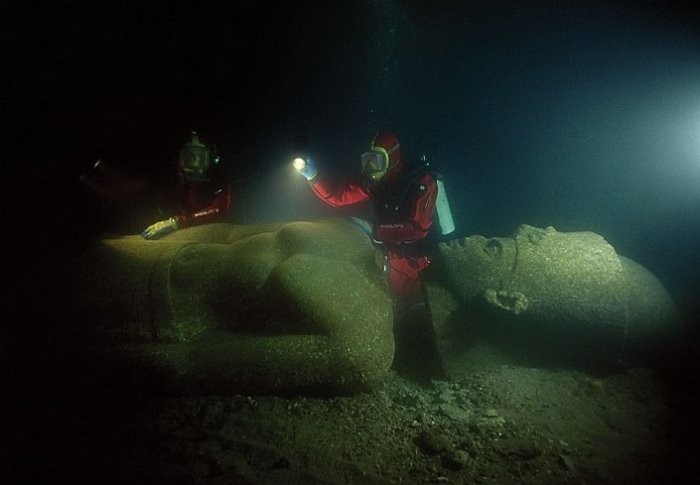
Remains of thick stone walls point to the border of its territory. Near the ruined walls, archaeologists found three huge statues of pink granite, which were allegedly destroyed during the earthquake. Two statues depict the still unknown Pharaoh and his wife. Third statue — Hapi, the Egyptian god of the Nile flood.

Inside the temple there is a monumental tomb of pink granite, covered with hieroglyphics. Its upper part still presents difficulties for reading, but the preliminary translation of the texts placed on the lower parts shows that this is undoubtedly the temple of Heraklion. A number of scientists, including Manfred Klaus of Frankfurt University, believe that the final decipherment of the inscriptions on the tomb will give even more.

Even more impressive is the two-meter black granite stele — almost a full copy of the stela, found in 1899 in Nokratzha. This is the first case of duplication of stele in Egyptology. Stela from Nokratzha, which is now in the Egyptian museum in Cairo, bears the text of the decree of Pharaoh Noktanebus the First, the founder of the 30th dynasty, who ascended the throne in November 380 BC. This decree introduced a 10-percent tax on Greek artisans and goods in Nokratzha and Tonis, which was to be sent to the construction of the temple to the goddess Nate.

The text ends with the words: & laquo; And his Majesty said: & laquo; Let it be carved on a stele erected in Nokratzha, on the bank of the Canal of Anu & raquo ;. The stele found is no different from the first, except for the last sentence, which says: & laquo; And His Majesty said: & laquo; Let it be carved on the stele, installed at the entrance to the Greek Sea in Heraklion-Tonis & raquo;/p>

The Gódio group also found a place where the harbor of Heraklion was located, in which there are now fragments of at least 10 ships piled in a pile. This suggests that they died from the tidal wave that followed the earthquake.

Wherever the explorers examined the underwater city, they found a variety of objects. All of them date from the first century BC. and earlier. Most of them — in good condition, despite staying under water for 2 thousand years.

Among the finds — gold earrings, bracelets, studs, rings, combs, a beautiful Greek goblet, covered with glaze, a smoker for aromatic substances, hundreds of coins. All have only a slightly scratched surface. And this is just the beginning — basic excavations (if this concept can be applied to archaeological work under water) — ahead.