The nuclear icebreaker "50 Years of Victory" In a voyage with Olympic fire to the North Pole he set two records. For the first time, the icebreaker reached the North Pole in the conditions of the polar night - before that they went to the Pole only in the light - and set a record for the speed of reaching the North Pole - 91 hours and 12 minutes.
Relay of the Olympic flame at the North Pole. How it was ...
We left Murmansk on October 15 at 17:25 and came to the Pole on October 19 at 12:37, passing a distance of 1395 nautical miles with an average speed of 15.3 miles per hour. The ice at the pole was 1.3 meters thick, and we reached without any problems. But these records were not our goal. The mission of our expedition was to deliver the Olympic flame to the North Pole and hold the torch relay stage there.

Atomic icebreaker "50 Years of Victory" In a voyage with Olympic fire to the North Pole he set two records. For the first time the icebreaker reached the North Pole in the conditions of the polar night - before that they went to the Pole only on a light one - and set a record speed of reaching the North Pole - 91 hours and 12 minutes. We left Murmansk on October 15 at 17:25 and came to the Pole on October 19 at 12:37, passing a distance of 1395 nautical miles with an average speed of 15.3 miles per hour. The ice at the pole was 1.3 meters thick, and we reached without any problems. But these records were not our goal. The mission of our expedition was to deliver the Olympic flame to the North Pole and to hold the torch relay stage there. It was attended by representatives of 8 countries that are members of the Arctic Council - Russia, Norway, Finland, Sweden, Canada, USA, Iceland and Denmark. Under the cut a story about how everything went & hellip;

The day before the pole, we rehearsed the relay race on the icebreaker. Igor Kutsenko, the general producer of the Torch Relay, and Alexei Rzhevsky, the manager for special projects of the Sochi 2014 Organizing Committee, fled instead of torchbearers with a burning torch. They also acted as guardians of the Olympic flame during the relay race

We checked all the props, including huge flags with partners' logos. By the way, the whole relay race is spent on the money of partners and the state has not invested a penny in it

The next morning, everyone began to wait for the Pole. The lamp was brought with the Olympic fire on the navigation bridge, and the last hour all the participants of the expedition spent together with the captain on the bridge, watching the instruments and approaching the pole

The North Pole reached at 12:37. The bridge was immediately celebrated with champagne. In the photo from left to right: Arthur Nikolayevich Chilingarov (the head of our expedition), Mustafa Mamedinovich Kashka (First Deputy Director General of Rosatomflot), Valentin Davydyants (captain of our icebreaker) and Starpop Ruslan Vladimirovich Sasov, who brought us to the pole

Arthur Nikolayevich shows the other members of the expedition a radar, which shows that we have reached the 90th degree of the north latitude, that is, the North Pole

Here is this radar. The figure in the upper right corner of 90'00.000'N shows that the GPS antenna installed on our icebreaker is located exactly at the North Pole point. Longitude does not matter, since all meridians converge at the North Pole point and a centimeter to the left of the centimeter to the right at the pole can differ by 180 degrees

As I said, in October at the North Pole the polar night and even at noon there is total darkness


We were lucky, and right on the North Pole there was a large and solid ice floe. First we landed on it and installed the North Pole sign:

It took 6 hours to prepare the relay and all the equipment. At 19:30 in Moscow, we started - carried the lamp with the Olympic flame from the bridge of the bridge and lit the torch of the first torchbearer:

The first torch was carried by the captain of our icebreaker Valentin Davydyants:


During the relay, not the torch with the fire, but the fire from the torch to the torch. When passing a fire, one of the accompanying torch "fire keepers" opens the supply of gas at the next torchbearer, then the torchbearers touch their torches, and the flame passes from one to the other, and at the end of the second "fire keeper" closes the gas on the torch of the previous torchbearer and continues running with fire. Valentin Sergeevich passed the Olympic flame to Elena Kudryashova - rector of the Northern Arctic Federal University:

Participants of the expedition and crew members acted as spectators:

The torchbearers were selected as follows: Sochi 2014 Organizing Committee & quot; decided that it would not be very fair, if only the torchbearers from Russia would flee by the Poles, and asked the embassies of the countries members of the Arctic Council to select a torchbearer from their country. These people and ran. The next torchbearer after Elena Kudryashova was Lassi Heininen from Finland. He is a professor at the Universities of the Arctic and Lapland.

The fire descended lower and lower on the decks:

Another torchbearer from Norway Jens Peter Nelsen is a professor at the University of Tromso:


He gave the fire to Pat Pitney - Vice Chancellor of the University of Alaska Fairbanks and Olympic Games champion in 1984 in Los Angeles:


From the torch, Pat fire received one of the most titled torchbearers of the relay race from Canada Stephen Podborsky, who works at the Olympic Committee of Canada. He is also a bronze medalist at the Olympic Placid in Lake Placid in 1980 and an eightfold winner of the World Cup downhill. In February 2012 Podborsky became the official ambassador of the 22nd Winter Olympic Games in Sochi from Canada:

He also brought down the fire on the ice of the North Pole:

And I gave it to Ilve Sjoberg - a representative of young scientists in Sweden:

Definitely, the cutest and most modest of the whole team:

If each of the torchbearers ran only his own distance, the "fire keepers" all of them ran. I'm not talking about your obedient servant who was running around and around:

On the ice, the route passed from one side of the icebreaker, which covered the ice floe from the wind. The torchbearers ran along the large perimeter around the North Pole sign, making a small round-the-world trip. The next was Steingrimur Jonsson from Iceland - Doctor of Physical Oceanography:


He gave fire to the Dane Christian Markusen - Geophysicist and Senior Adviser of the Geological Survey of Denmark and Greenland (GEUS)


Another penultimate was Ian Gunnar Winter - Director of the Norwegian Polar Institute:


All the torchbearers waited for him near the ladder:


Arthur Nikolayevich fled the last with the Olympic flame in his hands:

To the general applause, he lit the Olympic flame in the bowl:


At the end of the ceremony the torchbearers joined hands and made another round-the-world trip around the North Pole:

After that, all comers, including crew members, were released onto the ice, and a stormy celebration and photographing of each other began. All ended with a giant projection on the North Pole ice. I have static pictures, but I'm sure that the video of this presentation will appear in the near future:


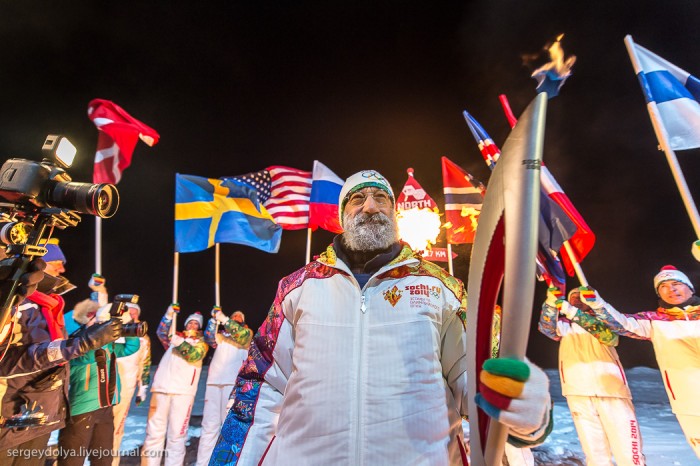
The last shot was the projection of the flags of all countries that took part in the relay torch of the Olympic flame at the North Pole. The torchbearers went out on the ice and took their place each at their flag:

A few hours later, our icebreaker headed for Murmansk. The next day, when we reached the latitude, where twilight appeared, the guys from Converse Avia took me to a helicopter and made several rounds around the icebreaker. I will also make a separate post with photos from this flight, but for now a couple of frames for seeding:


P.S. I want to express my gratitude to the Organizing Committee & quot; Sochi 2014 & quot; for the opportunity to visit the North Pole a second time, and also personally to thank Andrei Ivanov from Rosatom for the competent coordination of the whole event and an excellent company on board.
P.P.S. One of the torchbearers kindly gave me his torch, with which he fled at the North Pole, until I have my own, after I run with him in Volgograd in January.