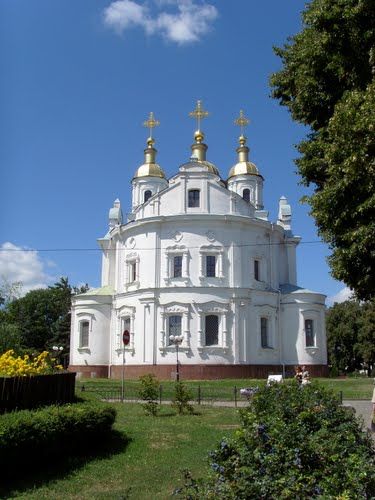
In 1748 the Cossack sergeant, representatives of the church community and the community of the city made a decision to build a new "Grad cathedral" - a stone one. The project of the cathedral was compiled by the famous architect, invited from New Serbia, Stefan Stabansky. Unfortunately, due to the lack of funds and building materials, the cathedral was built for 22 years. But despite all these delays the cathedral became the first stone church in Poltava.
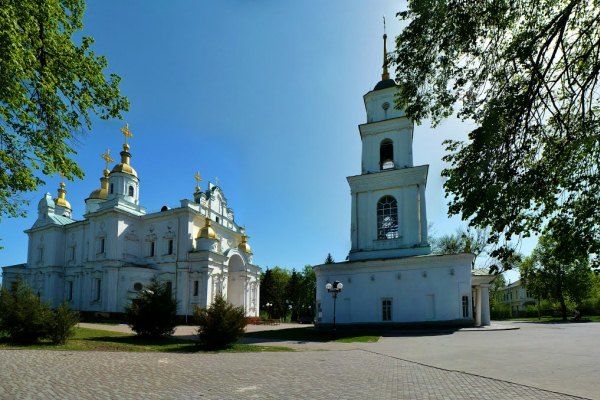
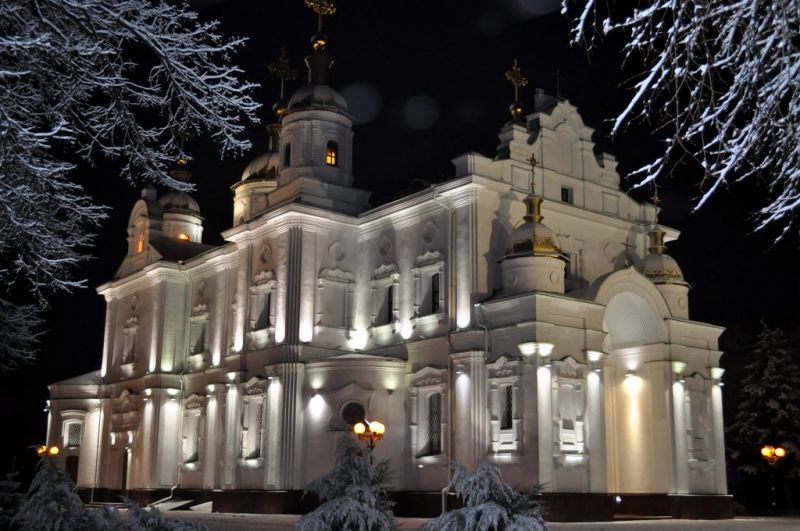
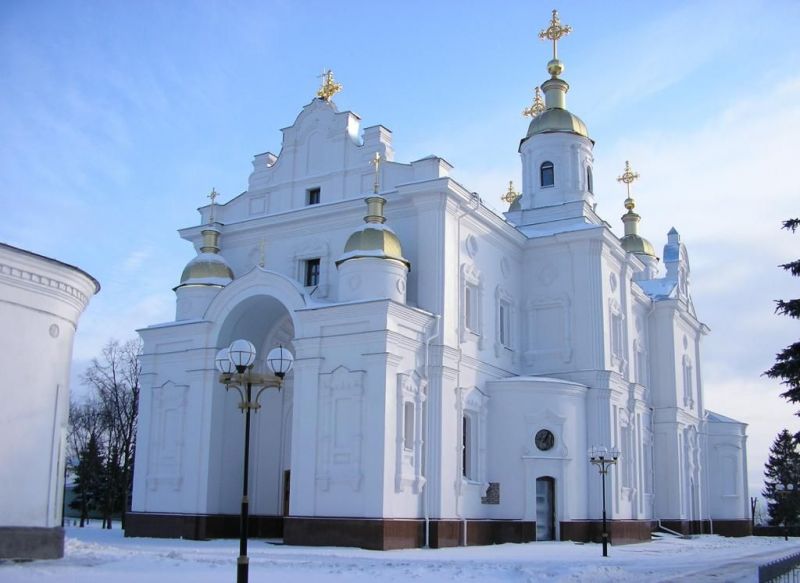
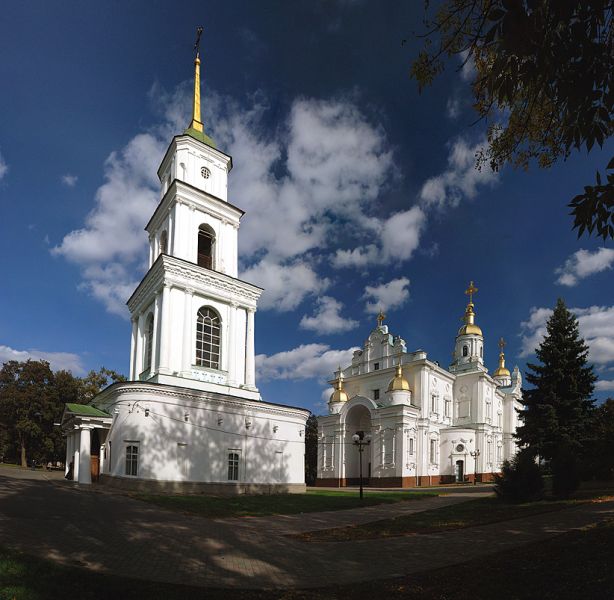
Initially, the cathedral was a three-domed cathedral, had two floors in the Byzantine basilica style, and on the facades were decorated decorative gables. Dimensions of the cathedral reached up to 30-32 meters in length and 17 meters in width. After 10 years, the first reconstruction of the cathedral was completed, two more domes were completed, and the cathedral became five-domed. Also, the sacristy was rebuilt, the choirs moved to the second floor, the floor made cast-iron (it was originally made of pottery bricks).
In 1847, after the episcopal chair was moved to Poltava from Pereyaslav-Khmelnitsky, the Grad cathedral became a cathedral.
In the 1889-1900s the cathedral was decided to expand. As a result of the reconstruction, the church became lighter and more spacious, its size increased by 170 square meters and the cathedral could accommodate more than ten thousand parishioners.
There are many interesting events connected with the history of the cathedral: here was the grandfather of the great writer and our fellow countryman - I.P. Kotlyarevsky, in 1787, this cathedral was visited by Catherine II, also in the cathedral once housed very rare, unique gospels of 1628 and 1644.
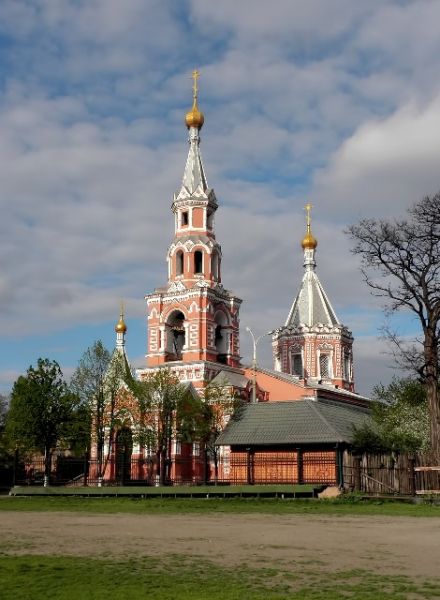
In 1774, near the cathedral began the construction of the bell tower. Unfortunately, there have also been delays. For the same reasons, insufficient funds and a shortage of building materials, the construction of the bell tower lasted longer than the construction of the cathedral, as much as for 27 years. In the end, in 1801, the construction of the bell tower was completed. The belfry is built in classical style, four-tiered, capped with a spire, 44 meters high. In the second tier there is a large bell weighing 350 poods, on the sides of it are cast images of the Assumption of the Virgin, the holy apostles Peter and Paul, and St. Nicholas. In the lower part of the bell, the inscription is written in Slavonic letters: "For the glory of the holy consubstantial and inseparable Trinity, this bell was made to the catholic Poltava Church of the Assumption of the Blessed Virgin with copper, bestowed by His Excellency Prince Vasilii Mikhailovich Dolgorukov, weight 350 poods, rock 1780, Gen. 25, Poltava ". On the third tier the bell, cast in the XVIII century from captured Turkish cannons captured during the storming of the fortress of Poltava, hung on the third tier, it is called "Kazikerman" and is now located in the Poltava Museum of Local History.
In 1934 the cathedral was completely destroyed, it was blown up. The bell tower was miraculously preserved, in its walls in wartime was a temple, then a museum of the history of architecture of the city.
To celebrate the 1100th anniversary of Poltava in 1999, with the blessing of the President of Ukraine, work began to restore the cathedral. In 2005 the cathedral was completely restored in its original form.
There is the Holy Dormition Cathedral at the address: Sobornaya Square, 3, Poltava.