Even after so many years, interest in the events of the Second World War has not faded. There are still disputes regarding the interpretation of many of its episodes and events. Unlike earlier wars, this war left behind a huge number of photo documents that captured those terrible events. All new and new images, which were previously in closed archives and private collections, become available to a wide audience. Of particular interest are realistic color photographs, which more fully convey the atmosphere of those years.
Kharkov of the German Occupation in Color
Today we present to your attention a series of photographs of occupied Kharkov, made primarily in 1942. Some of the buildings in the photographs were destroyed after the air raids and artillery shelling, but in a year even more Kharkov streets will be destroyed when in 1943 the city again becomes the scene of brutal fighting. On the photos presented in the selection, many streets are recognizable, but some buildings in the pictures have not survived to our days, destroyed during the fighting or demolished in the post-war years. In spite of everything, in the streets of the occupied city in 1942 the life continues "ndash; Kharkovites are engaged in trade, public transport is going on, signs are dazzling in German and Ukrainian languages, passers-by are considering German propaganda.

1. Citizens on the background of commercial pavilions of the Central market of Kharkiv.

2. Passers-by on one of the victims as a result of the bombing of the central streets of Kharkov. On the horizon you can see the current building of the Kharkov National University, and in those days - the House of Projects. The building was badly damaged during the war years and by 1960 it was rebuilt and given to the university.

3. Trade in the Central market. The dome of the Cathedral of the Annunciation (on the right) and the dome of the Assumption Cathedral are visible on the background, in which the House of Organ and Chamber Music has been located since 1986.

4. German soldiers at the showcase of the café & laquo; Caucasus & raquo; in Kharkov.

5. Portrait of Adolf Hitler in the shop window in occupied Kharkov, 1942.

6. The people of Kharkiv are viewing anti-Semitic and anisovian posters.

7. Tevelev Square in the occupied Kharkov (now — Constitution Square). The building on the right is not preserved, in its place the post-war development.

8. Hotel & la Red & raquo; in occupied Kharkov in June-July 1942. Before the revolution, the hotel was called "Metropol & raquo ;. It was one of the most beautiful buildings in the city, but during the occupation it suffered very badly and was not subject to restoration. In its place after the war a new building was built, the architecture usual for that time.

9. The area of M. S. S. Tevelev in occupied Kharkov (now — Constitution Square). Left — heavily damaged during the occupation of the hotel building "Red" razed after the war. The picture was taken from the roof of the building of the Palace of Pioneers (former Nobility Assembly), which was also destroyed during the occupation; now in his place a monument in honor of the proclamation of Soviet power in Ukraine (now dismantled).

10. German cars opposite the hotel & laquo; Kharkov & raquo; in 1942, on the central square of the city (now the Freedom Square), which from its foundation until 1996 was called the Dzerzhinsky Square. During the German occupation in 1942 was called the "German Army Square". From the end of March to 23 August 1943 was called the "Leibstandarte SS square" (raquo; by the name that just seized the city in the third battle for the Kharkov of the 1st division of the Leibstandarte SS "Adolf Hitler".

11. The queue for groceries near the Kharkov deli in 1942.

12. The Rembrandt & raquo; in the occupied Kharkov of 1942.

13. Trade at the entrance to the Central Market.

14. Embankment of the Lopan River in the Central Market area. On the horizon you can see the tram and the bell tower of the Assumption Cathedral.

15. At the bridge over Lopan in occupied Kharkov in 1942.

16. The children are examining the padded German tanks assembled on the station square (from the side of the main post office) of the occupied Kharkov. In the foreground the command version of the tank Pz.Kpfw. III.

17. Sverdlov Street, now Poltavsky Shlyakh street.

18. German patrol against the background of the Mark V tank near the Historical Museum in Kharkov.
In the early 1940s Kharkov Historical Museum became one of the largest in the Ukrainian SSR, its collection numbered more than 100 thousand items. During the Great Patriotic War the museum was damaged and then restored and supplemented by expeditions with materials from the areas of the region. Currently, next to Mark V is a T-34 tank.

19. The area of M. S. S. Tevelev in occupied Kharkov (now — Constitution Square). A view of the building of the Noble Assembly (1820, architect V. Lobachevsky). Behind him is seen the Assumption Cathedral.
Before the revolution, every three years several hundred Kharkov noblemen gathered in the building and held elections to the Nobility Assembly. March 13, 1893 in the building of the Noble Assembly in Kharkov took place P. Tchaikovsky. From 1920 until the transfer of the capital of Soviet Ukraine to Kiev in the building of the Noble Assembly, VUTYK — All-Ukrainian Central Executive Committee. In 1935, after the transfer of the capital to Kiev and the transfer of the government, the building was transferred to the first Palace of Pioneers in the USSR.
During the fighting for Kharkov in 1943 the building was completely destroyed. Now in its place is a monument in honor of the proclamation of Soviet power in Ukraine (now dismantled.)

20. Tram, passing through Sverdlov Street (now Poltava Shliakh).

21. Damaged by bombardment and shelling of the blocks around the Annunciation Cathedral, which, like other Kharkov churches, was opened for worship during the years of the Nazi occupation. The building of the cathedral was not damaged during the war years.

22. The buildings adjacent to the Central Market were seriously damaged during the war years.

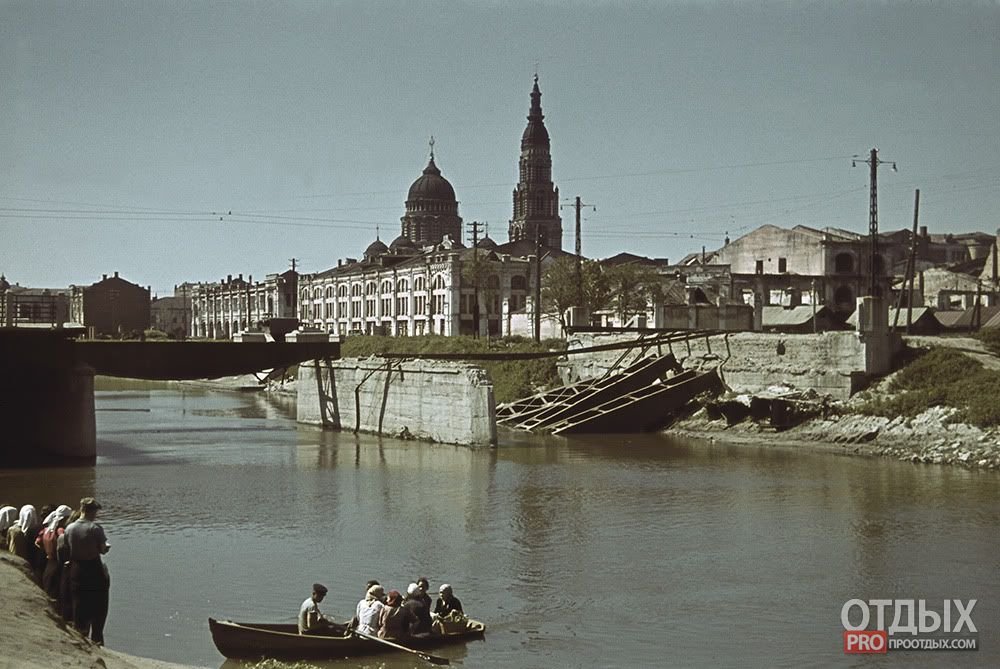
23. Boat crossing the Lopan river. Against the background is the bridge and the Annunciation Cathedral blown up during the retreat of the Soviet troops.

24. Tevelev Square (now the Constitution Square) and a view of the beginning of Sumskaya Street. In the foreground is the House of Science and Technology.

25. The building of the Gosprom in occupied Kharkov.
During the German occupation of 1941 & 1943 on the first floor, a stable was built, on the other floors in the beginning of the occupation there lived monkeys who fled from the zoo next to the building. Until August 23, 1943 in the State Industry survived three rhesus monkeys, which on the 65th anniversary of the liberation of the city, in August 2008, a monument was erected in the zoo. Before the retreat in August 1943, during the so-called "cleaning" raquo; Kharkov, the Germans mined the Gosprom, like many other buildings in the city, but the explosion was prevented by an unknown patriot, who was killed at the same time. Then the building was set on fire, but this did not do harm to the reinforced concrete skeleton of Gosprom.

26. A resident of Kharkov looks at the propaganda German poster. The inscription in Ukrainian reads "For the Freedom of Peoples."

27. A German regulator near a deli in the occupied Zhitomir (the corner of Bolshaya Berdichevskaya streets (with tram rails) and Mikhailovskaya). Above the store there is a banner with the inscription in German: & laquo; Welcome! & Raquo ;. Photos are often mistakenly attributed to a well-known series of color photographs of occupied Kharkov.