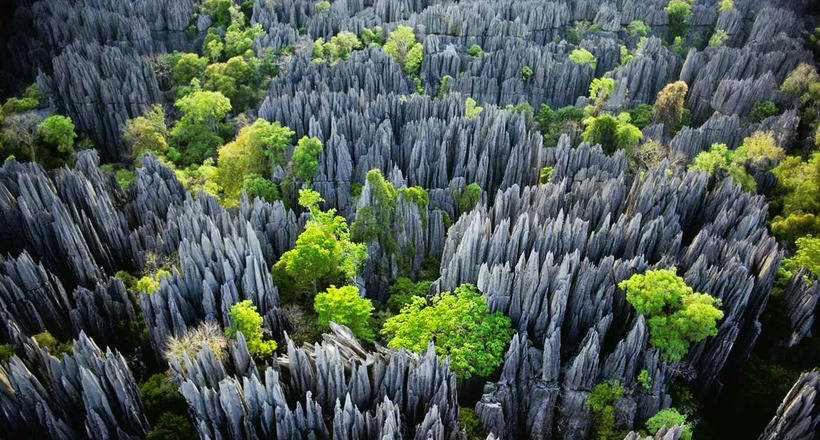
Madagascar - an amazing in its beauty of the island. But the so-called "stone forests" are especially distinguished among its exotic nature. Extensive spaces, covered with bizarre pointed rocks, amaze everyone who manages to get to these reserved places. "Stone forests" are even inscribed on the UNESCO World Heritage List.
The riddle of the appearance of a stone forest in Madagascar

They are located in the reserve Tsingi de Bemaraha on the west coast of the island. This is incredible in its beauty rocks. Their height is about 70 meters, and the tops are sharp like a knife blade. They are located with such frequency that even plants are rare here: it is almost impossible to gain a foothold in such rocks. From the animals of this bizarre world, white lemurs and wild birds are seen. A huge array of amazing rocks fascinates, creates the feeling of a fabulous country on a distant planet.
In the local dialect, this forest is called "scurvy", which means "a place where you walk on tiptoe" or "a place where you do not walk barefoot." Despite the fact that it is quite difficult to move around in this stone forest and in shoes, this place is frequented by tourists, especially mountaineering fans. For them, this is a real paradise.

According to experts, these bizarre stone spiers formed in two stages. First this territory was located in the World Ocean, where the foundation of this wonderful forest was formed. Being a residual form of the coral reef, this territory accumulated multimetric chalk and calcareous sediments for millions of years. But the final formation of the miracle happened already on land, when as a result of geological processes this part of the island was on the surface. Here, the wind and rainwater took over, although water erosion, according to scientists, was still crucial. Cretaceous and calcareous rocks have different resistance to the effects of the water element. As a result of intense heavy rains, the unstable Cretaceous sedimentary rocks dissolved and washed away. And more chemically stable calcareous layers remained, forming an unusual stone forest with peaked peaks. It should be noted that in the vegetative plan this is not quite a lifeless place. Below, in more or less wide areas, where sunlight can penetrate, trees grow, giving shelter to birds and small animals.

The Madagascar stone forest is becoming increasingly popular with tourists and extreme lovers. There are pendant bridges and observation platforms, allowing you to enjoy a magnificent panorama of this fabulous place.