The land on which stands Yalta, was inhabited by a man for a long time. The present Yalta grew on the site of the Taurian settlement, which existed in the 1st century AD. e. in the area of the former village of Chekhov. Near the city archaeologists discovered objects related to the stone and bronze centuries. In the old part of Yalta, on the slope of Polikurovsky Hill and on the outskirts of the city, "stone boxes" were found - burials of the Taurians, the oldest inhabitants of the southern coast. The habitat of the Taurus in the Crimea dates from the X-IX century BC. e. to the III century AD. e. In written sources of Greek authors this tribe has a bad reputation of cruel pirates who not only rob travelers, but also sacrifice them to their goddess Deva. But, of course, piracy for the Tauris was not the basis of the economy, but only "subsidiary fishery." Livestock, farming, hunting, fishing and dolphins, collecting sea shellfish gave them livelihoods.
History of Yalta
The land on which Yalta stands was inhabited by a man for a long time. The present Yalta grew on the site of the Taurian settlement, which existed in the 1st century AD. e. in the area of the former village of Chekhov. Near the city archaeologists discovered objects related to the stone and bronze centuries. In the old part of Yalta, on the slope of Polikurovsky Hill and on the outskirts of the city, "stone boxes" were found - burials of the Taurians, the oldest inhabitants of the southern coast. The habitat of the Taurus in the Crimea dates from the X-IX century BC. e. to the III century AD. e. In written sources of Greek authors this tribe has a bad reputation of cruel pirates who not only rob travelers, but also sacrifice them to their goddess Deva. But, of course, piracy for the Tauris was not the basis of the economy, but only "subsidiary fishery." Means for their livelihood were given by cattle breeding, agriculture, hunting, fishing and dolphins, gathering of sea shellfish.

The history of the Taurus settlement, where Yalta was formed, is certainly connected with the history of the Crimea. In the city itself during construction works often find objects from the period of the Crimean Middle Ages. In the Middle Ages, there was a fairly large village called Jalita. The earliest mention of Yalta (Jalit) is found in the description of the coast of Crimea in the early 12th century (1145). In the 13th century Venetians penetrated the southern coast, and then the Genoese. In documents and maps of the XIV century. Yalta is called Yalitha, Callita, Gialita and Etalita.
Since the beginning of the XV century, Yalta with other southern coastal lands was part of the feudal principality of Theodoro, populated by a nationality, professing Christianity. Then she moved to the Genoese, and later, until 1475, again treated Feodoro.
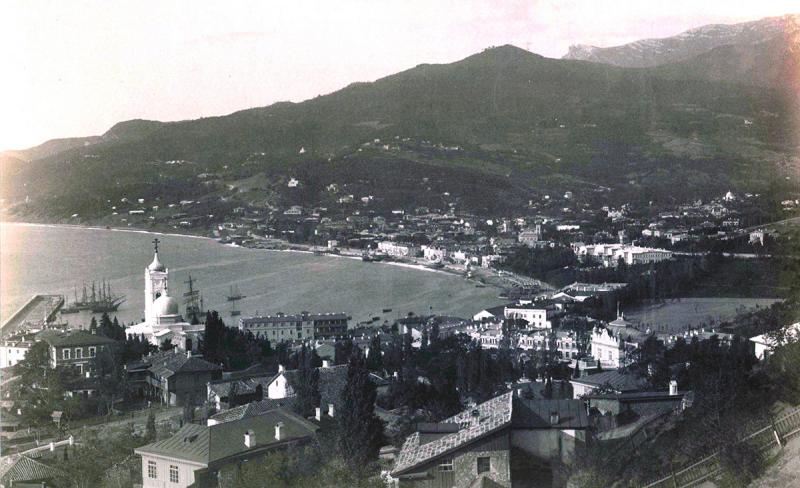
From 1475 to 1774 Yalta entered the province, which was in the personal possession of the Turkish sultan. During this period, it became obsolete and by the end of the 18th century it was a small fishing village - several miserable shacks and a church. It was located in the lower part of Polikurovsky Hill, at Cape John (now there is a sea station on this place).
After the Crimea was incorporated into Russia (1783), the lands of present-day Yalta were given to large landowners "for the cultivation of lemon, orange, olive and other trees." The village began to grow slowly, although the lack of roads seriously hampered its development.
In 1823, the Governor-General of Novorossia, which included the Crimea, was appointed MS. Vorontsov. Enterprising royal dignitary, the largest landowner, Vorontsov created in Alupka and Massandra industrial wineries.
In the development of viticulture, in the distribution of subtropical ornamental and fruit trees on the southern coast, the Nikitsky botanical garden, organized near Yalta in 1812, made a great contribution.
In the twenties of the XIX century, Yalta was connected by road with Simferopol, in the thirties - with Sevastopol. In 1838 Yalta received the status of the city and became the center of the new Yalta district. This event is evidenced by the chapel of St. Nicholas the Wonderworker. However, even before the 60's, the whole of its western part was occupied by vineyards and tobacco plantations. Yalta began to be built only in the 70's, especially after the construction of the Lozovaya-Sevastopol railway in 1873.
The healing powers of Yalta and its environs were persistently advocated by the doctors SP. Botkin and VN Dmitriev. S.P. Botkin the first expressed the opinion that Yalta and the entire Southern coast is the best climatic station in Russia for tuberculosis patients. On his advice the royal family of the Romanovs bought Livadia for themselves.
This was the impetus for the rapid development of Yalta. To be closer to the tsar, the court nobility began to build palaces and dachas here. After this enterprising bourgeoisie began to build hotels and villas designed for wealthy people.
The establishment of Soviet power in the Crimea (1920) contributed to the further development of the city. The organization of a network of resort institutions began. On the basis of nationalized hotels, boarding houses, dachas, sanatoriums are organized. By the summer of 1921 in Yalta resort area 18 sanatoriums for 2400 places worked. In 1925, in the former royal estate of Livadia, the first peasant sanatorium was opened, and at the foot of the Bear Mountain, the first tents of the Artek pioneer camp stretched. Soon the construction of new health resorts begins. In 1928 in the mountain forest zone of Yalta the sanatorium "Dolosy" was put into operation.
The seizure of Nazi Germany by the Crimea in the autumn of 1941 was interrupted by resort construction. On April 16, 1944, the troops of the Separate Maritime Army liberated Yalta. Restoring the war-devastated Yalta was built and updated.
On February 4-11, 1945, a conference of the heads of the three powers of the anti-Hitler coalition of the USSR, the United Kingdom and the United States was held in Yalta at the Livadia Palace. Issues of the final defeat of fascist Germany, the post-war arrangement of the world and the activities of the United Nations ( UN). The United Nations, founded by the decision of the Yalta Conference, created the conditions for the development of modern International law. Therefore, the results of the conference for the modern world can not be overestimated.
In Yalta there are well-known Institute of Physical Methods of Treatment and Medical Climatology named after I.M. Sechenov and the research institute of viticulture and winemaking "Magarach". Since 1961 a regular trolleybus traffic has begun between Simferopol and Yalta, a trolleybus route has been opened in the city itself.
When you arrive in Yalta you will certainly hear the expression "Big Yalta". This is not a reservation. Big Yalta is a significant part of the Southern coast of Crimea with a length of about 70 km. - from the village of Foros in the west to the village of Krasnokamenka in the east. Yalta is an administrative and resort center on the coast. In the territory of the Big Yalta there are wine-growing, tobacco-growing, ether-oil and vegetable-garden enterprises. The world famous are the wines of the factories of the winery "Massandra". In recent years, many new houses and health resorts have been built in Yalta, and large-scale works have been carried out to improve.