Sights of Tatarov
While on vacation in Tatariv, you can not only enjoy the amazing Carpathian nature and exciting skiing from the slopes of nearby Bukovel and Vorokhta, but also visit local attractions.
Unfortunately , there are no sights in Tatarovo itself, all of them are at a certain distance from it.
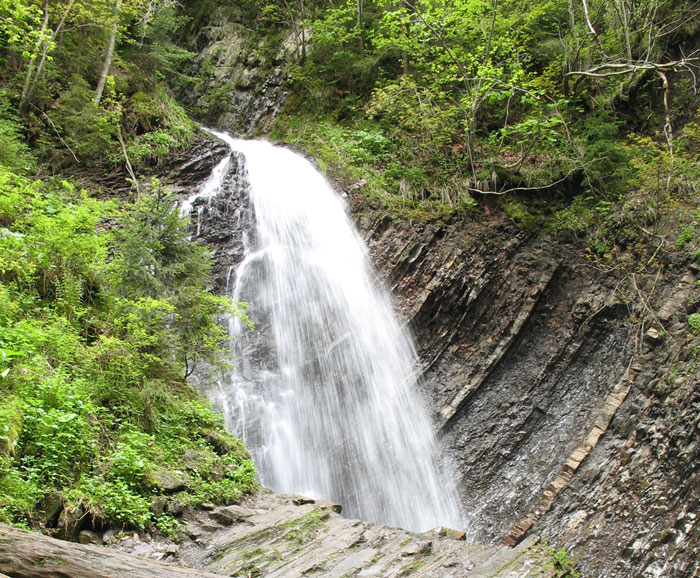
Guk Zhenetsky Falls, which is located on the river. Zhenets at an altitude of 900 m above sea level, is included in the number of large waterfalls of the Ukrainian Carpathians, its height is 15 m. The magnificent nature, the raging waters of the river and the spectacular view of the waterfall will all make an indelible impression on every person who has ever visited this region. The road to the waterfall goes through the tract. On the way there are gazebos for rest, a small kolyba and benches with tables.
The Dovbush Trail, which starts from the tributary of the Dribka tract, runs between the cliffs to the Ambara Dovbush, enters the Gorgan Zaprutsky Range, makes a vicious circle and leads to the starting point. On the "Dovbush Trail" the view of the tourist is attracted by the original stone compositions of the sculptor Darius Grabar, dedicated to the people's avengers, which was once commanded by Olexa Dovbush. Attracts to itself tourists and mountain Doboshanka where, on national stories-legends, Dovbush loved to happen. Particularly interested is the Dovbush Stone, which is a silent giants rising above the Prut. "Dovbush Trail" was created as a memory to the people's avengers and their legendary leader Oleksa Dovbush, who acted here in 1738-1745. The unique creation of nature is the amazing rocks of Dovbush, which has long since become a true tourist Mecca for travelers. A unique heap of stone blocks of Yamnen sandstone (the main geological rock)which has been here since the Ice Age, hitting visitors.
Observatory on Mount Pop Ivan (Black Mountain) was built in the 30s of the twentieth century. The history of this building resembles the life of the Carpathian region itself, which has changed hands so many times.
On the Montenegrin ridge you can see the once established neat concrete columns with the letters P and S. This is the old demarcation line, which after the First World War was the border between Czechoslovakia and Poland. In the thirties, the idea arose to erect a new observatory, since the old one in Warsaw did not meet the technical requirements. In 1935 it was decided to build a meteorological station and a powerful border post on the Black Mountain with the support of the Polish Ministry of Air Defense.
As a result, the military and peaceful tasks were united. The contest was announced, and a year later a symbolic stone was laid in the foundation of the meteorological observatory. Just two years later - on June 29, 1938, the grand opening of a real palace was constructed in a constructivist style, not a simple building, but adapted to the harsh weather conditions of the highlands. Polish officials and Polish and a number of Western Ukrainian astronomers attended the celebration. It was surprising that - at an altitude of more than two kilometers and tens of kilometers from the nearest settlements, in just two years a colossal building appeared that had two floors on the eastern side, and five from the western side (due to the peculiarities of the relief). To the house adjoined the tower-rotunda with a stone spiral staircase, which connected with the main building by the passage on the first floor.
The rotunda was crowned with a copper dome that opened automatically - it was a place for a telescope. In total there were 43 rooms and 57 windows in the palace. The thickness of the walls of the basement floor was 1.25 m. The windows in the house were framed with metal, and inside there were oak frames. On the first floor there were living rooms, a station master's apartment and a conference room, on the second floor there was a dining room, offices, a hotel, a communication room (though the mail rarely went, and the trained dog of one of the employees delivered it). On the top floor there is a hall for meteorological observations. A stone fence was erected around the observatory, the main porch and paths were spread with stone. Above the main entrance, all this was crowned with the heraldic eagle and the inscription in Polish - Astronomical and Meteorological Observatory Marshal Pilsudski. In the economic building there is a boiler house and a small power station with a battery house. The water pipeline was connected to the observatory, which pumped water from the lowland with two electric pumps.
To build this miracle of architecture and technology helped residents of the Carpathian Hutsul villages. It was they who, on horses and their own backs, delivered stones and wood for the construction. In the same way 800 tons of building materials were delivered from Vorokhta station (70 km from the construction), 33 boxes with equipment and equipment (the heaviest weighed 950 kg). The original cargo was a cork tree that traveled from Africa to France, then Poland, and finally to Vorokhta, further to the village of the foothills of the Shibene, and from there to the observatory. The cork served as a warming material between the thick stone wall and the thin brick wall. The mountain road, which connected the observatory with the settlements below, was laid by the hands of the Hutsul peasants. Life in the observatory was not easy. This is indicated by the unofficial name of the observatory, the Poles nicknamed ... White elephant. Strange seems to be the name for the gray house becomes clear when looking at the photograph of the observatory in winter. At 30-40 ° C, the frosty palace is quite stilldigs a crust of snow and ice, and then the outlines really reminds a white elephant. It should be added that scientists who climbed a mountain on a sleigh in winter often fell under snow avalanches, and then military men were sent to search for them.
In 1939, Poland was no longer divided, divided between Hitler and Stalin. The building of the observatory passed to the Soviet Union. The Soviet government decided to use the White Elephant to its destination, and in September 1939 the first in the USSR high-altitude geophysical observatory and weather station was organized.
During the Great Patriotic War, the observatory was badly damaged, it was unbearable to revive the old miracle of architecture and technology of the poor postwar Academy of Sciences. Residents of the surrounding villages stripped the White Elephant, left without any inspection, removed the copper roof, took out the windows and doors, and then the severe climate did its work. Today, tourists who have climbed to the Black Mountain, will see only strong walls that resemble a fortress destroyed by a brutal war.
Not far from Tatarov, in the picturesque gorge of the Carpathian Mountains, is the ancient village of Manyava. Here on the cliff above the river there is an ancient monastery-monastery of the 17th century. It was founded by natives of Athos by monks Jov Knyaginetsky and Ivan Vishensky. The date of the founding of the Manyav monastery is 1608. It was then that the first written mentions appeared about him. Once this monastery obeyed directly to the Patriarch of Constantinople. At one time there was a large library of early printed books. In the middle of the XVII century. in the monastery were up to 200 monks. He had dozens of monasteries in subordination in Galicia, Bukovina and even in Moldova. In 1612, the Krestovozdvizhenskaya church was erected in the monastery. In 1620-1621 the monastery was surrounded by a defensive wall with three towers. However, during the Turkish raid in 1676, the hermitage was destroyed and restored only in 1681. There is a suggestion that on the territory of the monastery is buried the hetman of Ukraine Ivan Vygovsky, who died in1664 year. Another Manyavsky monastery is famous for its iconostasis, created at the end of the XVII century by the icon painter hieromonk Iov Kondzelevich. This majestic structure, measuring 13 x 11 meters, consists of six rows, in which there are about 100 icons of different sizes, from miniatures to icons of more than two meters. Significantly, the iconostasis stands next to the same outstanding monuments as the Kozeletz Iconostasis in Chernigov and Sorochinsky in Poltava. In 1970-1980 in the monastery were carried out significant restoration work. After that Maniavsky monastery was declared a historical and architectural reserve. At the moment on the territory of the monastery is located the Krestovozdvizhensky Monastery of the Ukrainian Orthodox Church of the Kyiv Patriarchate. Well, above the monastery is located one of the most beautiful Carpathian waterfalls - Maniavsky Falls. It is located in a mountain gorge. But getting there is hard enough. The waterfall is a spectacular sight. The height of the waterfall is about 20 meters, the water from itfalls off several cascades. At the foot of the waterfall - a small lake, where you can swim if you want.
Find the Best Professionals for Your Project
Expert repair, construction, and renovation specialists ready to help you right now
Recommended articles
More articles:
 Faces and emotions of the Winter Olympics - 2014 in Sochi (day five)
 Fashion show from Salon du Chocolat
 Simpatyaga Sprint Beemer with Glemseck 101
 Friday's positive
 Happy Valentine's Day: hearts are everywhere
 Faces and emotions of the Winter Olympics - 2014 in Sochi (the seventh and eighth days)
 All the winners of the photo contest World Press Photo Contest 2014 (part one)
 The world's largest solar power station