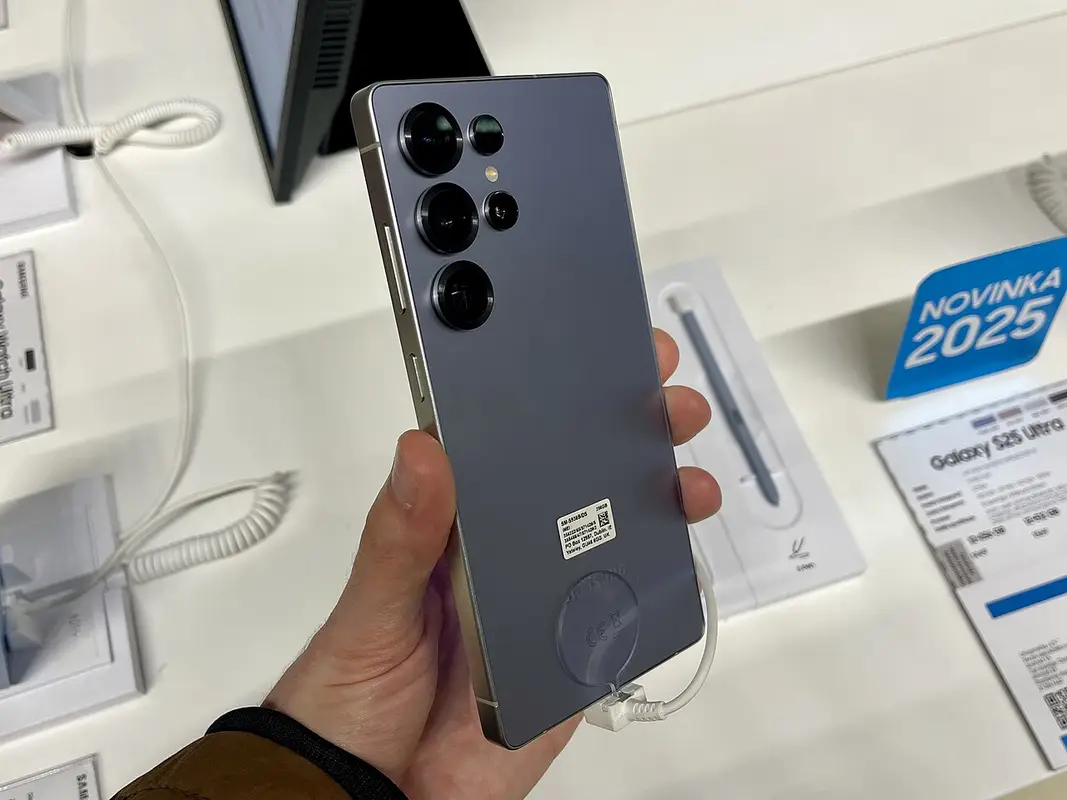
Samsung Galaxy S25 Ultra: The Android flagship with revolutionary AI and a 200-megapixel camera
The Galaxy S25 Ultra is not just a evolution of the previous generation; it represents a significant leap forward in mobile photography and artificial intelligence. Its base price is $1,299 (about 130,000 rubles at current exchange rates), putting it in the same price range as the iPhone 16 Pro Max and the Google Pixel 9 Pro XL. However, Samsung’s true strength lies in the specific set of features it offers.
Design and Construction: Titanium Instead of Aluminum
The device’s body is made from Grade 5 aviation titanium, which is 40% stronger than the aluminum used in the iPhone 16 Pro. Weighing only 218 grams with a 6.9-inch screen, it’s 15 grams lighter than the Galaxy S24 Ultra. The edges are rounded at a 10° angle, making it more comfortable to hold even after extended use for photography or video recording.
The display is an AMOLED panel with a resolution of 1,440×3,120 pixels, a refresh rate of 120 Hz, and a maximum brightness of up to 3,000 nits. It supports HDR10+ standards, and in testing conditions under direct sunlight, the display remained perfectly readable. The thickness of the body is 8.2 mm, while the bezel around the screen is just 2.8 mm on all sides.
In a departure from tradition, Samsung includes only a USB-C cable in the box, without a charger. The company justifies this as an eco-friendly measure, but we see it as a somewhat weak argument. On the positive side, the S Pen has been improved, with a latency of only 2 milliseconds (compared to 6 milliseconds in the S24 Ultra), which makes drawing and taking notes much more responsive.
Under the Hood: Snapdragon 8 Elite and Galaxy AI
The Snapdragon 8 Elite Gen 3 processor was developed in collaboration between Samsung and QUALCOMM and represents the final generation before the transition to ARM v9.2 architecture. In AnTuTu tests, it scored 2,456,000 points—18% higher than the Snapdragon 8 Gen 3 in the S24 Ultra. At the same time, power consumption has decreased by 12% thanks to the 3-nm manufacturing process.
The video processor now features its own dedicated core for processing 8K videos at 60 frames per second. In practical terms, this means you can record 8K videos simultaneously, apply AI filters in real time, and get preview images displayed on the screen without any lag.
Galaxy AI is a set of built-in processing tools that operate directly on the device, without sending data to Samsung’s servers. The Photo Enhance function restores details in both shaded and bright areas within 0.3 seconds. Generative Edit allows you to remove objects from photos or change the background using a neural network—this is faster than Google Photos, where such processing can take 3 to 5 seconds.
The device comes with 12 GB of LPDDR5X RAM and storage options of 256 GB, 512 GB, or 1 TB in UFS 4.0 format. When copying an 8K video file of 10 GB, the process takes only 8 seconds. With a 5,000 mAh battery, it can provide 18 to 20 hours of usage in typical mixed-use scenarios without recharging.
Camera: 20-megapixel main camera with 10x optical zoom

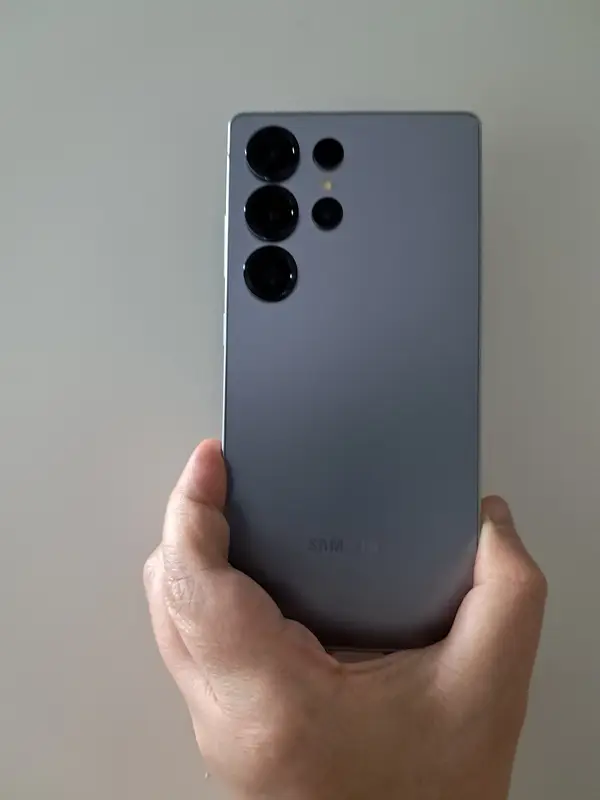
The triple-camera system includes a primary sensor with 200 MP resolution (pixel size of 0.56 micrometers), a ultra-wide-angle lens with 50 MP, and two telephoto lenses: one with 10x zoom (50 MP) and a hybrid 50x zoom lens. The Adaptive Pixel technology allows the sensor to automatically switch between high-resolution mode and a mode that enhances light sensitivity depending on the shooting conditions.
Even at 10x zoom, the image quality remains impeccable—no noticeable pixelation is observed even when the image is cropped by 100%. For comparison, the iPhone 16 Pro Max only offers 12x digital zoom without any optical zoom capabilities. The Google Pixel 9 Pro XL, on the other hand, has only 5x optical zoom, which is significantly less.
The front camera has a resolution of 12 MP and auto-focus; its equivalent focal length is 24 mm. During video calls via Telegram and WhatsApp, image stabilization ensures that the video remains clear even when the user is moving. Video recording in 8K mode can continue steadily for up to 30 minutes before the system needs to cool down—the built-in thermal management module takes about 5 minutes to dissipate excess heat.
User Experience: Integrating One UI 7 with Android 15
Samsung One UI 7 is based on Android 15 and includes enhancements for AI-powered functionality. The interface now features a new set of gestures: double-tapping on the back of the screen can now launch any app, not just built-in functions. Customizations are available through Settings → Advanced → Gestures.
Cloud synchronization with Samsung Cloud automatically backs up all your data, wallpapers, and app settings. When switching to a new Galaxy S25 Ultra, the restoration process takes an average of 8–12 minutes, compared to the 25–30 minutes required in previous generations.
The security features include a fingerprint scanner that works even with wet fingers or in low-light conditions, as well as face recognition via the infrared camera (Knox Vault 2.0). Face unlocking is functional even in complete darkness.
Knox Knox Security Suite has been enhanced with quantum cryptography, which means that in the future, when quantum computers become available, your data will not be vulnerable to brute-force attacks on encryption keys. For now, this is more of an investment in the future than an immediate necessity.
Comparison with Competitors and Recommendations
The Galaxy S25 Ultra clearly outperforms the iPhone 16 Pro Max in terms of photography (200 MP versus 12 MP, although the iPhone takes higher-quality photos in low-light conditions), 8K video recording, and starting price (1,299 dollars versus 1,399 dollars). The Google Pixel 9 Pro XL is superior in software-based photo processing and text functionality via Lens, but it lags behind in hardware performance and is more expensive—1,199 dollars for the base version compared to the S25 Ultra’s 1,299 dollars.
Who we recommend the Galaxy S25 Ultra for: professional photographers, videographers, content creators, and those who use the S Pen for document editing and note-taking. The price of 1,299 dollars is justified if you will actually make use of the 200-MP camera and 10x zoom feature, rather than just considering it a marketing gimmick.
The device comes with a 2-year warranty along with Samsung Care+, which covers accidental screen damage and water spills. An extended 3-year warranty costs an additional 149 dollars in the United States.
In conclusion, the Samsung Galaxy S25 Ultra is the best Android flagship on the market in 2026, if you are willing to pay the premium price and truly make full use of its performance, camera capabilities, and display quality. No compromises here—just top-notch features.