On April 1, Gmail's postal service turned 10 years old. During this time, the product, which was not believed even inside the corporation, has become one of the leading postal workers in the world, and journalists call it Google's best April Fools' joke. Time magazine prepared a detailed article about the launch of the service for the Gmail decade, and we chose the most interesting article from it.
Retro: Mom sent soap
Search for the whole head
There is a widespread view that Gmail was developed in the 20 percent of the time that Google assigns employees for their own projects. But Paul Buckheit, the creator of Gmail, denies this: he initially received a salary for doing the mail service.
Buckheit, the 23rd employee of Google, who came to the corporation in the late 90's, and later invented for her the legendary slogan "Don''t be evil & raquo; (& laquo; Do not be angry & raquo;), started working on Gmail in August 2001.
In fact, back in 1996, he started making his own web application for reading e-mail. But then Bakhajte abandoned the project in a few weeks — he was bored.
One of the main lessons he learned from that experience is — understanding how his own psychology works: & it is important to always have a working product & raquo;.
The first thing I do on the first day of work on the project — build something useful, and then just improve it. Paul Buckheith, the creator of Gmail
In the case of a postal service, the first thing Buckheit did was — this is the search engine for his own e-mails. He showed the project to colleagues, and they wanted a similar search for their letters. Bakhayt realized this too.
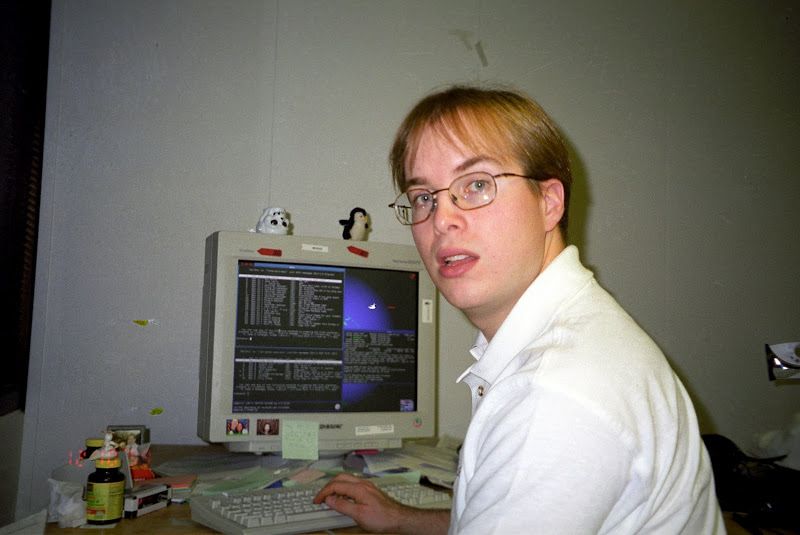 Paul Buckhite in 1999
The fact that Gmail is based on search has its own logic. In the process of development, Google decided to give each of its users an incredible amount of disk space for letters at that time: one gigabyte. This was 500 times more than the mail service offered by Microsoft. So, users could store all their emails in the box, and not delete the old ones for cleaning.
Many of those who knew about the development of Gmail, related to the product and to its business strategy with skepticism, considered it a bad idea, because it has no connection with the web search — primary & laquo; driver & raquo; development of Google. But the founders of the corporation, Larry Page and Sergey Brin, actively supported the project, and he eventually saw the light.
Interface and technology
In the process of development, Gmail grew new people. In 2002, the first day of work at Google, Brian Rakowski learns about the service being created from his boss — Marissa Mayer, the future CEO of Yahoo. Rakowski became the first product manager in Gmail.
At the time of arrival of Rakovski, the mail service was at a very rough stage — & laquo; it did not look like Gmail now, or even how it looked at the time of launch & raquo ;. Most of all, the young manager, just graduated from college, was afraid that Google engineers would like the service in this form and they will not adapt it to the mass market.
In August 2003, less than a year before launch, Gmail's appearance was still extremely primitive. So the new Google employee, Kevin Fox, took up the service interface.
Fox had to be made so that Gmail looks & laquo; in Google & raquo ;. But the problem is that the company did not have a lot of services, and it was unclear what it means — do & la-google & raquo; You could be inspired by the Google News search service launched in September 2002. But there was one cardinal difference — and the search engine, and Google News were sites.
Gmail was thought of as a web application. Therefore, Fox was inspired by both sites and applications for computers, but not thoughtlessly imitated them. After three iterations of the development of design, there appeared that Gmail, which is recognized today.
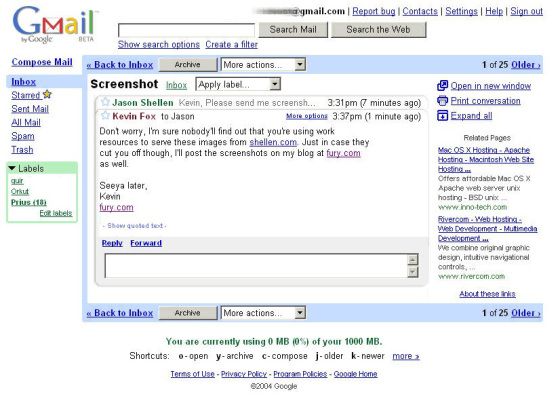
Gmail in 2004
From a technical point of view, Gmail also made similar applications, rather than simple sites. The existing mail services worked on pure HTML, so almost every action had to reload the entire page.
Paul Buchteit used the JavaScript language to bypass HTML restrictions and make Gmail more interactive and similar in response to simple applications. This approach will then be called AJAX and will be used in every web application. At the same time, Buck-kite was a pioneer of new technology. "However, he remembers, not everyone was happy about this: many considered using JavaScript as another bad idea.
One of the problems we encountered was that the browsers did not work very well then ... We were afraid that we would "lash out" & raquo; browsers, and no one will want to use [Gmail]. Paul Buckheith, Gmail creator
Thanks to the new technologies in Gmail, we managed to implement one of the & lquo; branded & raquo; service features — The letters were not shown as separate messages, but were combined into chains. Fox remembers that "trying to make the strings look familiar and intuitive to the user was the biggest challenge".
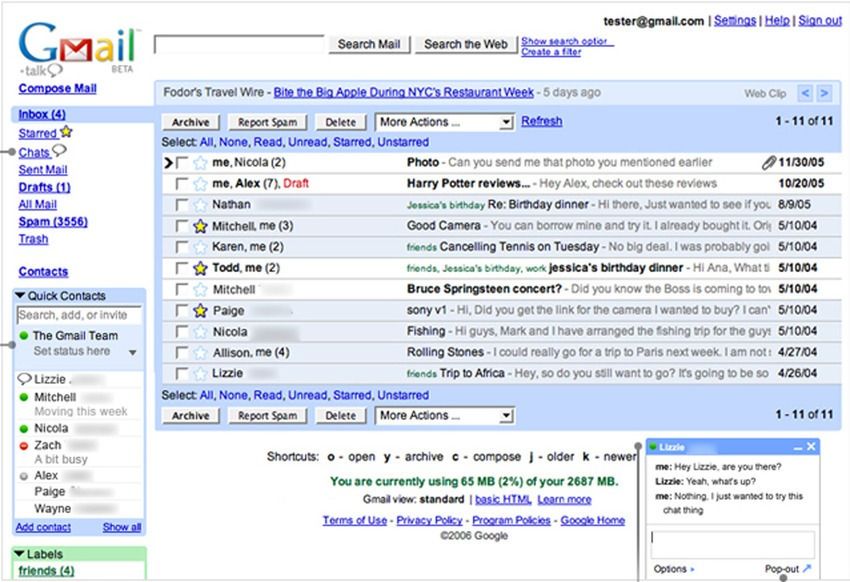
Gmail in 2006
In parallel, the question of the business model of the new product was solved. Someone suggested that Gmail be paid, but Buckheit and the other employees of the corporation wanted their service to be used by as many people as possible. Therefore, it was decided to focus on advertising — and not on huge banners, as in other free email services, but on small text ads.
The ads were contextual: the advertised product corresponded to the content of the correspondence. Google provided an example: if you are discussing a Beach Boys concert with another, then you will see two ad units from two ticket agencies.
Run
In early 2004, Gmail was already ready. By that time, almost all Google employees had already used it from the internal network. It remained to set the launch date — and eventually converged on April 1, & ldquo; fool day & raquo;.
The date was chosen specially. Since 2000, Google has arranged various drawings on this day. This time the corporation was going to, for example, announce the recruitment of employees to the scientific laboratory on the Moon.
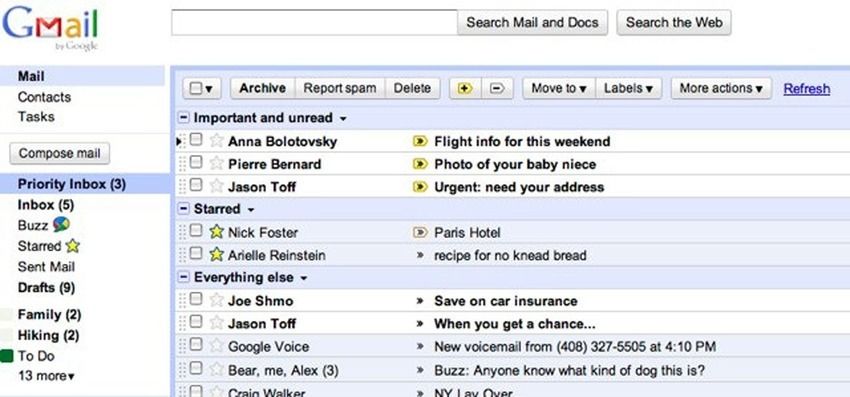
Gmail in 2010
Sergey Brinu liked the idea of launching a new product on April 1. The best April Fool's joke, in his opinion, would be to launch on this day something unusual that will continue to exist the next day. In the case of Gmail, this also worked because the gigabyte of free space looked fantastic: as a result, journalists called and clarified whether it was a joke or the truth.
However, Gmail had a problem — there were no servers that would withstand millions of users and provide them with the necessary space. And in general it was unclear how much this service will be in demand, and, recalls Buckheit, it was a vicious circle: "We could not get many computers, because people thought that we would not start; but we could not start, because we did not have computers & raquo;.
As a result, Gmail identified three hundred old Pentium III computers, which Google no longer wanted. Due to limited resources, the mail service started in private mode: to get an account in it, you had to receive an invitation.
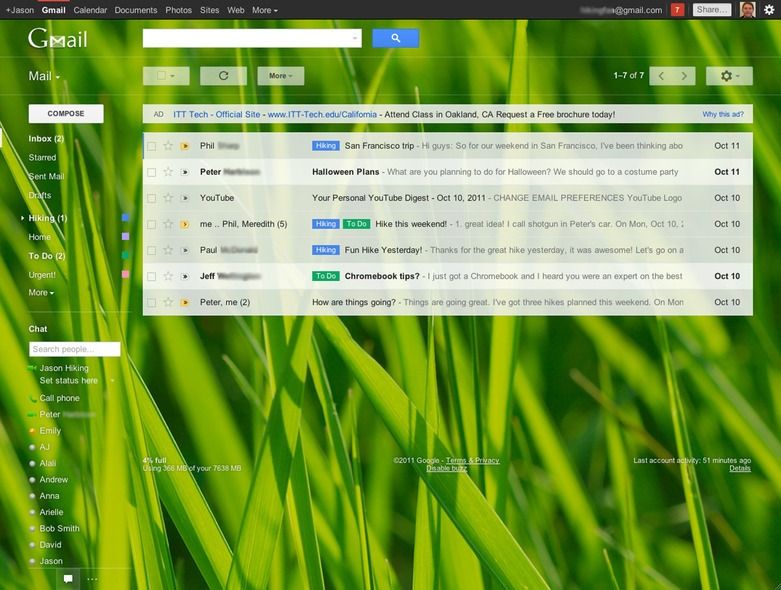
Gmail in 2011
Invitations were not a marketing move, but a vital necessity, as there was a danger not to accommodate all comers. But in the end they created an incredible excitement: people dreamed of having an account on Gmail, mail from Microsoft or Yahoo was considered something second-rate. It came to buying invitations on eBay for $ 150 and above.
If the service initially had more resources, it would grow even faster, Buckhait now believes. Open registration in Gmail was opened in 2007, on Valentine's Day. Label "beta & raquo; held for another two and a half years: he had to abandon the corporation, because corporate clients did not want to use something unfinished.
The main complaint to Gmail from the very beginning was the very advertisement, which was adjusted for the content of correspondence. On April 6, a number of organizations signed a letter to Breen and Page, which said that such a system would be a bad precedent. The authors of the letter demanded to freeze the postal service until their claims were eliminated.
Scanning private correspondence in the form offered by Google releases a genie from the bottle. letter to Larry Page and Sergey BrinIn California, even almost did not pass the law prohibiting the scanning of the contents of letters without the permission of the sender. But Google was able to fight off: the company listened to critics, dismantled all the claims and responded in detail to them in their policies. The main thing that the corporation is pressing: letters & laquo; read & raquo; robots, and information is collected anonymously.
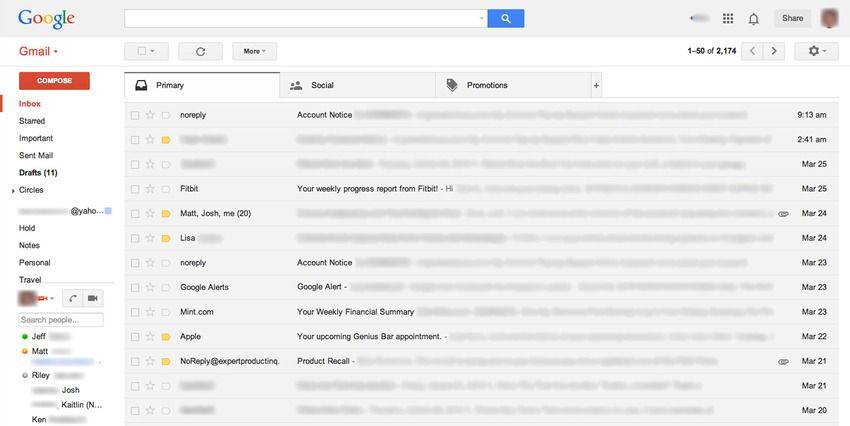
Gmail in 2013
The last time the corporation reported on the active audience of Gmail in 2012: then it was 425 million users. Over the next two years, its size has certainly grown. It seems that very few people are already worried that his letters are read by robots.
Paul Buckheith left Google in 2006 to start another social startup with FriendFeed — he bought Facebook in 2009. Kevin Fox, who worked on the design of Gmail, also left in FriendFeed. Brian Rakowski, Gmail's first product manager, is now working on Android.
Gmail's current manager Alex Gouly says that today the service developers are faced with new tasks: to focus the product on actions (like the system drawing out the information about the upcoming flight from the letter) and rethink it for mobile devices & mdash ; tablets and phones.
And that's enough to take developers for the next five years.