Yesterday we started a story about the technology and technology of one of the most large-scale military conflicts in the history of mankind, accompanied by an incredible surge in progress in the development of lethal weapons.
Technology of the First World War (part two)
< p>Loading a German tank A7V on a railway platform. In total, they were produced about a hundred. A7V became the only tank produced in Germany and participated in the military operations of 1914-18.

A pseudo-horse, like a cover for a sniper.

Women work in one of the shops of Lincoln Motor Co., Detroit, Michigan, USA.

The duel between the tank and the flamethrower on the outskirts of the Austrian village, 1918.

Abandoned tanks on the battlefield near the Belgian town of Ypres.

A German soldier with a camera near the destroyed British tank Mark IV, 1917.
The use of gas masks in Mesopotamia, 1918.

American soldiers with a French 37 mm machine gun in the trench, Alsace, France, June 26, 1918.

American troops on French tanks Renault FT-17, near the forest of Argon, France, September 29, 1918.

The suit of a German pilot with electric heating and fur boots. It was necessary for flights on airplanes with an open cabin in the winter.

Camouflaged British Mark I tank surrounded by horses and infantry.

Turkish troops with German field howitzer M98/09.

The Irish guardsmen in gas masks on the eve of the Battle of the Somme, the first half of November 1916.

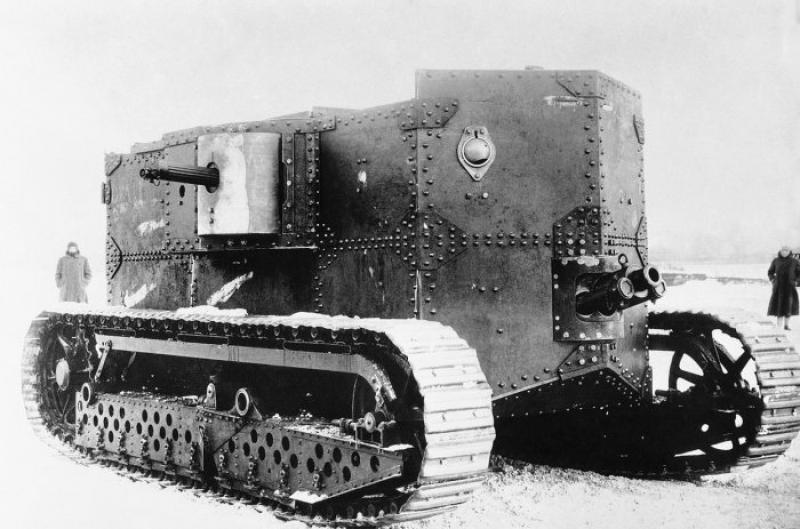
The gasoline-electric tank Holt was the first American tank of the times of the First World War. But it remained a prototype because of its unwieldiness and lack of functionality.

The destroyed steel bridge is replaced by a temporary wooden bridge. Note that at the bridge over the Scheldt River, the base is the collapsed bridge and the failed tank.

Read tomorrow the final part of the material on the technology and technology of the First World War.