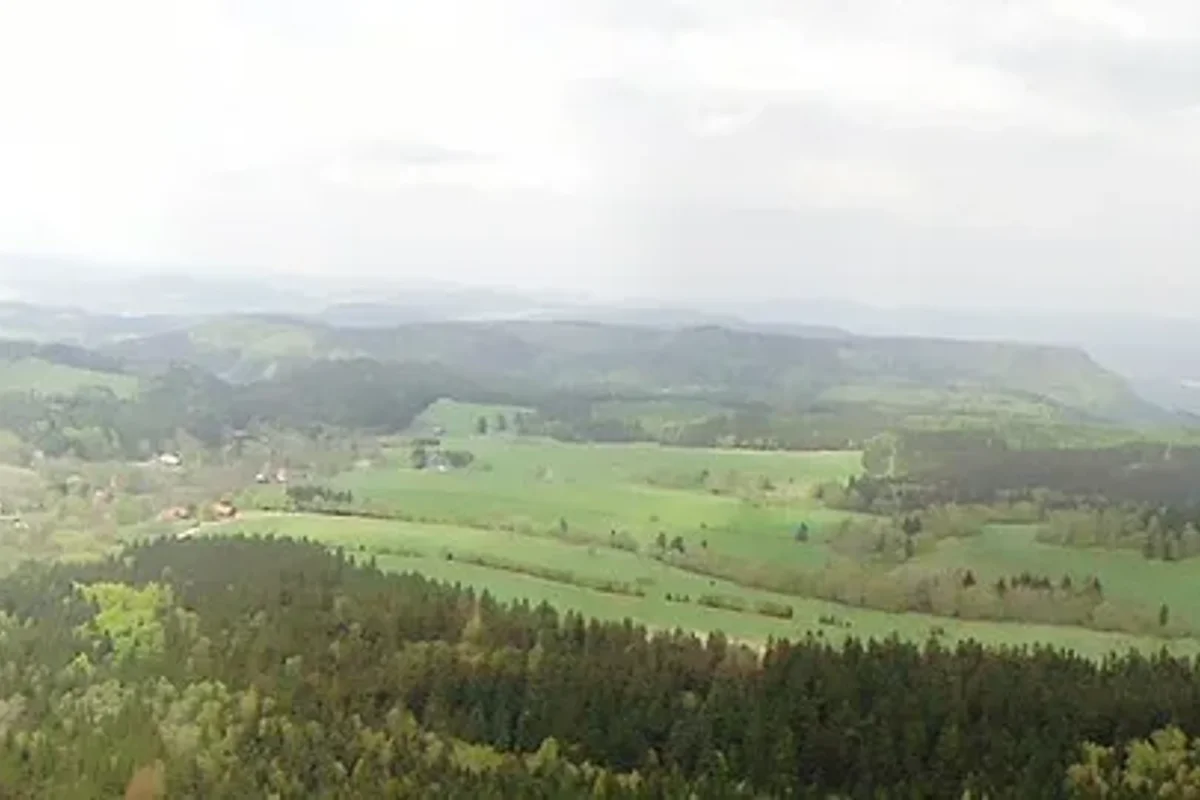
Žabljak and Lake Black: a high-altitude region in Montenegro at 1456 meters.
Zhablyak is squeezed so tightly between two mountain ranges that it seems as though the village grew right out of the rocky plateau. There are no sea coasts or beaches here — but there is something rare: a constant mountain wind, a starry sky free from light pollution, and the feeling of being on top of the Balkans. Lake Black (Crno Jezero) lies just a few kilometers from the village, and its name is entirely justified: the water is truly black, reflecting the steep slopes and pine forests that drop straight into the water.
Lake Black: Montenegro’s deepest lake

The Black Lake
The lake is located in Durmitor National Park, and the entrance fee to the park is 5 EUR for adults (free for children under 7 years old). Parking by the lake costs 2 EUR per day. There are several ways to reach the water: the circular trail around the lake takes about 1.5–2 hours at a leisurely pace, while a short downhill walk from the parking lot to the shore takes only 20–30 minutes.
What few people know is that Black Lake was formed as a result of glacial activity about 15,000 years ago. The lake bottom contains remains of ancient glacial fish that became extinct after water temperatures rose. The lake is now completely safe for swimming, but the cold water demands respect.
Route to Durmitor’s glacial lakes: from Žabljak into the mountains

If Black Lake is just a prelude, then the routes to the other glacial lakes constitute the main symphony. There are 18 glacial lakes on the Durmitor plateau, scattered across mountains at elevations ranging from 1600 to 2100 meters. From Zabljak, it is easiest to reach Zmjsko Lake and Waterfall Lake.
The route to Lakes Zmijsko and Vodopada starts from the Žabljak tourist center (coordinates of the information desk:
Interesting fact: Lake Vodopada is the only glacial lake in Montenegro from which a waterfall flows directly into the neighboring lake. This creates a rare landscape that resembles Scandinavian nature more than the Balkans.
For more experienced hikers, there is a route to Lake Veliko (Veliko Jezero)—the largest glacial lake on Durmitor. This trek will take a full day (6-7 hours), but the views are worth it. The lake is at an altitude of 2100 meters, and on a clear day, the cloud line below can be seen from its shores.
Mountain Huts and Overnight Stays

Zabljak is more than just a transit point. The village itself has several cozy inns and mountain huts. The most atmospheric is Plinarska Hija Durmitor
There is also a more modern option — the Srna Gora Hostel
What few people know is that Žabljak becomes a ski resort in winter. The ski center is open from December to March, when snow accumulates up to 2-3 meters here. Even in summer, remnants of snow patches can be seen on the northern slopes of the Čapak and Savin mountains.
Local cuisine and restaurants
There are only a few cafes and restaurants in the village, but they prepare local food honestly. Cafe Orao
If you want to spend the night outside the village, there’s a hut called Marash
Interesting fact: In Žabljak and at the Dürmitor huts, wood-burning stoves and fireplaces are still used for heating. This means the village is literally choked with smoke in winter, and the internet and phone service here are unstable. Tourists come here precisely to disconnect from the world.
How to get there and practical information

Zabljak is located in central Montenegro, within the Durmitor National Park. The nearest city is Podgorica (the capital), which is about 155 km away from Zabljak. It takes 2.5 to 3 hours to reach there by car along a winding road that rises from 50 meters above sea level to 1456 meters. It’s not a boring road—the views change every 10 km.
If you don’t have a car, buses run from Podgorica to Žabljak: two trips per day (07:00 and 14:30), with tickets costing 12-15 EUR one way and a travel time of 3-3.5 hours. Murіć Tours offers shuttle services for 60-80 EUR for groups of up to 4 people.
The best time to visit Žabljak and the Durmitor lakes is in June, July, and August. During these months, the weather is stable (daily temperatures around 18-22°C), the trails are completely snow-free, and tourist facilities operate at full capacity. In September and October, it often rains, though the landscapes become even more beautiful with golden larches and yellow grasses.
The tourist information office
Few people know that Žabljak is the only place in Montenegro where tall species of fir trees, typically found in Central Europe, grow. Botanists come here to study the microclimate of the plateau and document rare plant species.
Money: Local restaurants and lodges accept euros and cards, but not everywhere. It’s better to withdraw cash in Podgorica before traveling. There is one ATM in Žabljak itself, but it isn’t always operational. Communication: The Telénor and Montenegro (Crnogorski Telekom) mobile networks work, but the signal can be unstable in some areas, especially in the forest.