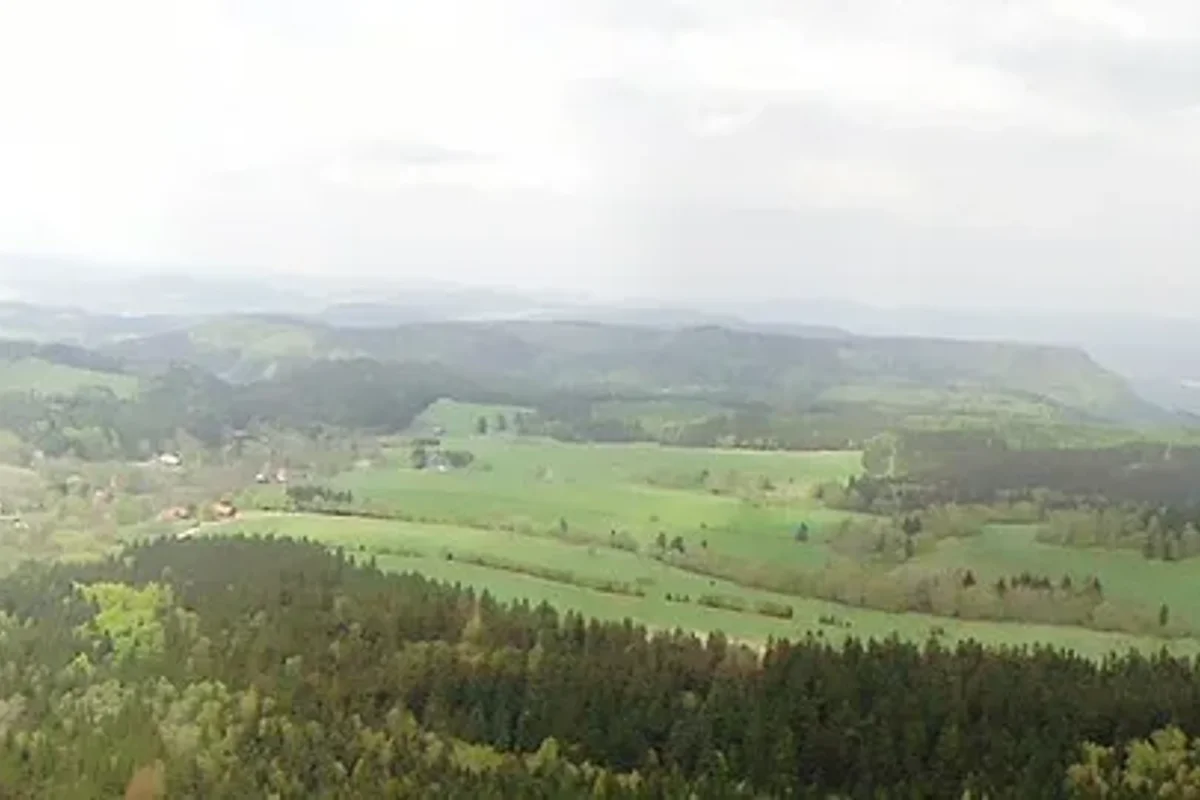
Guarda: a medieval castle on the border with Spain and a Portuguese fortification line.
Guarda hides one of Portugal’s best-kept secrets: it is not just a town, but an entire system of medieval fortifications that locals call Portugal’s answer to the Maginot Line. The Castle of Guarda
Guarda Panorama: The Land of Fortifications and Medieval Border Secrets

Guarda is not just a castle; it is an entire ecosystem of defensive architecture. Along the Portuguese-Spanish border throughout the Middle Ages, a chain of fortifications stretched out, serving as a barrier against Spanish expansion. Unlike more famous European castles, this line never received a unified name in history, but locals refer to it as the “Guarda Frontier.”
Few people know that the Guarda Castle was built in the 13th century by King Sancho I specifically because the previous fortress (Montezinho Castle, 8 km away) was not high enough and did not provide a good view. The new castle was constructed at the highest point of the plateau precisely so that it could overlook Spanish troops 50 km away.
Today in Guarda, you can take a trail known as the “Path of Fortifications”: it is a walking route that connects the remnants of old defensive lines, forts, and observation posts. At the northern edge of the town lie the ruins of Forte da Guarda
Interesting fact: The Guard was part of the so-called Belt of Fortresses, which regained significance during the Portuguese War of Independence (1640-1668). When Portugal separated from Spain, the Guard once again became a key point in the defensive line, with its fortifications enhanced by new structures in the style of Villa David. Thus, the castle, which was already half a century old, received a second life and a new purpose.
Three must-see main attractions

1. Castelo de Guarda
2. Museu da Guarda
3. Botaj (Voihtasa) — observation platform
Route along the fortifications: a non-tourist path for explorers

If you’re not satisfied with the standard castle tour, there’s a lesser-known route taken by few tourists. Begin at the Sаntа Маrіа parish church (in the town center), which was built inside the castle as part of the defensive complex. Then head north along Ruа dе Sаntіagо — on this street, support structures for medieval walls embedded in the facades of modern buildings can be seen in several places.
Continue to Forte da Guarda
The third stage of the route is the western defenses. From Guarda center, head west along Rua da Graça (this is approximately an 800-meter downhill walk). Here, at the edge of the old town, remnants of a perimeter wall that once surrounded the entire residential area are still intact. Local residents use these stones as part of the boundaries of their plots, and traces of battle paths and embrasures (holes for arrows and guns) can still be seen in some areas.
Few people know that if you continue westward along the route and descend into the valley, you’ll find traces of an old Portuguese road that ran from Guarda to Montezinho and beyond — it was an ancient border patrol path. Today it’s a grass-covered trail, but its stone foundations are still visible in some areas. GRS for navigation: start of the trail
The full route takes 4-5 hours on foot (including stops for photos and rest). The shortest version involves just the castle + Botajão viewpoint + museum: 3 hours. The best times of year are May-June or September-October, when there’s no extreme heat and plenty of light for photography.
Budget and logistics: how to get there and how much it costs

Guarda is located at an altitude of 1097 meters in the Trás-os-Montes mountain range, about 200 km from Lisbon. There are several ways to get there:
By car (the most convenient option): From Lisbon to Guarda, it takes about 2.5–3 hours driving on the A1 highway to the town of Coimbra, then follow road IR2 toward Guarda. You can rent a car in Lisbon for 30–50 EUR per day (economy class). Gas: approximately 8 EUR for the round trip. Parking in the center of Guarda is free.
Bus: FlіхВus and local carriers (Rоdаvіаjеm) offer buses from Lisbon to Guarda. Cost: 25–35 EUR one way, travel time: 4–5 hours including transfers. Services run daily (at least 1–2 trips). Website: www.flіхbus.ru. The Guarda bus station is located in the city center, and it’s 10 minutes’ walk to the castle.
Train: Trains from Lisbon to Guarda pass through Coimbra, taking about 4-5 hours, with ticket prices ranging from 20-28 EUR. However, the schedule is inconvenient (often only 1 train per day). Train station: Gаrе dа Guаrdа,
Fun fact: Guarda is considered the highest city in Portugal, at an elevation of 1097 meters above sea level. This means the climate here is colder than in the rest of the country—snow is possible in winter, and temperatures rarely exceed 28°C in summer. The best time to visit is from May to October.
Where to stay: Budget options (hostels, apartments on Airbnb): 25-40 EUR per night. Mid-range (3-star hotels): 50-80 EUR. Recommended hotels: Hotel Turismo (Rua Tenente Valadim,
Food: A lunch at a local restaurant (pastéis de nata, corn porridge, goat cheese) costs 8-12 EUR. Recommended places: O Forno (Rua de Touguinha 55,
Total daily budget per person: accommodation (if staying overnight) 50 EUR, museum 4 EUR, entrance fees and donations at the castle 3 EUR, food 25 EUR. Total: approximately 80-90 EUR if traveling by rented car (plus the rental cost per person). If traveling with a group, the budget per person can be reduced by 30-40%.
Little do people know that there is a regional tourist card called Guarda Card, which offers 10-15% discounts at museums, restaurants, and some hotels. It can be purchased at the city’s information center (Av. Neves Costa, free of charge — just pick it up). The city also hosts seasonal cultural events: a medieval theater festival in July (Festa Medieval de Guarda), and a celebration of Portuguese culture and crafts in September. If you visit during these months, the city will be more lively with more services available.
Gvarda is a city that doesn’t rush. It lives its own life, and tourists are rare here. This rarity is its greatest treasure. You won’t find a crowded tourist experience here, but you will discover genuine history etched in stone, along with views of the border that once changed empires.