Dijon: Burgundy’s ducal palaces and the Santiago Pilgrimage routes.
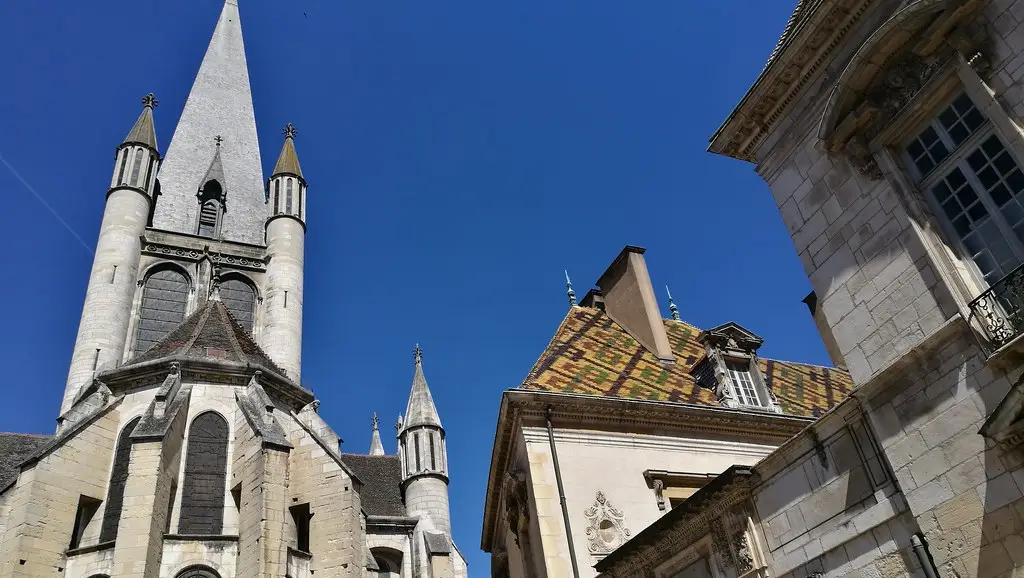
In the center of Dijon stands the palace of the Dukes of Burgundy, where time seems to have stood still in the 13th century. I walked through narrow streets, past stone facades with Gothic details, until suddenly a panorama of rooftops covered in black tiles in a style the French call “tuiles à faîte” unfolded before my eyes. This is more than just architecture: it represents the power held by the Dukes of Burgundy for five hundred years. Every stone here tells the story of a time when the duchy was richer than the Kingdom of France.
Why Dijon is now at the center of pilgrims’ and tourists’ attention
Dijon lies right on the Camino de Santiago route—the French branch of the famous pilgrimage path to Spain. Since the 1980s, this path has seen a revival, and now thousands of people pass through Dijon each year in search of both spiritual and physical challenges. The distance from Dijon to Santiago de Compostela is about 1,500 kilometers. Most tourists come here specifically to begin or continue their journey. The city serves as an ideal starting point: here, one can obtain a pilgrimage passport (credencial), walk through historic narrow streets, and stay a few more days for tours of the palaces.
Routes through Burgundy pass by the vineyard terraces of Côte d’Or, so pilgrims and tourists often combine their spiritual journey with tastings of world-class wines. The region produces Burgundian Pinot Noir and Chardonnay, which are valued higher than French champagne in the eyes of many wine connoisseurs.
Dukes of Burgundy’s Palace: Gothic Architecture and Power in Stone

The Ducal Palace
Entry to the palace is paid: 8 EUR for a tour of the interior halls. It is open Tuesday to Saturday from 9:00-12:00 and 13:30-18:00, and Sunday from 9:00-13:00. Guided tours are available in English and French (5 EUR extra on top of the entrance fee). Inside, there are the dukes’ kitchens, halls with wooden ceilings and frescoes, and prison cells in the tower with views of the entire city. The Odette staircase—a masterpiece of the Renaissance—is adorned with carvings and gold leaf. Tourists often complete it in 20 minutes, but if you stop at each step to examine the carvings, you can spend an hour there.
Museum of Fine Arts: Ducal Treasures
Inside the Duke’s Palace is museum
St. James’s Way routes through Burgundy and wine routes


There are three main routes that pass through Dijon and the surrounding Burgundy region:
1. Via Lemovicensis (The Limoges Route) — starts in Chartres and passes through Dijon to Spain. The distance from Dijon to Limoges is about 350 km on foot, with travelers usually completing it in 15-16 days. The route is well marked with white and red stripes on trees and stones. Dijon serves as a resting stop rather than the end point of the journey.
2. Côte d’Or Wine Route — a branch off the main route. From Dijon, heading north toward Beaune lies the “Wine Road” (Route des Vins), flanked by vineyards, wineries, and small villages such as Jevreux-Chambertin, Vougeot, and Nuits-Saint-Georges. The distance from Dijon to Beaune on foot is about 60 km, which can be covered in 3-4 days. This wine route combines with the pilgrimage experience: pilgrims receive discounts at wineries (up to 10-15%) and can stay overnight in monasteries or pilgrim hostels for 20-30 EUR per night.
3. The route via Vézelay — another branch of the Santiago path, it passes through the Yonne hills and the ancient Basilica of Mary Magdalene in Vézelay
Food, wine, and culinary secrets of Dijon


Dijon is famous for its mustard, known as “Moutarde de Dijon.” This recipe has existed since the 13th century, and today the city even has a whole mustard museum
Burgundy wines are produced in small vineyards that the French call “climat.” A single climat may be as small as 5 hectares, yet the wine from that plot can be more expensive than wine from 50 hectares in a neighboring region. This is due to history: in the 10th–11th centuries, the dukes of the duchy granted plots to monasteries, and the monks refined winemaking techniques on those plots throughout their lives. These historical boundaries are preserved exactly as they were.
Restaurants and tastings:
— Restaurant Lеs Gоurmеts
— Newton-Beaunois Wine Cellar
— Street food: At Les Nalles market (Rue Saint-Michel), you can find Époisses cheese
Camino de Santiago route: how to start the pilgrimage from Dijon
The Dijon Tourists' Office
From Dijon, the routes go in several directions:
— South toward Limoges: the route passes through Oulx-les-Bains, Longeau, and Châteauneuf. It features hills, some forests, and very picturesque scenery. 350 km, 15-16 days of walking.
— North toward Bonne and the wine region: the route follows vineyards and small villages, ending in Vézelay. 110 km, 4-5 days.
— West toward Lyon and the Provence route: this is the Via Tolosana, which leads toward the Pyrenees. It’s a less common route but extremely beautiful.
The general rule for the pilgrimage: distances between cities are 15-25 km per day, overnight stays in pilgrim hostels (albergues) cost 15-25 EUR, and hot meals at cafes along the route cost 10-15 EUR. For a two-week journey, you can expect to spend 500-700 EUR on accommodation and food.
Practical information: prices, transportation, best times to visit
When to go:
— May-June and September-October are the ideal times. The weather is warm (18-23°C), not too hot along the route, making it easy to walk. These months see the highest number of pilgrims on the Camino de Santiago.
— July-August is hot (25-28°C); it can be boring at noon along the route, there are many tourists in hotels, and prices are 15-20% higher.
— April and November are cool (12-18°C); there may be rain, but the scenery is beautiful and there are few tourists.
How to get there:
— By plane: Dijon Airport (Aérorort dе Dіjоn-Воurgоgnе) is located 7 km from the city. From the airport to the city center, take bus No. 105 (cost 2.50 EUR, travel time 25 minutes) or a taxi (25-30 EUR).
— By train: There is a direct TGV train from Paris’ Gаrе dе Lуоn to Dijon, taking 2 hours 20 minutes, with ticket prices ranging from 50-80 EUR depending on when it is booked.
— By car: Dijon is situated at the intersection of highways A39 and A36. Parking in the city center costs 2 EUR per hour, while daily parking in a garage is 15-20 EUR.
Accommodation:
— 3-star hotels: 70-100 EUR per night. Hotel Monge
— Hostels: 25-40 EUR per bed. Aubеrgе Jеunеssе dе Dіjоn provides a common kitchen, free breakfast, and a 5% discount for pilgrims.
— Pilgrim hostels (for pilgrims with moderate means): 15-20 EUR per night with a blanket and pillow, sometimes dinner included. Along the Santiago route through Dijon, there are official hostels in Dijon, Longueau, and other towns.
Daily budget:
— Accommodation: 50-80 EUR (3-star hotel) or 20 EUR (hostel).
— Food: 25-40 EUR (lunch at a restaurant 12-15 EUR, dinner 15-20 EUR) or 15-20 EUR (market, café).
— Attractions: Duke’s Palace + museum 12 EUR, Mustard Museum 5 EUR, wine tasting 15-25 EUR.
Total: 100-150 EUR per day for a traveler with moderate spending habits.
Language:
French is the main language. Young people speak English, but in small cafes and among older people, English might be a problem. Download the Google Translate app with offline mode before your trip. Along the Camino de Santiago, signs are available in multiple languages, though pilgrims usually communicate in English.
Some surprising facts:
- In the 15th century, the Duchy of Burgundy was richer and more powerful than the Kingdom of France. The dukes ruled not only present-day Burgundy but also modern Belgium, Luxembourg, and parts of the Netherlands. This state existed for four centuries and was only abolished by a decree from Louis XI in 1477.
- Dijon mustard was exported to royal courts in the 13th century and considered a luxury item. One pound of mustard was more expensive than a kilogram of meat. The recipe was kept strictly secret, and only Dijon merchants were allowed to sell mustard under the name “Dijon.”
- Approximately 15,000 pilgrims pass through Dijon each year on the Camino de Santiago. This makes Dijon the second most popular pilgrimage destination on the French section of the route after Limoges.
- Wines made from Pinot Noir grapes from the Côte de Nuits region (near Dijon) are valued higher than wines from Bordeaux. At a Christie’s auction in London, a bottle of Romanée-Conti from 1947 was sold for $495,000 — one of the most expensive wines in the world, and it was produced just three kilometers from Dijon.
- The roofs of the dukes’ palace are covered with glazed tiles in the Burgundian style for a reason: these tiles reflect solar heat and prevent the building from overheating in summer. This technology was developed in the 13th century and remains relevant today—these roofs only need to be cleaned twice a year, unlike regular shingles.