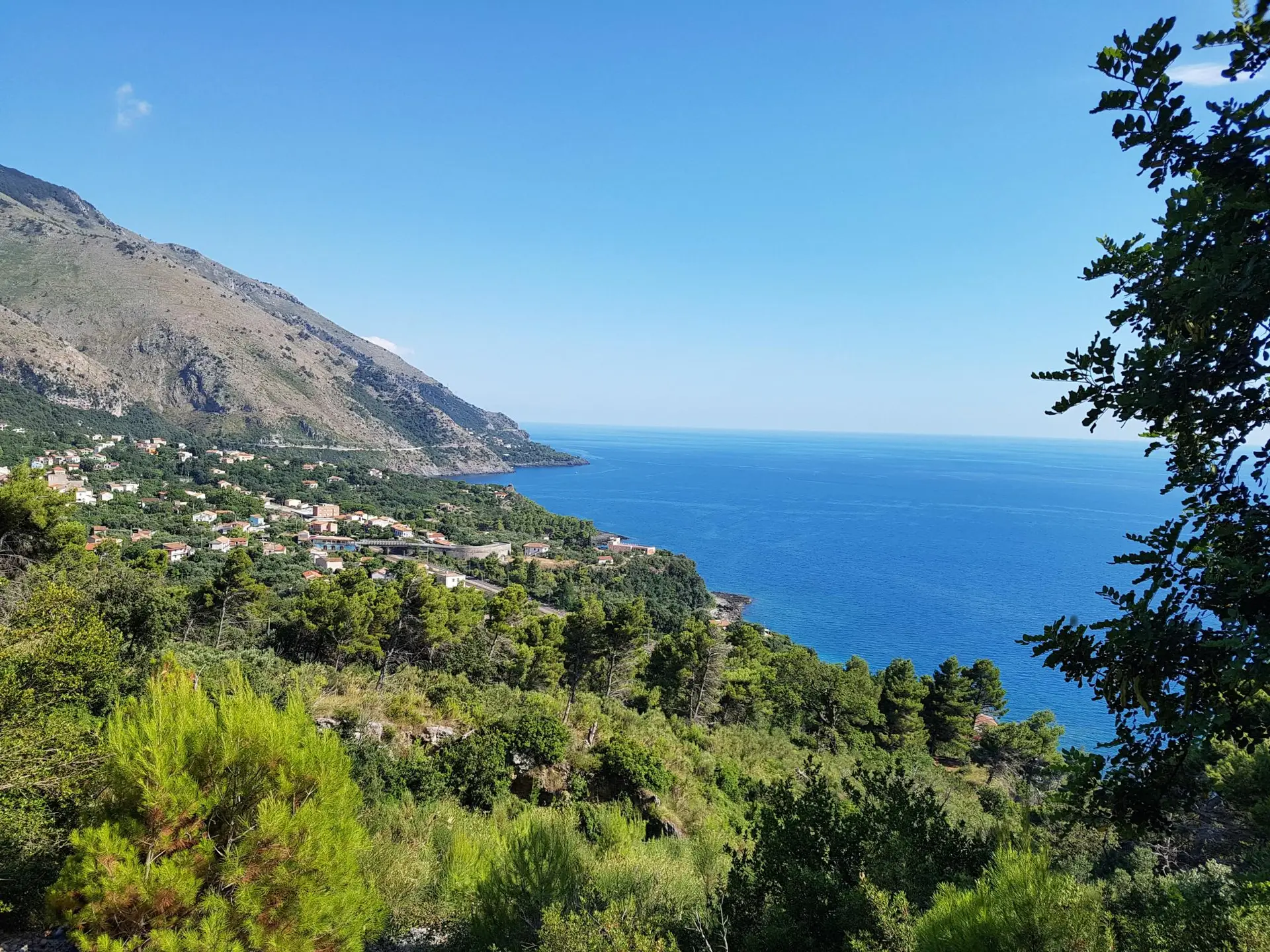
Christ the King in Maratea: a white statue overlooking the Tyrrhenian Sea and the beaches of Basilicata.
Maratea greets tourists in a completely unexpected way: a narrow strip of land between the steep cliffs of the Lucanian Mountains and the sea, with almost no sandy beaches — but instead deep bays, caves, and rocks. Above it all, atop Mount San Biagio, floats a 21-meter-tall white statue. This is Christ the King — the second-largest statue of Christ in Europe after the famous monument in Rio de Janeiro. Waves below, a white figure above, and around it nothing but nature and cliffs. Maratea is not a beach paradise in the traditional sense. It is a place for those who want to see something majestic and spend time in solitude.
Christ the King Statue: How to Get There and What to Expect at the Top
The statue is located at an altitude of 600 meters above sea level on Mount San Biagio. A hiking trail leads there from the center of Maratea, taking 45–60 minutes depending on fitness level. The route is steep but well-marked. An alternative is to park a car at the foot of the mountain and climb 15 minutes to the viewing platform.
The statue was erected in 1965 by sculptor Florestano De Amatis. It stands 21 meters tall (including the pedestal), exactly 2 meters shorter than Christ the Redeemer in Rio
The best time to visit is early in the morning (before 10:00) or at sunset (1.5 hours before dark). It’s hot due to the sun during the day, and tourists crowd the shore. If you arrive at sunrise, the statue is illuminated from below by a pink light — it’s like being in a movie.
Maratea’s Beaches and Caves: Where to Swim and Explore the Rocks

Maratea is not a place with a classic sandy beach. Instead, it features pebbles, stone platforms, and numerous caves. The main swimming spots are:
Mazano Beach
Fiumicella Beach
Maratea Caves are a system of sea caves accessible only from the water. Local boatmen offer tours for 25–40 euros per person. The caves are known as “St. Peter’s Cave” and “Soros’ Cave.” The water inside is neon-colored, almost blue due to light reflection. It’s like being inside a precious gem.
Black Sand Beach (Caleta Pozzo)
Coastal Route: How to Walk Along the Lucanian Coast

Maratea is part of the Costiera dei Cedri Alli, one of Italy’s most rugged coastline areas. There are several good hiking trails available:
The “From Maratea to Porticello” route (8 km, 2.5 hours) starts from the city center, follows the cliffs, passes by fishing villages and caves, and ends at the small fishing marina of Porticello. The route is not difficult but requires comfortable shoes. Along the way, there are spots where you can go down to the water to swim.
The “Lucanian Mountains Ridge” high-altitude route (12 km, 4 hours) is for those who enjoy heights and panoramic views. It begins at the Christ statue and follows the ridge, offering views of both the sea and the valleys inland. It requires good physical fitness, and water and sunscreen are essential.
Sea kayak route — local rental shops offer one-day kayak tours along the coast (45–70 euros per person). You can explore caves and cliffs that are inaccessible from land. June to September is the best time, when the sea is calm.
Food and Local Flair: Where to Eat in Maratea
Maratea is a fishing village, so the food here focuses on seafood. Don’t expect Michelin-starred cuisine, but you can expect freshness and honesty.
Ristorante Vitantonio
Trattoria Gianni Franzi
Caffetteria Piazzetta
The local specialty is “pasta e fegato” (pasta with tomatoes and sweet bread) — a dish from Basilicata that’s almost forgotten but is still prepared in some family-run trattorias.
How to Get to Maratea and Practical Information
Maratea is located in the Basilicata region (Ваsіlісаtа), on the Tyrrhenian Sea coast, between Salerno and Cosenza.
By car: From Naples, it’s about 2.5 hours via the A3 highway (Salerno), then the regional road SS18. From Salerno, it’s 1 hour. Parking in the center of Maratea is paid (1.5–2 euros per hour, up to 15 euros per day); there are free parking lots on the outskirts.
By bus: Direct buses operated by SİTA Sud depart from Naples or Salerno (5–7 euros, 2–3 hours). The buses arrive at the central piazza in Maratea.
By train: The nearest train station is Marana-Massaua, 15 km from Maratea. From there, you need a bus or taxi (15–20 euros).
Best times to visit: May–June and September–October. July–August is the peak season with many tourists and temperatures above 30 degrees. April and November are also good, but the water is cooler (16–18 degrees). In winter (December–February), it may rain, but there are hardly any tourists.
Daily budget: Lunch at a trattoria costs 12–18 euros, entry to the Christ statue is 2–3 euros, renting a lounge chair and umbrella costs 15–20 euros, and a boat ride to the grotto costs 25–40 euros. In total: 60–90 euros per person per day for food and entertainment (excluding accommodation).
Things to know before you go
- The Christ statue in Maratea was one of the first such monuments in Europe, built in 1965 — 7 years before the famous Christ the Redeemer in Rio de Janeiro was declared a wonder of the world. The height of the Maratea monument is 21 meters, making it the second tallest in Europe.
- Maratea is one of the smallest recognized tourist centers in Basilicata, with a population of only about 3,600 people. Despite this, the Christ statue attracts over 500,000 visitors each year.
- The local sea, the Tyrrhenian Sea, is quite deep already 20 meters from the shore. This means the water is crystal clear, but swimming requires caution. There are no shallow areas; the depth increases immediately.
- Rare Mediterranean monk seals live in the caves of Maratea. Their population is critically small (less than 600 individuals worldwide), so visits to the caves are sometimes restricted during the breeding season (May–June).
- Maratea is part of the Pollino National Park, one of Italy’s most wild and least visited parks. If you want to avoid crowds of tourists and see a pristine coastline, this is the place for you.