Those few historical references that have survived on the oak shelves of the archives date its appearance in 1650-mi years. It turns out that the cathedral belongs to the same age as Kharkov! Only the first stones of it, or rather, the first beams of the wooden church of the Annunciation of the Most Holy Theotokos, were laid in the vicinity of the village of Zalopansky. Sponsored by its rich merchants, the church rapidly expanded and evolved, but its architecture was no different from other churches.
The Annunciation Cathedral
XVII & XIXth century
The first church in the name of the Annunciation was founded around 1655, at the same time as Nikolaevskaya and Rozhdestvenskaya. The wooden single-table temple of the Zalopa parish was made in traditional Ukrainian three-cupola forms with a separate wooden chopped bell tower and enclosed by a wattle fence instead of a fence. Rapid development of the settlement gave impetus to the expansion of the parish: according to the Kuryazh acts of 1720, there are already two priests in the church staff. After a major fire in 1738, restored in the same form. The image was preserved on the city plan of 1787.
Of the priests of this period are known: about. Alexei (Kuryazh Acts of 1659), Fr. Pavel (Kuryazh acts of 1701 and 1713), John Matveyev (& dagger; 1738) and his colleague Avtonom Zakhariev (& dagger; 1779), Gerasim Slivitsky and Petro Rozhansky, his co-worker prot. Matthew Rozhansky.
In 1789 a new stone one-dome temple was built in the style of early classicism, designed by PA Yaroslavsky, consecrated on September 8, 1794. Like all parish churches in Kharkov, it was single-altar until the 1830s, when population growth necessitated the expansion of old Kharkov churches. In 1836 & 1838 were added chapels in the name of St.. the Great Martyr John of Warrior and St. the Great Martyr Barbara. The main organizer was the church elder Kupets Alexander D. Skrypnik. In 1844 & 1846, major repairs were carried out. With the efforts of Lieutenant-Colonel MI Batezatul, the heads of the church, the iconostasis, the higher place, the altar and the canopy over the throne were gilded with the best gold of gold & raquo;
In 1846 & 1863, the church wore the title of "Cathedral of the City of Gdańsk" & raquo ;. Description according to the statement on the Kharkov Hradic deanery for 1858:
The church in the name of the Annunciation of the Blessed Virgin Mary is a stone building, with a stone strong bell tower. Has three thrones: in the name of the Annunciation of the Blessed Virgin (cold), and the last two are warm. Utvaryu is sufficient. Pritchta is based on the staff: archpriest, priest, deacon, deacons — 2 and sextoys — 2. There is no earth at this church. On the maintenance of priests do not get salaries, but they receive free gifts of parishioners. There are no attributions to this church. House in this parish church in the 2 nd Kharkov male gymnasium in the name of St. Sergius of Radonezh (it was founded in 1851, the building is also stone). Rector — Protopriest Stefan Yakovlevich son Stefanevsky. Number of parishioners: males — 484 people, women 568.
In the same year, in connection with the ever increasing parish growth, the question of the cardinal restoration of the temple was raised, but remained open, and the church was only slightly expanded. November 22, 1887, on the initiative of a small circle of eminent and well-off parishioners and with the permission of Archbishop Ambrose (Klyucharyov), an extended meeting of parishioners took place, at which the decision was unanimously taken to build a new church.

New Temple
The solemn laying of the new church was accomplished on October 2, 1888, alongside the old temple, which operated during the twelve-year construction. On behalf of the construction committee, the project was developed by the architect of the Kharkov Institute of Technology, Professor M. I. Lovtsov, a member of the Blagoveshchensk parish. Financing for the construction was carried out mainly due to numerous and generous donations of merchants, both Kharkov and other cities. All expenses for the construction of the church and interior decoration cost 400 000 rubles, one brick is laid for about 7 million.


The church was finished and consecrated in 1901. At the same time, the old church was demolished, from which the most revered icons of the Savior, the Mother of God, Nicholas the Miracle-Worker, John the Warrior, the Great Martyr Barbara were transferred to the new one. One of the largest temples of the Russian Empire accommodates 3,500-4,000 people. The iconostasis of white Carrara marble was made by the Moscow master VI Orlov. 29 icons of the main iconostasis — AD Danilevsky (St. Petersburg Imperial Academy of Arts), icons of side iconostasis — M.D. Mikhailov, wall painting I.N. Svyatenko (Kharkov). The main iconographic motifs are taken from the Kiev Cathedral of Vladimir and partly from the Cathedral of Christ the Savior in Moscow. Lateral apses, as in the former Annunciation Church, in the name of St. Great Martyr John the Warrior and St. Barbara the Great Martyr. In the basement church of the baptismal throne in honor of All Saints.
On July 3, 1914, the church was once again given the status of the "Cathedral of the City of Graves".
Present time
The Soviet era was a hard test for the cathedral. The Bolsheviks closed the temple, promising that cultural events and meetings of cultural and sport figures would be held on its territory. However, according to the inhabitants of the city at that time, there was nothing but stables and a warehouse in the cathedral. During the Great Patriotic War the temple resumed its services.
The whole period of the occupation of Kharkov did not stop the work of the cathedral, and when the city was liberated & ndash; he is given the title of cathedral. By the beginning of the fifties the cathedral had been given the relics of the Kharkiv Saint Meletin and St. Athanasius Patelaria, the Patriarch of Constantinople. And already in the ninetieth cathedral were transferred the relics of the martyr Alexander (Petrovsky), Kharkov archbishop, who was repressed in 1938.
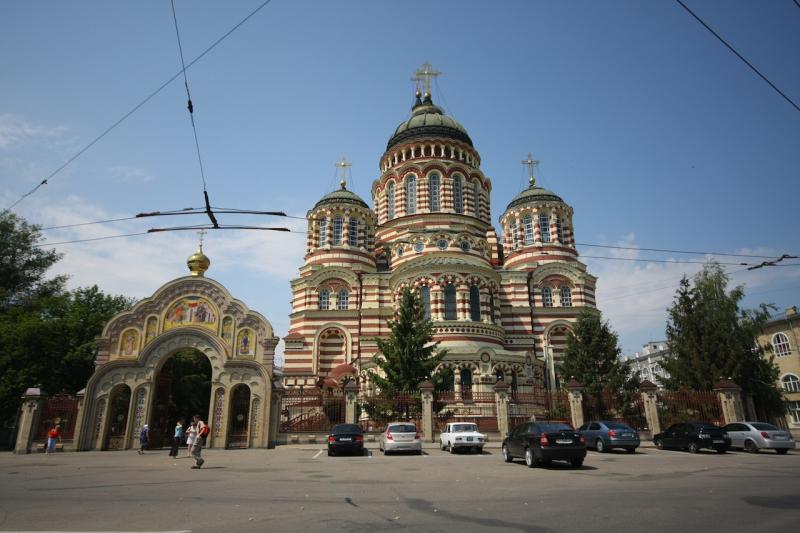
Today the cathedral is a majestic building surrounded by a painted stone hedge, which is illuminated in the evening by hundreds of lamps. The style of the cathedral is characterized as a mixture of Russian, Neo-Byzantine and Gothic traditions. Famous Russian architect of the early twentieth century, Kharkov Mikhail Lovtsov, known for his craving for experiments, boldly combined various traditions in one building. Not sparing merchant's money, paints and materials, the cathedral has become a unique architectural monument, promising to stand still for many years.
In 1993, the relics of the martyr Alexander (Petrovsky), the Kharkov archbishop repressed in 1938, were placed in the cathedral.
In July 1996, a new hurricane cross bent violently on the bell tower. A year later, on June 2, 1997, the restored cross along with the upper part of the bell tower dome was destroyed by a fire that occurred in the upper part of the dome under welding. When the dome was restored after the fire, its height slightly increased.
An interesting fact was the history of the bell tower of the cathedral, by the way, one of the highest for those times & ndash; 80 meters. She was attacked several times by nature and, unfortunately, could not stand them. Twice fell, one time because of a strong hurricane, and the second & ndash; because of a fire.
However, this made the bell tower only stronger and higher & ndash; a new design that can be seen today and represents a nearly ninety-meter dome that has become a worthy decoration of such a magnificent monument.
In 2007 & 2008, a new fence was built around the temple, emphasizing its monumentality.
On May 7, 2011, the Annunciation Cathedral was visited by the Patriarch of Moscow and All Russia Kirill. This was the first official visit of the head of the ROC to Kharkov in the history.