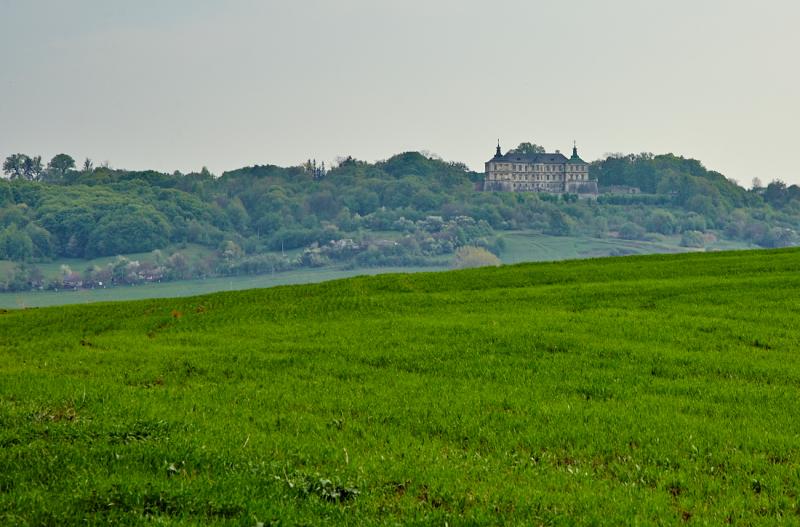
Podgoretsky Castle
In 1720, Stanisław Rzewuski purchased the castle along with the surrounding villages from Konstantin, son of Jan III Sobesky. In 1728, his son Wacław Rzewuski began a major reconstruction project of Podgórzece Castle. Additional buildings were constructed between the pavilions and the wall, expanding the palace to three floors in height. The covered walkway connecting it to another pavilion was dismantled. For the frequent visitors to the estate, a special entrance gate called the “Getman’s Entrance” was built, complete with a sundial. Wacław Rzewuski amassed a large collection of valuable paintings and antique weapons, transferring some of the most precious items from the Olesze Castle. He also established a printing press and a theater on the property.On the site of today’s castle, there were older fortifications that were mentioned around 1530. Around 1633, the crown hetman Stanisław Koniecpski, who purchased the castle from the Pidgorzecki family, ordered the famous fortification architect Guillaume Le Vassser de Boplan to design new fortifications, and the artist Andrea del Aqua created a plan for a two-story palace with three-story pavilions on either side and a tower, in the style of Baroque and late Renaissance. Construction took place from 1635 to 1640. The functional areas were arranged around a square courtyard with a terrace adapted for defense purposes. On three sides, the palace was surrounded by a deep moat; on the north side, facing the plain, there was a beautiful terrace with a balustrade and sculptures. Access to the castle was through a large archway—a portal with two columns. As early as 1646, King Władysław IV visited the castle, and a fireworks display was held in his honor. During the War of Liberation led by Bohdan Chmielnicki, the castle suffered severe damage.
In 1779, Wacław Rzewuski passed away, having spent his final years as a Capuchin monk. Three auctions were held to sell off his assets, and in the last one in 1787, Podgórzece along with the villages of Chwatow, Hutischae, and Zagorce were purchased by Wacław’s son Sewerin Rzewuski, who was renowned for his alchemical experiments and searches for hidden treasures. During this period, the castle began to decline gradually. The actual owner became Remishevsky, the manager, who gradually sold off the valuable items within it.
This situation continued under Sewerin Rzewuski’s son, Wacław, who spent most of his time traveling and died in 1831. In 1833, Leopold Rzewuski (1808–1869) moved into the castle. He repaired the damaged roof and doors, bringing the structure back into order. Since he had no children, Leopold decided to donate the castle to Prince Eustachius Sanguszka with the condition that he would restore it. Between 1867 and 1903, extensive restoration work was carried out on the property.
Until 1939, the Podhorze Castle housed a private museum dedicated to the Sanguszko princes. In 1940, with the arrival of Soviet authorities, the castle was transferred to the Lviv Historical Museum. During World War II, the palace suffered severe damage; in 1945, it was looted by soldiers from the Zolochiv garrison. In 1947, the museum was closed, and in 1949, it was converted into a sanatorium for tuberculosis patients. In 1956, a major fire destroyed much of the interior furnishings, prompting restoration work. Since then, the sanatorium has continued to operate in the building.
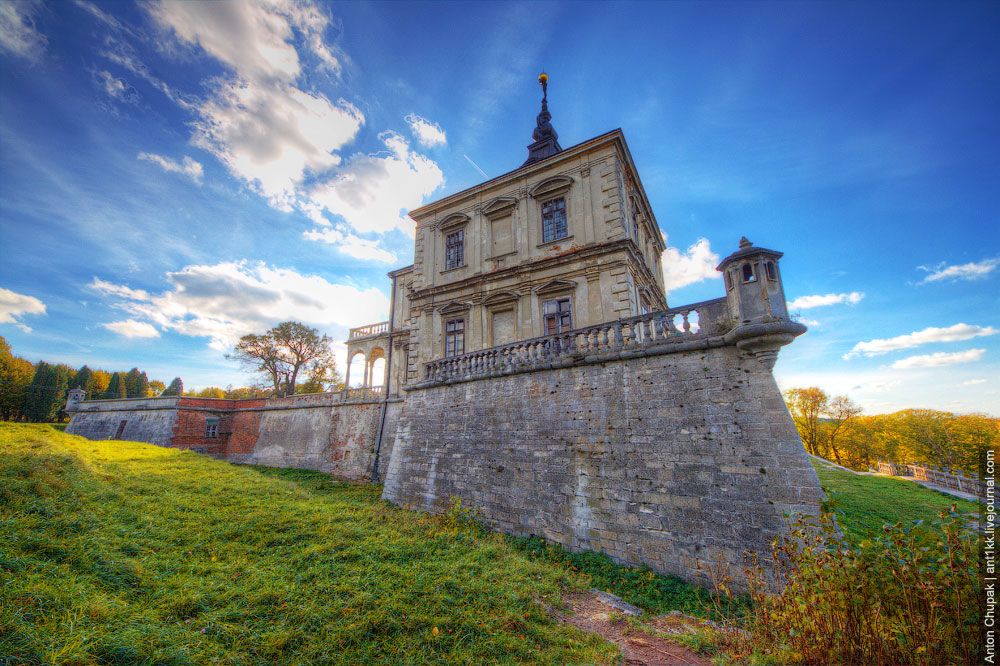
In 1997, thanks to the efforts of the public and B. H. Wozniczky, the Podhorze Castle was transferred to the Lviv Art Gallery. That same year, a charitable foundation for its restoration was established under Wozniczky’s leadership. The gallery preserves 85% of the artifacts from the castle, which are planned to be returned and displayed in a restored museum of interior design. In 2010, the Podhorze Castle celebrated its 370th anniversary.
The interiors of the Podhorze Castle amazed contemporaries with their beauty and opulence. Rooms such as the Chinese Room, the Golden Room, the Knights’ Room, the Green Room, the Mirror Room, and the Mosaic Room lived up to their names. Items belonging to King Jan III Sobieski were also preserved separately. The rooms were adorned with portraits of the castle’s owners, as well as copies of works by Raphael, Rubens, Titian, and Caravaggio. Polish artist Czechowicz created paintings, and Jacob de Baan produced canvases on historical themes such as the Siege of Smolensk and the reception of Swedish and Brandenburg envoys by Władysław IV. The dining hall featured a portrait of Hetman Koniecpolski and 72 portraits of famous political and religious figures, as well as a black marble table on which King Jan III was baptized.
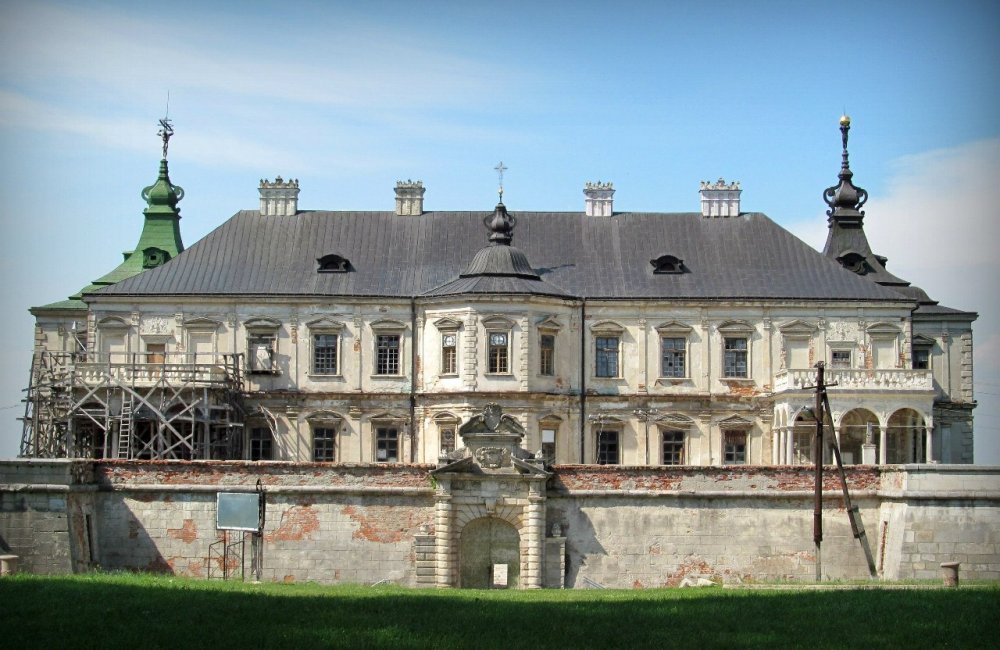
The unique character of the architectural ensemble in Podgoretsk is enhanced by the park, whose lush greenery surrounds both the castle, the courtyard, and a series of other structures. In ancient times, it was precisely the park that left a much stronger impression on visitors than the castle itself.
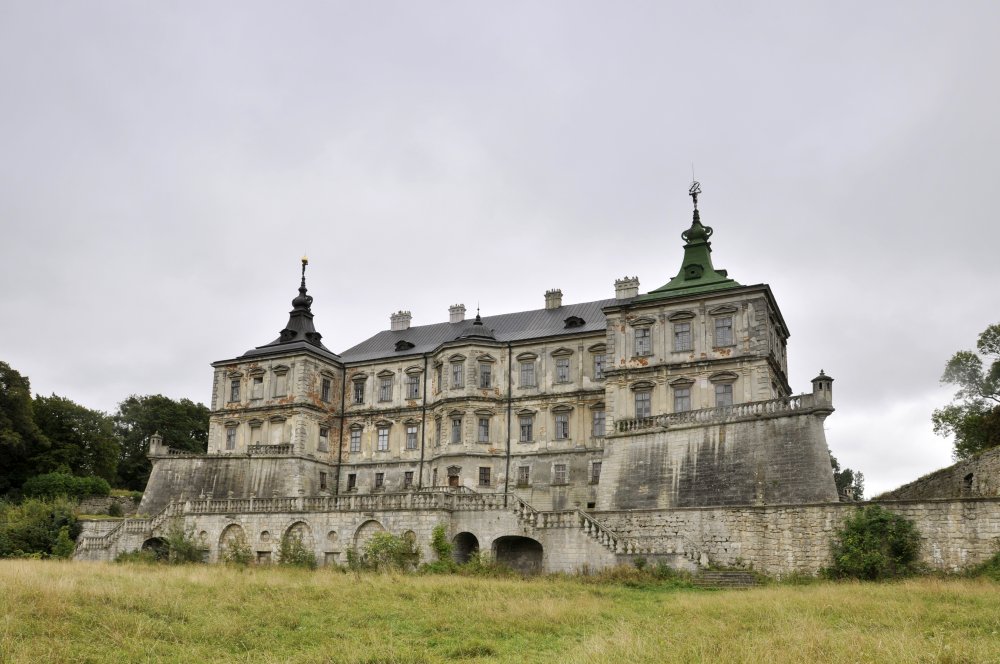
The Podgoretsk Park is classified as a monument of national significance in the field of garden and park design. Built to the highest standards of so-called “Italian” parks, it is the finest and perhaps the only such park in Ukraine.
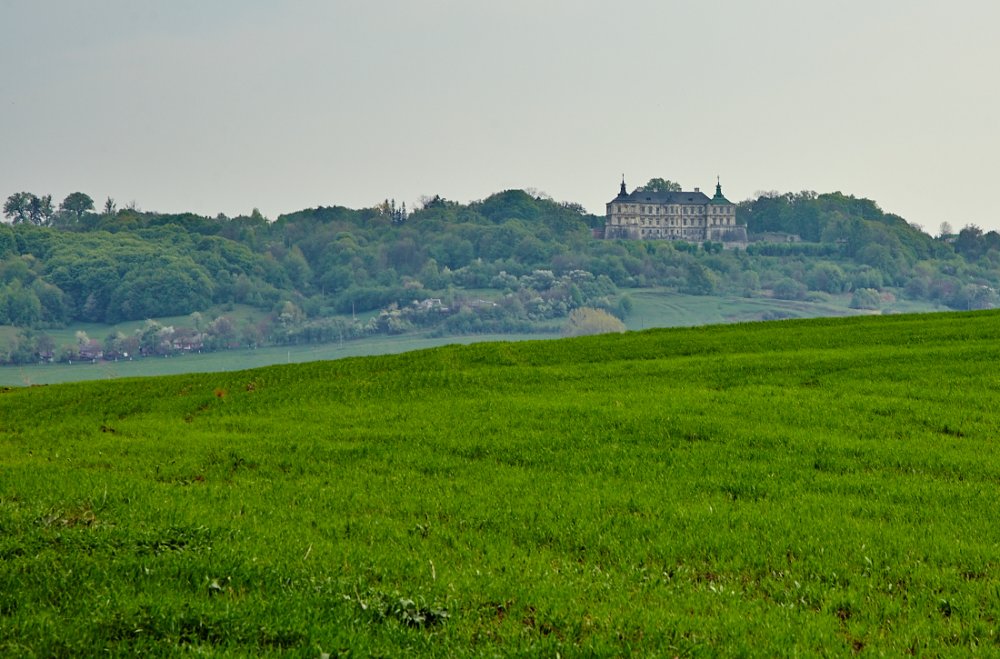
The local park encircles the castle on all sides, and it is distinguished by the coherence of its artistic conception and the carefully thought-out interrelationships between landscape, architecture, sculpture, and vegetation.