Samarkand has long been a spiritual and scientific center of the Middle East, it has preserved many monuments along which it is possible to trace the epochs of the city.
Uzbekistan. Samarkand

During the day we walked through all the key points, I heard many legends that developed over two millennia of the life of this city & hellip;. In Uzbekistan, the second national language is Russian, almost everyone speaks it.

The train on which we arrived is called Afrasiab, in honor of the ancient city located on the site of present Samarkand

Service is very good: on the platform you are greeted by smart and polite flight attendants

The car inside reminds our Peregrine Falcon. There is a monitor with data on the speed of movement - at some point noticed 220 km/h

While driving through the country, I noticed a lot of poplars. Uzbeks have a tradition - when a child is born, parents plant several dozen poplars. This is done with the expectation that in the future - when the child and trees will grow - you could build a house from them. The city is divided into three parts - New, Old and Ancient. Samarkand is the same age as Rome. The most famous ruler is Amir Timur, known to us more like Tamerlan. Also famous are his grandson Ulugbek and Bobur, who left Samarkand for India and founded the Empire of the Great Moguls there. The very one that later the English conquered. In Samarkand, everyone drives on the same cars: 80% of the car park - either Deu or Chevrolet. Once in Uzbekistan was the production of Uz-Deu, which subsequently went bankrupt and sold the Chevrolet plant, so here you can often see with both brand icons

First, where we came - the tomb of the prophet Daniel

16 years ago, Alexis came to Samarkand second. The proximity to the biblical prophet made such an impression on him that he spent more than an hour and a half in the holy place, instead of the planned 20 minutes. He drew attention to an old dried almond tree, consecrated it, and the next year deadly suddenly gave a runaway. It is described as a miracle, although they add that such a tree is found

And this is the grave of the prophet Daniel. It is believed that Tamerlan brought the ashes of the prophet, but there is still no certainty - some historians believe that the ruler brought part of the relics of the saint, others say that a handful of earth from the burial place. It is believed that the grave of the prophet is constantly growing, and there is also no consensus as to whether the relics increase with time, or the grave is specially made to hide the remains of marauders. To date, the length of the grave is 20 meters

At the very end of the hall is a stone. It is believed that if three times to raise it and make a wish, then it will be fulfilled

The abbot. Seven generations of his ancestors also were the guardians of the ashes of Daniel

Next to the grave are selling souvenirs:


Nearby is the holy spring. You can collect water or drink from the common bowls that are next:

By the way, on this place a few years ago found the remains of an ancient mosque, supposedly the 14th century:

And this is Shahi Zinda - a complex of mausoleums of the Samarkand nobility and the holy fathers of the Middle East. The title is translated as & quot; living king & quot ;, and a legend is also associated with it. It is believed that the cousin of the Prophet Muhammad, Kusam ibn Abbas, came to Samarkand as part of the Arab army. And so, during one of the sorties of resisting Zoroastrians, he was wounded, but managed to hide in some crevice. The army searched for its leader for a long time until he dreamed of all the soldiers, saying that he was alive and is in paradise, where the Lord took him out of the crevice:

This balcony with a canopy is called aivan - it is in almost every prayer house with mosques:

40 steps of Shahi Zinda. It is believed that if the number of steps counted during the ascent and descent coincides, the person is cleansed of sins. In fact, at the heart of this belief lies a deeper and wiser legend. Earlier, some pilgrims performed a forty-day moleben, rising every day to a higher level. With the staircase there is also a legend about Bahauddin Naqshbandi, the famous Sufi master. During his post, when he reached the last step, a rider on horseback suddenly rushed to him from the mausoleums. Everyone decided that now he would trample the old man to death, but the master did not get scared and did not back down. The rider stopped beside him, and it turned out that Kusam ibn Abbas himself decided to check the spiritual master on top of his journey:

And these are mausoleums. In the complex there are nameless tombs: it used to be believed that noble and famous people are buried in such places, and they need not be signed:

The glaze of the 14th century was perfectly preserved:


At the exit we were attacked by gypsies, although they did not molest much. By the way, a little later, in the Registan, the gypsies gave me money to find out that I collect banknotes. The gypsy gave a rare note at five o'clock. Rare it because it is not used in calculations - 1000 sums are equal to 10 rubles. This was the first time in my life when gypsies gave money to me, and did not ask for them from me:

Observatory of Ulugbek - grandson of Tamerlane. If Tamerlan and all other relatives were military, Ulugbek was a scientist. Among other things, he was fond of astronomy and even built an observatory:

Now this is a popular place for wedding walks:

The building of the observatory, unfortunately, collapsed and only its underground part remained:

However, even on it you can estimate how smart Ulugbek was:

The reconstructed model of the observatory: it was based on a huge sextant, with which Ulugbek calculated the many coordinates of celestial bodies

One of the most beautiful streets of Samarkand. And all the cars are white, because it's very hot in summer:

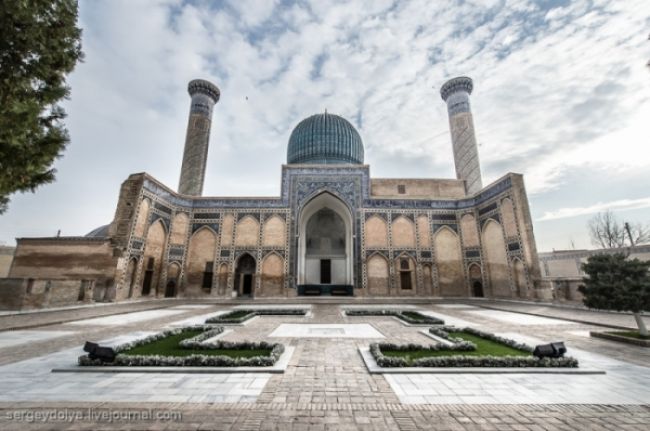
And this is Gur Emir - the family mausoleum of Tamerlane and his relatives:

Tamerlane lies in the center, near the grave of Ulugbek, sons and grandchildren, as well as a spiritual mentor. Tamerlane was superstitious - this is due to his first and only draw in the battle, caused, as he considered by sorcerers:

But in fact the real tomb is one floor below and is locked:

This decision was made due to the fact that many visitors perpetuated their visit with the inscriptions "Here Was Vasya" on the walls:

This Registan is once the religious center of Samarkand and the entire Middle East. In the Registan there are many madrasahs - schools, where they combine spiritual and secular education. The first and old is, of course, Ulugbek madrasah:


One of the minarets allowed me to rise:

The climb was very difficult - the steps seemed to me to be 40 centimeters high:

View from the minaret


There were already a lot of curious people before me, some of whom decided to write themselves into history:

And so it looks like a gold mosque in Tillia-kori madrassa (central part of Registan):

After that, we went to the Samarkand winery named after Khovrenko:

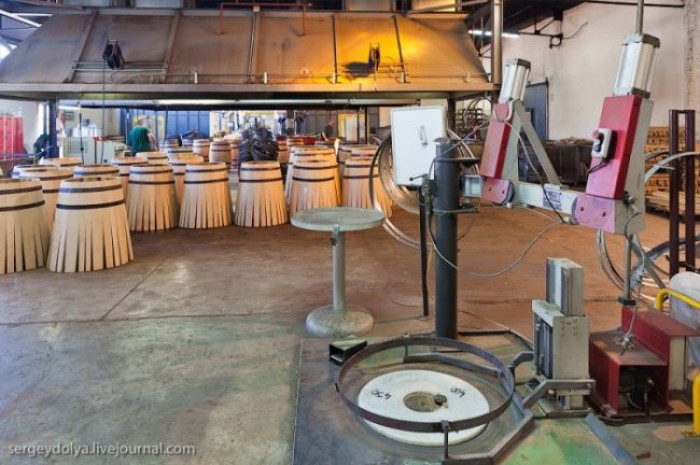
The once prosperous enterprise today does not withstand the competition of small industries and does not work at full capacity - practically all these barrels are empty:

Recently, the workers found a walled cellar in the wall, in which were found the stocks of the old wine:

In this very cellar there was a small tasting:

And these are local bloggers with whom we walked around the city. In addition to Rustam, who told me wonderful stories about his city, but at the time of the picture, he ran to congratulate his grandfather on his 87th birthday. Thank you for the warm company!

Stay Tuned!