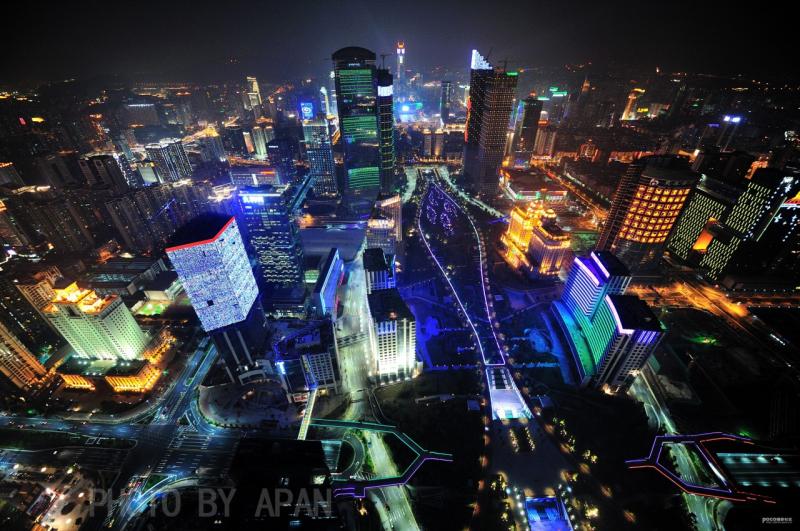
In two years, China produced more cement than the US for the entire XX century. According to official data of the State Bureau of Statistics of the Republic of China, for the period from January to December 2014, the cement industry of China produced cement in the amount of 2 billion 476 million tons. And over the last two years, 4 billion 890 million tons (4.9 gigatons). The US, according to USGS Cement Statistic, for the period from 1901 to 2000 produced only 4.5 gigatons of cement. In recent years, the US has produced about 80 million tons of cement per year (30 times less than China), Russia 65 million tons.
China's concrete meters
So, what do the Chinese spend such a breakthrough of cement? Let's see. It is better, as they say, to see once than to hear a hundred times.

Well, why do Chinese people need so much cement, Americans think. Do they still have old cement fillings? About China, I do not know, but in the United States in semi-underground dentistry really continue to put cement fillings. As a result, dental treatment may be cheaper than a flight from the US to Russia, followed by treatment and accommodation at the hotel. Why inflate the GDP of the construction sector, you can also inflate to obscene something that can not be abandoned, and medicine is best for this.
Yes, and construction, if you approach the matter wisely, you can pump up additional demand. After all, you can also build reliable reinforced concrete structures that will last for more than one hundred years. But this is not profitable for anyone. Neither builders, nor bankers, nor realtors, nor insurers. Sooner or later saturation of the housing market will occur and the demand will be minimal. It is much more profitable for the economy to build houses of plywood and drywall. Such definitely will not last several centuries. The service life at them ideal and if and exceeds term of payments under the mortgage it is not much. As soon as the owner of such a house fully settles with the bank, so you look and the time will come up for a new home. As a result, we have a constant demand, plus increased costs for repairs, and even without insurance, you can not do it (a small hurricane, flood, or just a shower can leave without shelter).
Let's take a look at a typical American city (take Los Angeles as an example). It looks something like this.

In the heart of the city is Downtown. A quarter of skyscrapers with offices of banks, insurance companies, investment funds, administrative buildings, headquarters of large international corporations.

In the direction of downtown on all sides are high-speed highways. And in a radius of several tens, or even hundreds of kilometers from downtown, there is a so-called "suburbia". Separate islets where as a ruler lined up one-, one-and-a-half and two-story houses. This is the very territory where the majority of the American population lives.


Thanks to this development, the US cities have truly cyclopean dimensions. To assess the scale, I will give a comparative map of American cities (red) and the world's largest megacities (green):

Chinese urbanization has gone a little different way. No, in China there is also a low-rise residential development in the suburbs of large cities, but it has not acquired any dominant role in the construction industry.
Low-rise buildings in the suburbs of Shanghai:

Low-rise buildings on the outskirts of Wuxi (I note that in Wuxi and another 3-4 not very well-known Chinese cities, the construction of some kind of similarity of the American suburbia is so far only within the framework of the housing experiment):


This is how a typical Chinese construction in the cities of million people looks like in the city of Guiyang (all photos in this topic are clickable). I think our builders and engineers should consider this picture more carefully and learn the best foreign experience of large-scale and dynamic construction.

I'll talk about Chinese cities a bit later. In the meantime, I'll return to my main topic. Where does China spend those colossal volumes of cement that it produces. Roads, houses, hospitals, power stations - all this requires concrete. Even some parts of the infrastructure may require huge structures of concrete. Let's take a look at some of the main directions of concrete consumption in more detail.
AUTOMOBILE ROAD.
As an important consumer of cement in China, in addition to housing is road construction. By the end of 2013, the total length of China's roads exceeded 4.1 million km, including 104.5 thousand km of highways. By the end of 2014, already 111.9 thousand kilometers. The recent increase is about 10 thousand km of highways per year:

The system of China National Expressway Network is by far the largest in the world.

For comparison, the National System of Interstate and Defense Highways as of 2013 is 77,017 km.
Until 1987, China did not have a single kilometer of expressways. According to the initial plan, China intended to build a network of national highways for 35,000 km only by 2020. But already on January 1, 2005 the total length of the roads approached this figure. In 2011, China surpassed the National System of Interstate Highways, which was built in 1956 and seemed unattainable in scale. In recent years, the American road network has practically stopped in its development. For example, in 2012-2013, it increased from 76,788 km to 77017, that is 229 kilometers.
According to the Transport Development Program in the coming years, China will form a network of high-speed roads that will connect all regions and almost all cities with a population of more than 200 thousand people.


At the end of 2014, China had 264 million vehicles, of which 154 million vehicles (about 117 million of them - cars and light commercial vehicles). Over the past 5 years, the share of cars in the total number of cars has increased rapidly: from 43.88 to 58.62 percent. In provincial cities, scooters and motorcycles are still the predominant mode of transport.
Traffic in the provincial town of Liuzhou:

For a year the fleet in the country increases by 20-22 million cars (in the USA 15-16 million, in Russia 2.5-3 million). And if in cities where people move mainly on scooters, there are no problems with traffic jams, but in the largest metropolitan areas of China this is one of the main problems. With traffic jams on the roads in China are struggling in a rather unusual way. To date, in China, six cities have established restrictions on the issue of license plates (Shanghai, Beijing, Guangzhou, Tianjin, Guiyang, Hangzhou).

The pioneer in this case was Shanghai, which introduced the auction system for the sale of automobile license plates back in 1986. Shanghai car plates are often called the most expensive piece of iron in the world. In 2002 - at the beginning of the continuing period of price growth - a metal plate with a number cost the customers about 15,000 yuan ($ 1800). The historical maximum cost of the Shanghai license plate reached in March 2013. The lucky winners in the auction posted an average of 91,898 yuan ($ 14,800) on average.

In Beijing, went even further. Now, drivers will be able to travel to the city on weekdays, depending on the number on which the car number ends. For example, on Monday it is forbidden to travel with a unit and a six, and on Tuesday you will have to walk for those with a deuce and seven.

TomTom, a navigation product company, recently published its annual city traffic peak during peak hours, the TomTom Traffic Index. In 2014, this ranking included for the first time the cities of China. According to TomTom, 10 Chinese cities have entered the top 30 of the world's leaders in traffic jams. These are the cities (in brackets occupied by them in the ranking):
Chongqing (12th), Tianjin (14th), Beijing (15th), Guangzhou (17th), Chengdu (19th), Shanghai (24th), Shijiazhuang (25th), Fuzhou (28th), Shenyang (29th) , Hangzhou (30th).
In the TomTom study, 218 cities participated in 36 countries. Moscow and St. Petersburg occupy the fourth and seventh places on this list.

BRIDGES.
Already today in China, 300 thousand bridges (one thousand of them - a length of more than a kilometer). Of the 100 largest cable-stayed bridges in the world, 55 are in China. And it is interesting that out of the 40 largest cable-stayed bridges in the world, 20 are thrown across the Yangtze River.
Cable-stayed bridges across the Yangtze in Wuhan.

The Sutong Bridge is the second cable-stayed bridge in the world, after the bridge to Russky Island.

No bridge was built across the Yangtze until 1957. The "First Bridge", it is called, was built in 1957 in cooperation with engineers from the USSR. True, they had to leave, not having finished their work, because of the political disagreements between our countries. The bridge is two-tiered - on the lower tier there is a railway line, on the upper four-lane freeway. In addition, there is even a museum on the bridge telling about the history of the creation of the first ferry across the Yangtze.


Now the bridges across the Yangtze are about 80, including more than 10 bridges, world record holders in different categories. There are: the largest arch bridge in the world, the largest arched concrete bridge, the largest twin, the largest railway viaduct, the largest twin railway bridge, etc.
Chaotianmen Bridge is an arch bridge with the world's longest span:

Mingzhou bridge in Ningbo city:


The Chinese are building copies of the most famous bridges in the world. In the city of Tianjin, an exact copy of the most beautiful bridge in Paris - the Alexander III bridge:

There is another copy of this bridge, although it's not completely 100%, where in the province they built the same, only much longer. And in the city of Suzhou is a copy of the most beautiful bridge of London - Tower Bridge, the bridge was twice as wide as the original.
The world's longest ocean bridge. The bridge of Hong Kong - Zhuhai - Macau is one of the largest infrastructure projects in China. The bridge will connect Hong Kong with Macao. Completion of the construction is planned for 2016.

It is to this region in the southeast of China (the Pearl River Delta) that urbanists proclaim the title of the largest metropolis of the future.

AIRPORTS.
The Civil Aviation Administration of the People's Republic of China approved a plan according to which most even small regions of the country will receive their own airports. Until 2030, the goal is to bring the number of air harbors in the Middle Kingdom from 399 to 2000. That is, more than 100 airports will be built in China every year, creating 1600 such objects in just a decade and a half.
Kunming Changshui International Airport (Kunming)

Hefei Xinqiao International Airport (Hefei)

Daocheng Yading Airport - A small airport in Sichuan province, is the most high-altitude in the world. The airport is located at an altitude of 4411 meters above sea level.

Fresh data on passenger traffic in the largest Chinese airports following the results of 2014 and comparison with 2013. In the third column, we can observe the increase in passenger traffic as a percentage of the previous year. As we see the growth, and quite significant, is observed in all airports in China, with the exception of Dalian. It should be noted that now in the city of Dalian, the construction of the world's largest sea airport is under way. Perhaps this explains the temporary drop in passenger traffic.
Passenger traffic of Chinese airports following the results of 2014:

By global standards, China's airports are not that big. Only Beijing with its 86 million passengers is in second place in the ranking of the world's largest airports, losing to the first Atlanta. It is true that if two Shanghai airports are added together, then the total will be even greater than that of Beijing, but still slightly less than in Atlanta. Of the remaining Chinese airports, only Guangzhou is in the top 20 of the world ranking. One of the largest in Russia, the reconstructed Pulkovo airport, will enter the Chinese big twenty airports with a scratch, hitting only 19th place, and into the world's largest one hundred airports without ever hitting, just a few steps from the elite hundred.
Perhaps the most futuristic airport in the world can be called the Shenzhen Baoan Airport. The new terminal, designed by the Italian architectural firm Fuksas, impresses with its design both inside and outside.
Shenzhen Bao'an International Airport


RAILWAY HIGHWAYS
A tremendous breakthrough in the development of the SCM (or as they are called high-speed rail) over the past 10 years has been committed by China, leaving far behind the closest competitors from Europe and Asia. China now has the world's largest network of high-speed and high-speed railways, exceeding those in Japan and Europe combined.

The huge network of high-speed railways (WSM), gradually entangles the entire Middle Kingdom, giant viaducts and viaducts reach a length of 100-150 km.
The Danyang-Kunshan Viaduct, part of the Beijing-Shanghai Highway, with its 165 km long (of which 9 km laid directly above Yancheng Lake) - is an absolute world leader.

High-speed highway Guangzhou-Guiyang. At a speed of 250 km per hour, the train passes through 510 bridges and 236 tunnels.

The 189 km long Shijiazhuang-Taiyuan high-speed railway has the longest tunnel in China - 28 kilometers.

The largest railway viaduct in the world - Caijiagou Railway bridge. Massive supports are made in the form of a Chinese character - "people":

The first attempts to introduce monorail transport in Chinese cities. Monorail depot in Chongqing:

Chinese railway stations are amazing in their size and architecture, perhaps even more than airports. This map shows on one scale the largest Chinese stations (on the left), in comparison with the largest railway stations in Europe (in the lower right corner):

Wuhan railway station (Wuhan):

Hangzhou East Railway Station (Hangzhou - West Railway Station)


Shenzhen North Railway Station (Shenzhen - North Railway Station)


Guangzhou South Station (Guangzhou South Station)


Tianjin West Railway Station (Tianjin West Station)


Tianjin East Railway Station (Tianjin - East Railway Station)

Beijing South Railway Station

Shijiazhuang Railway Station (Shijiazhuang)


Harbin West Railway Station (Harbin - West Railway Station)

CONSTRUCTION OF HOUSING.
China's current urbanization is a colossal and unprecedented process in its scope in history. Living space per capita in cities increased from 4 square meters in 1980 to 31.5 square meters in 2010, although this is much less than in the US (65 square meters per person), but more than in Russia (24 m2 per person).
Not so long ago the city center of Chengdu looked like this:


What do you think in what years these photos are made? In the 70's or 80's? You probably will be surprised, but this is a 1999 photo. For some 15 years the city has changed beyond recognition. Do you know where is the largest building in the world? Do you think the Washington Pentagon or the Dubai airport? No, in 2013, the palm tree passed to Chengdu. The new world leader, the New Century Global Center, is almost three times as large as the Pentagon. Its height is 100 m, and the sides are 500x400 m. Inside is the largest artificial beach in the world with artificial waves, artificial sun and even an artificial light sea breeze.


And this is the center of Chongqing City in 1981 and in our time:

The only building of the city center that has survived to this day is the Monument to the People's Liberation. And the very central square of the city began to resemble Time Square in New York.

In 1978, only 17.9% of the country's population lived in cities. Today, the number of townspeople has increased to 40%. In accordance with the plans of the authorities, by 2020 this indicator should amount to 55%. At present, the task is to move 300 to 400 million peasants to the cities in the next 16 years.
A typical Chinese village:

Currently, 520 million Chinese live in 660 cities and 20,000 medium-sized settlements. In China there are only two cities with a population of more than 10 million people - Beijing and Shanghai. The 36 millionth Chongqing is in fact a municipal area of 80,000 square kilometers, which includes extensive rural and close to them zones.
Development of the city of Chongqing 1990-2007:


By 2025, China will have more than 220 cities with a population of over one million people compared to 125 million in 2010 and 23 megacities with a population of more than 5 million people.
Shanghai Pudong is a classic example of how the "empty" urban construction project in the late 1990s. quickly became a full-time urban center with a population of about 5.5 million today.

The stories of "ghost towns" grab the reader, but provoke incorrect conclusions. Along with the natural expansion of existing industrial clusters, China is making attempts to develop entirely new territories, build new cities in the "clean field", far from populated areas. This task is naturally more difficult, but the strategic goals deserve such efforts.
The construction of the huge city of Kanbashi in Inner Mongolia, which began in 2004, was odious. The city capable of hosting a million inhabitants has a population of only 30 thousand people. Why did they build this city on the border with Mongolia? Is the project a gross mistake?
In explored reserves of mineral resources, Inner Mongolia ranks 5th in China and is the second region of the country in terms of the amount of hard coal in the amount of 224.75 billion tons. The region is unique in that it has reserves of rare-earth elements in the amount of 80% of all world reserves!
Mining projects are not implemented quickly, it takes time. There is little doubt that in the long term the city will be populated and doomed to become a prosperous center of the raw industry of North China.
The most notorious city is Kanbashi:

According to the International Monetary Fund, the share of the real estate sector is about 14% of China's GDP and it will be much higher if it adds steel, cement, furniture, home equipment and attached transport and energy infrastructure, real estate accounts for about a quarter of the Chinese economy.
New projects are waiting for their time. The Hefei City Development Project:


The most rapidly developing megacities of the world.
According to the company MetroMonitor, which monitors the 300 largest cities in the world in 2012, out of the world's 20 fastest growing cities, 19 were Chinese.

And the slowest growing cities in Europe: 42 of the world's 50 worst mega-cities were European. What is interesting in the list of the worst came in when one of the world's leading development leaders - Dubai.

So it was when it was, many will say. Now China is not the same as before, the whole world quietly covers the growing economic crisis, and confident and qualitative growth can be observed now only in the United States.
Now any competent economist or financial analyst will lead you a widespread thesis that China's growth rate is slowing down. In 2014, the growth of the Chinese economy amounted to an insignificant 7.4%. Such low GDP growth has not been observed since the 90s of the 20th century. Moreover, in 2015 GDP growth is expected to fall to ridiculous 7% or even catastrophic 6.5%.
But for a minute, those same 7.4% of last year is 1.3 trillion dollars (if you count according to the CIA technique, taking into account the purchasing power parity). Or exactly half the GDP of France or Britain. That is, in less than two years, China is growing by one Great Britain or one France, or Canada and Australia combined.
A comparison of the GDP of the largest 50 countries in the world according to the CIA reference book for 2014:

But in spite of the fact that China itself is not developing at the rapid pace that was before, nevertheless, there are still eight, nine, and even ten percent growth in the country of the city. Statistics on the results of the whole year I did not manage to wait, so we will be content only with the first three quarters of 2014.
TOP-30 largest cities in China in terms of GDP:

Unfortunately outside of China these cities know practically nothing. On hearing only 4-5 of the most famous such as Shanghai and Beijing. I think that practically no one can immediately name at least 10 Chinese cities with a population of over one million. I would like to slightly open the veil of secrecy from undeservedly forgotten Chinese megacities, showing a few photos for each, with small comments. Initially, even going to take the same TOP-30 cities with the largest parameters of GDP. But in the end, deciding that it is not quite representative, especially since this topic is not dedicated to the Chinese economy as a whole, but only to concrete Chinese concrete meters (from the word Concrete), so I chose the ranking of cities by the so-called "Urbanization Rating" ". According to this rating, cities receive points depending on the number of buildings over 80 meters, plus additional points for very high buildings are given. As a result, thirty of the most urbanized cities in China look like this (I remind you once again that all photos in this article are clickable):
30. Liuzhou (Liuzhou)


29. Jilin (Girin)


28. Sanya (Sanya)


27. Nanchang (Nanchang)


26. Guiyang (Guiyang)


25. Kunming (Kunming)


24. Harbin (Harbin)


23. Zhengzhou (Zhengzhou)


22. Ningbo (Ningbo)


21. Jinan (Jinan)


20. Suzhou (Suzhou)


19. Nanning (Nanning)


18. Changsha (Changsha)


17. Fuzhou (Fuzhou)


16. Xiamen (Xiamen)


15. Shenyang (Shenyang)


14. Chengdu (Chengdu)


13. Qingdao (Qingdao)


12. Wuxi (Wuxi)


11. Hangzhou (Hangzhou)


10. Macau (Macao)


9. Dalian (Dalian)


8. Wuhan (Wuhan)


7. Tianjin (Tianjin)


6. Nanjing (Nanjing)


5. Beijing (Beijing)


4. Chongqing (Chongqing)


3. Shenzhen (Shenzhen)


2. Guangzhou (Guangzhou)


1. Shanghai (Shanghai)