Market Square, Lviv
Market Square History
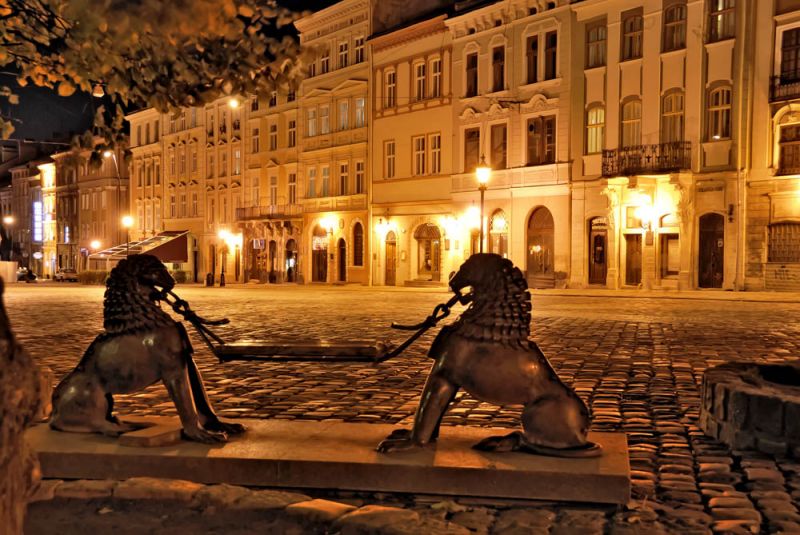
The Market Square is one of the most refined and architecturally ideal places in Lviv. The history of the square is quite interesting. Prince Danilo Galitsky founded Lviv in the 13th century, and in 1349 the city was conquered by the Kingdom of Poland. On behalf of Casimir III the Great, the German colonists began the construction of a square modeled after a medieval European city with a market square in the center.
Its name is associated with the principle of construction and comes from the German word der Ring, which means "ring, enclosed space". Over time, the name was transformed into "Market". Later, Austrian and Italian architects added beauty to the area.
Area Architecture
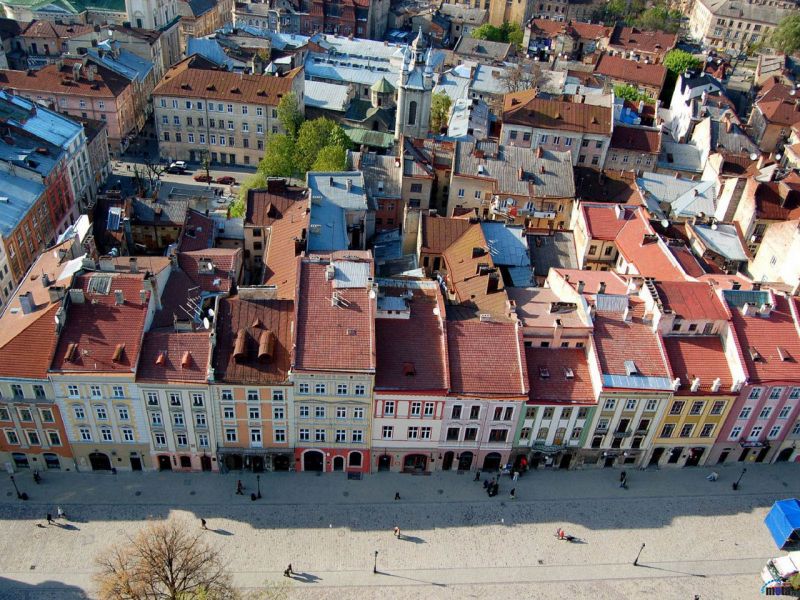
The architectural decoration of the area of 142 by 129 meters has 44 houses with a town hall in the centerand is made mainly in the Renaissance style. Sometimes you can see the echoes of Gothic architecture, the elements of which were preserved after the greatest fire in the history of Lviv in 1527.
The new Lviv, including its main square, was completely different, built in the Renaissance style. Then began to build more solid structures - stone (houses made of stone and bricks). The length of the facade of the Kamenets did not exceed 9 meters. The fact is that at that time in the construction of the Market Square there was, so to speak, "rule of three windows". Each stone should not have more than three windows on the facade. This gave the right to equal opportunities, because every first floor window was used for trade, workshop or advertising. Thus, the houses are located close to each other and are lengthened inward.
It was not a cheap pleasure to build a stone in the square - only rich merchants and wealthy nobility could afford it. There was also a constraint on floors. Only gentry and higher clergy were allowed to build more than three floors, or windows on the facade. A vivid example is the Kornyakt Palace or the Bandinelli Palace. Only in the 18th century this rule was abolished, so now you can see that many houses later completed the floor or expanded facades.
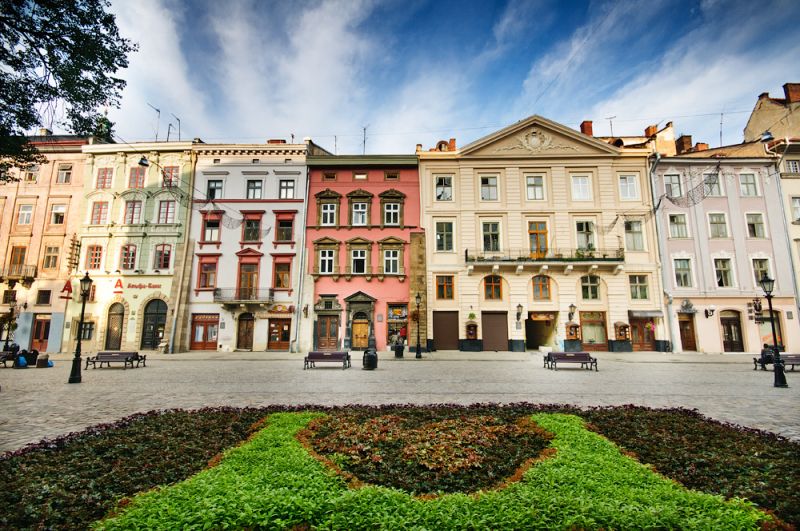
It is worth paying your attention to the facades of houses. You will easily notice that the distance between windows is not the same. Two windows, as if separated, are light-houses, and next to them is a vankir-a small side room. A striking example is the Black Stone. Such planning was typical for the Renaissance.
Several centuries ago there was no numbering, and the names of the Kamenists corresponded to the characteristic external features of the decor or the name of the owner. Today, the houses are numbered, but their names have been preserved, among them the Lubomirski Palace, the Scholz-Wolffowicz Stone, the Geppner Kamenica, etc. Each structure on the Market Square is covered by interesting legends and, undoubtedly, is worth your attention. The most interesting and valuable of them are on the east side of the square.
Architects and masters tried to distinguish each stone, give it individuality, use the latest technologies of that time, decorate both the interior and the exterior. In the Middle Ages, each house had its own color, it was, so-called, Lviv polychrome, but in the 19th century, at the time of Austrian rule, all houses were built in gray, which was due to the spread of cement companies. And only 30 years ago the people of Kamenets were given their original appearance.
The Market Square impresses with its originality, refinement and luxury. It is also decorated with four fountains with statues of ancient Greek gods, symmetrically located around the town hall. Ancient stone blocks, the architectural mosaic of the Kamenets and the grandeur of the town hall create a charming atmosphere of the Middle Ages.
Find the Best Professionals for Your Project
Expert repair, construction, and renovation specialists ready to help you right now
Recommended articles
More articles:
 Fountain Swarovski - giant with crystal eyes
 Koenigsegg Regera - the fastest and most powerful production car
 Egyptian pyramid-skyscraper
 London at the Beginning of the 20th Century
 The new legend Morgan Aero 8
 Solar Impulse 2 went to a new record
 Announced a unique thin and lightweight Macbook
 Eshima Ohashi Bridge - the largest Japanese bridge with a rigid construction