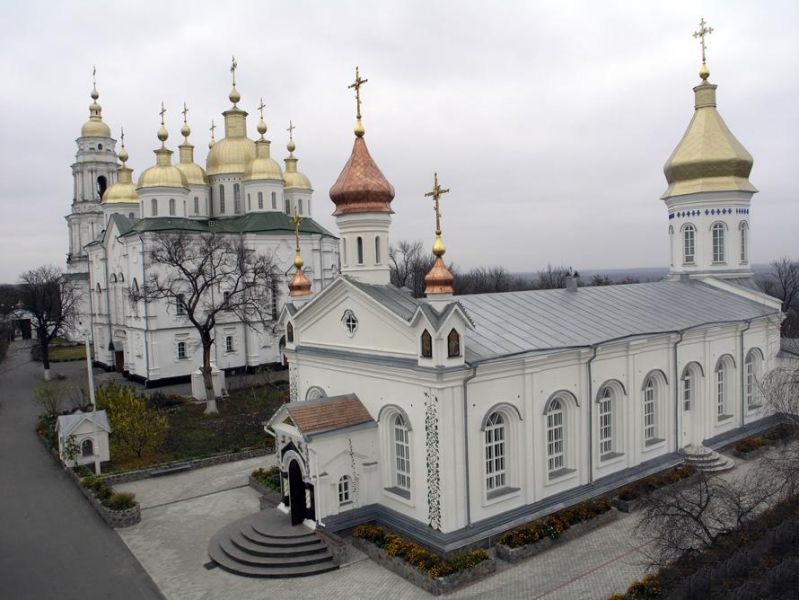
In Poltava, on the mountain above the Poltava River, there is a majestic Krestovozdvizhensky monastery. It was built in 1650 in honor of the liberation of the city from Polish enslavement. The monastery was founded by the abbot Kalistrat on the means of the Poltava colonel Martyn Pushkar and the representatives of the Cossack sergeant Ivan Iskra and Ivan Kramar. For a long time the temple was one of the most developed cultural centers of Ukraine. The beauty of the monastery was admired by the Ukrainian poet Taras Shevchenko, Russian painter Grigory Myasoyedov and other cultural figures of his time. Now it is a monument of national importance architecture, which welcomes hundreds of guests from different parts of Ukraine.
The main temple of the monastery - the Vozdvizhensky Cathedral, built in the late 17th century, is considered the greatest decoration of the architectural ensemble of the Krestovozdvizhensky Monastery. This seven-domed cathedral has no main and secondary facades, since all of them are architecturally designed, and therefore are perfectly visible from all corners of Poltava. A few meters from the main church are the Trinity and Simeon's churches. The latter was built in 1887 in honor of the son of the famous Poltava patron Innokentii Kotelnikov. They say that when my father drove sick son Semyon for treatment, they stopped at the Krestovozdvizhensky monastery. The temple liked the boy so much that he asked to be buried there in case of death. Soon my father still had to fulfill his son's last will.
Separate attention in the Holy Cross Monastery complex deserves a four-tier bell tower almost 50 meters high, built in the style of Ukrainian baroque. Some artists compare it with the bell tower of the Kiev-Pechersk Lavra, while admiring the rich stucco molding and ten majestic bells. By the way, the biggest of the bells weighs more than 6 tons!
In addition, the fraternal and economic buildings, as well as the abbot's house, have been preserved on the territory of the monastery complex. And in the first half of the 19th century, the Monastery Cemetery was founded within the monastery.
Recently the Holy Cross Exaltation Monastery celebrated its 360th anniversary. He survived numerous looting and devastation, witnessed the Battle of Poltava. Unfortunately, it was not possible to preserve the unique iconostases of the main temple of the monastery. The painting on religious and historical themes that adorned the interior of the so-called "Catherine Hall" was completely destroyed. To date, the location of the Gospel and liturgical books of the late 16th and 18th centuries from the monastery library remains unknown. However, each of the structures that survived to this day can tell a lot about the heroic events that took place at its walls. And it's worth to hear and see.