Parliamentary Library of Ukraine (branch), Brodsky Mill
History of the library
At the beginning of the 19th century, in Kiev Podol, where numerous estates of wealthy merchants were located, it was convenient to keep warehouses for items of commerce delivered to the city along the river. The merchant of the first guild Andrey-Anse Glezer bought a plot here.
Together with his companions in 1855, he submitted a petition for the construction of the millin this convenient place. The three-story mill building, as well as all accompanying buildings: forge, well, compartment for the steam engine were built in 1856-1857. In 11 years, all this property was bought by Amalie Schödel. And in 1870 he was captured by I. Brodsky, one of the founders of the sugarhouse family, who later gave his son to L. Brodsky.
New owners bought the area next door, the mill space expanded. The four-story building was erected as early as 1888. The fire in 1891 brought the institution huge losses. In a year the production began to be restored under the name "Joint Stock Company of the Kiev Steam Mill". Lazar Brodsky was at the head. By the beginning of the 20th century the enterprise flourished. In 1904 L. Brodsky died, and the company of shareholders was given the name of the famous industrialist.
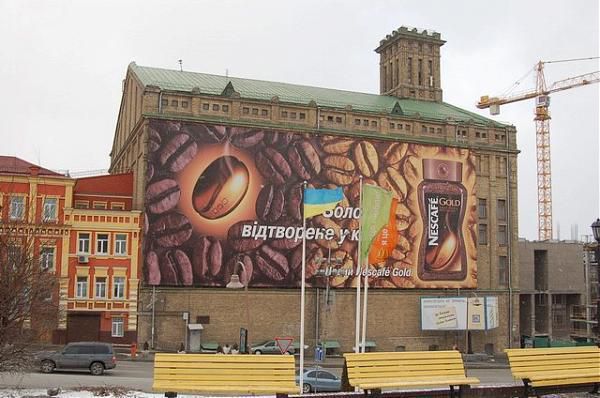
In 1906, there was another fire. The enterprise was reinstated. It worked even in the dashing years of the Civil War. However, in 1920 another destructive fire destroyed both the main building and the buildings. As a result of this event, only two structures survived. One of them is an elevator, called Kiev's Brodsky mill.
This building was erected in 1907. Designed by C. Wolkenstein, supervised the work of architect V. Bessmertny. The building is built in the style of the Basilica of the Middle Ages with a tower at the top. Inside, it was divided by overlaps into seven tiers.
In the times of the USSR there was a granary, warehouses. In 1970 the house was given to the Ministry of Culture of Ukraine, where the book depository of the library named after. CPSU. Now here is the National Parliamentary Library of Ukraine