Irish Notes

然而,我并没有离开机场,也没有踏上爱尔兰的土地, so technically speaking, Ireland was still the 64th country I had visited, and the first new country of this year—even though it was actually my 12th trip there since the New Year celebrations. But what makes Ireland famous? Its green clover, St. Patrick’s Day, leprechauns, rugby, the IRA, U2, its dances, the harsh northern landscape, Irish triple-distilled whisky, Bailey’s liqueur, Guinness beer, and of course, the joke “Where in Dublin? Ah, wherever you want to go! Whatever you say!”
Unfortunately, we didn’t make it to “Dublin proper”, but we did visit quite a few Irish pubs and enjoyed some Guinness there...

Guinness is practically the national drink of Ireland:

You can find it in every pub in the country, and there are quite a lot of them.


Besides Guinness, you often see red Smithwick’s beer and apple cider soda Bulmers.

Unlike in many other countries, in Ireland people tend to hang out in pubs rather than at home or in clubs. Even middle-aged and older people often wear jackets and shirts and go to pubs to spend an evening drinking Guinness.

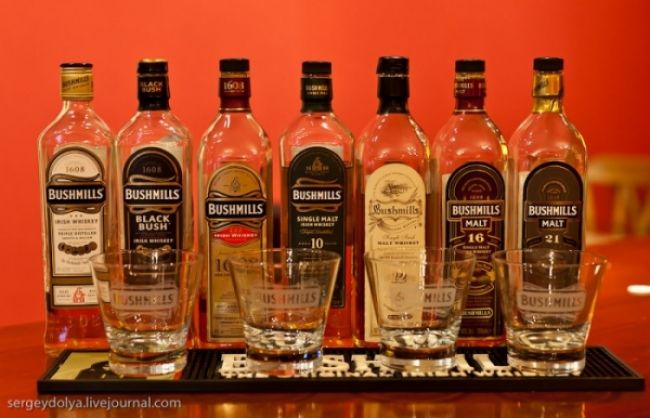
The second most famous drink in Ireland is whisky. Irlanders consider themselves the originators of this drink; in Irish, the word for “water” is “uisce”, and this term evolved into “whisky”.

Every pub has its own unique atmosphere, created by various small details—like for example, this sign above the women’s restroom.

In front of several restaurants, I saw signs indicating that they had been awarded the title of “Best Irish Restaurant” in a particular year by Bridgestone. Strangely enough, these years often coincided...


Just by looking at a castle, you can usually tell what purpose it was built for. If the windows are narrow and there are battlements on the roof, it was probably built for defense and military control of the area. But if the windows are wide, it means the castle was designed for a luxurious life and entertainment.


The modest interiors of the 16th-century castle of Dangwyir, one of Ireland’s most popular tourist attractions, are quite different from the comfortable homes we are used to seeing.

All the floors are connected by narrow spiral staircases with narrow windows along the way.


And this landscape picture I took wasn’t on the moon, but in the Burren National Park. Here, in the cracks of the limestone plateau, different ecosystems coexist—alpine plants grow alongside subtropical species, and forests can even grow in areas where you would expect to find grasslands.

Limestone formed around 350 million years ago, when what is now Ireland was at the bottom of a tropical sea. In these cracks, you can find fossilized coral, sea urchins, sea lilies, and ammonites.

In the Burren National Park, you can find one of Ireland’s most popular attractions: the Dolmen of Poulanbron. In Irish, this means “the pit of misfortune”.
This burial tomb dating back to the Neolithic period was built around 6,000 years ago. During excavations in 1985, remains of 22 adults and 6 children were discovered beneath it.

Another famous attraction in Ireland is the Moher Rocks. On a clear day, you can see that this rocky formation stretches for 8 kilometers along the coast.

These rocks seem to “remember” the people who built the dolmen 6,000 years ago.

Unfortunately, it was raining heavily that day, so instead of enjoying the scenery and the huge waves, we got completely soaked. My beloved red jacket, which you often see me wearing, got completely wet, and even my underwear got soaked through. But not every day in Ireland is rainy. In the following days, we enjoyed some beautiful sunshine and lovely clouds.


The coast in the small town of Galway:

I was surprised by how many locals were swimming in the ocean at a temperature of just +13 degrees Celsius.

There were plenty of people walking along the beach. Everyone would walk to the end of the path and then kick the wall at the end with their feet.
About 100 years ago, there was a long promenade along the coast of this city. It was either 6 or 8 kilometers long, but then a local landowner built a house by the sea and enclosed it with a fence, so the path became much shorter. Today, locals are trying to remove this fence in order to restore the original length of the promenade.

Galway’s main tourist street:

People were enjoying the nice weather and drinking Guinness.
I really liked the name of this shop: “Twice as nice”.
Local shops are selling plenty of Aran knitwear—fisherman’s sweaters made from undyed home-spun wool. Since these sweaters are made from wool that hasn’t been fully processed, they have natural water-repellent properties. The sleeves are slightly shortened to prevent them from getting too wet when working at sea. Each family develops its own unique pattern, and these sweaters were originally used to help identify the bodies of drowned fishermen who washed up on the shore.

In every corner, you can buy Claddagh rings. These rings are shaped like a pair of hands holding a heart surrounded by a crown. The heart symbolizes love, the hands represent friendship, and the crown stands for loyalty.

People wear Claddagh rings as a symbol of friendship or commitment. There are specific meanings depending on how the ring is worn: If it is on the right hand and the heart faces away from the wearer, it means the person is looking for love. If it is on the right hand and the heart faces the wearer, it indicates that they are in a romantic relationship. If the ring is on the left hand and the heart faces the wearer, it is considered a wedding ring.

Well, they really came up with a clever system, didn’t they?
On the streets, you can see many people holding signs with advertisements on them.
There is a common stereotype that all Irish people are red-headed. But I haven’t noticed any such individuals among the locals I met.


Like in many other countries, Ireland also has its share of hidden dangers on the streets.
There are some lovely old ladies.
Young people these days...
Stay tuned!