Uzbekistan. Samarkand

In just one day, we managed to visit all the main attractions. I learned many legends about this city that have been passed down for over two thousand years… In Uzbekistan, Russian is the second national language, and almost everyone speaks it.

The train we took is called Afrasib, named after an ancient city that used to be located where Samarkand is now.

The service on the train is very good: at the platform, we were greeted by friendly and well-dressed conductors.

The interior of the train car resembles our Sapsan. There is a monitor showing the current speed; at one point, it showed 220 kilometers per hour.

While traveling across the country, we saw many poplars. In Uzbekistan, it is traditional to plant dozens of poplar trees whenever a child is born. This is done with the idea that one day, when the child and the trees grow up, they can be used to build a house.
The city is divided into three parts: New Samarkand, Old Samarkand, and Ancient Samarkand. Samarkand is as old as Rome. Its most famous ruler was Amir Timur, better known as Tamerlane. His grandson, Ulugbek, and Babur also played important roles in the history of this city.
In Samarkand, everyone drives basically the same cars: 80% of the car fleet consists of Deus or Chevrolet models. Once, Uzbekistan used to produce its own Deus vehicles, but the company went bankrupt and sold its factory to Chevrolet. That’s why you can often see cars with both brands on them here.

Our first stop was the tomb of the prophet Daniel.

Sixteen years ago, Alexei II visited Samarkand. The fact that he was so impressed by this place that he spent more than an hour and a half instead of the planned 20 minutes made a deep impression on me. He noticed an old, dried-up almond tree and blessed it. The next year, that tree suddenly began to grow again. People consider this a miracle, although they also admit that such things happen sometimes with trees.

And this is the actual tomb of the prophet Daniel. It is believed that Tamerlane brought back the prophet’s ashes, but there is no absolute certainty about this. Some historians think the ruler brought back a part of the holy man’s remains, while others believe it was just a handful of soil from the burial site.

At the back of the hall, there is a stone. It is said that if you lift it three times and make a wish while doing so, your wish will come true.
The current priest here has had seven generations of ancestors who also served as guardians of the prophet Daniel’s ashes.
Near the tomb, souvenirs are sold.
Not far away, there is a sacred spring. You can collect water from it or drink directly from the shared cups that are available there.
By the way, a few years ago, the remains of an ancient mosque from the 14th century were discovered here.
And this is the complex of mausoleums called Shah Zindah. It is named after a “living king” and is also associated with a legend. According to the legend, Kusam ibn Abbas, a cousin of Prophet Muhammad, came to Samarkand as part of an Arab army. During one of their battles, he was wounded but managed to hide in a crevice. The army searched for him for a long time until he appeared in a dream to all the soldiers and told them that he was alive and in heaven, where God had taken him after he fell into the crevice.
This small balcony with a canopy is called an iwan. They can be found in almost every mosque.
The 40 steps of Shah Zindah are said to purify one’s sins if the number of steps you climb up and down matches exactly. According to this belief, some pilgrims used to perform a forty-day prayer ritual, climbing one step higher each day. There is also a legend associated with this staircase.
Regarding Bahaudin Nakshbandi, a famous Sufi master, there is a story that says that during his fast, when he reached the last step of the staircase, a horseman appeared in front of him. Everyone thought the old man would be killed, but he remained calm and unafraid. The horseman turned out to be Kusam ibn Abbas himself.
These are the mausoleums. In this complex, there are also unnamed tombs. It is tradition in Uzbekistan to bury famous people in such places without naming them.
The glaze from the 14th century is still in excellent condition.
The glaze on these objects has preserved very well over the centuries.
At the exit, some gypsies approached us, but they didn’t bother us too much. Later, in the Registan, some gypsies actually gave me money when they learned that I collected coins.
The Ulugbek Observatory was built by Tamerlane’s grandson, Ulugbek. Since Tamerlane and his relatives were mainly military leaders, Ulugbek was a scholar. He had a particular interest in astronomy and even built an observatory.
Nowadays, this place is often used for wedding ceremonies.
Unfortunately, the building of the observatory has been destroyed, and only its underground part remains.
However, even from what remains, it is clear how intelligent Ulugbek was.A model of the observatory has been reconstructed based on a large sektant. Using this instrument, Ulugbek was able to calculate many celestial coordinates.
One of the most beautiful streets in Samarkand. All the cars here are white because it is extremely hot in summer.
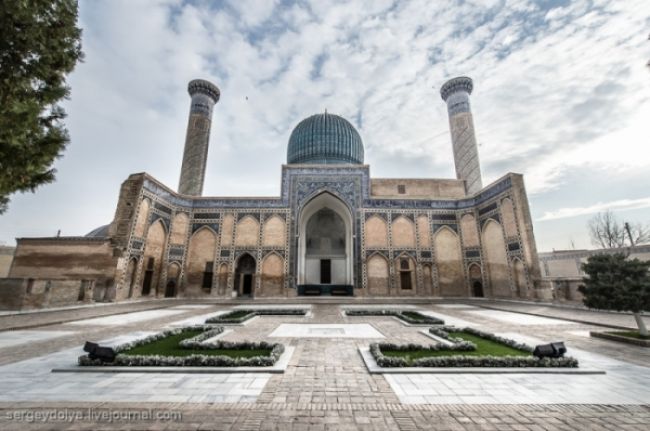
This is the Gur Emir Mausoleum, where Tamerlane and his relatives are buried.
Tamerlan is buried in the center, with Ulugbek, his sons, grandchildren, and his spiritual mentor beside him. Tamerlane was superstitious, and this was related to his only defeat in battle, which he attributed to magic.
但实际上, the real tomb is located one floor below and is locked.
This decision was taken because many visitors left messages like “Here was Vasily” on the walls.
This is the Registan. Once it was the religious center of Samarkand and the entire Middle East. There are many madrassas here, schools that combine spiritual and secular education. The oldest of them is, of course, the Ulugbek Madrasa.
I was allowed to climb up one of the minarets.
The stairs were extremely narrow and seemed to be about 40 centimeters high each step.
The view from the minaret was breathtaking.
Many people before me had tried to leave their mark on this place by writing their names or messages.
Some people even tried to make history by “writing their name into history” in such a way...
This is the golden mosque within the Tiila-Kori Madrasa in the center of the Registan.