Französische Herbstburgen
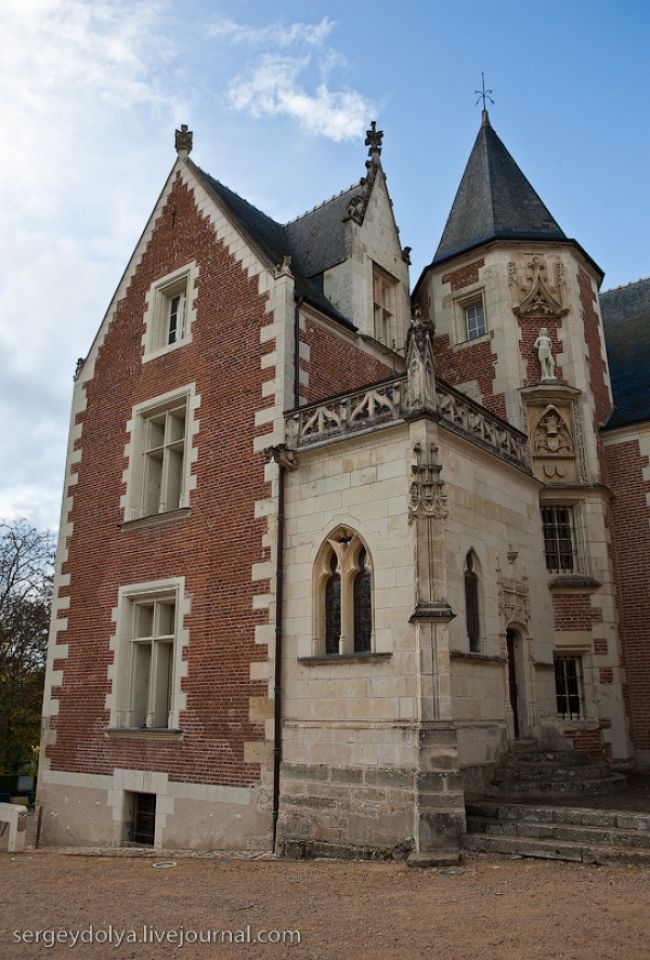
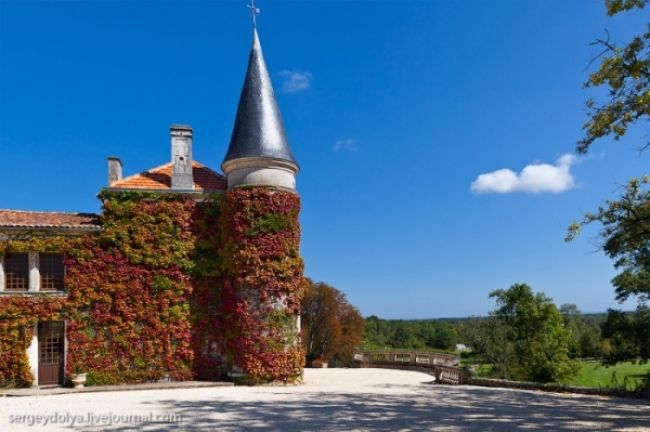
Early in the morning, while everyone was still asleep, I took a stroll around our castle-hotel:
The bench was quite wet, but I imagined knights from the 15th century sitting there with their ladies, enjoying the cool shade during the midday heat.
At 9:30, we all boarded the microbus and headed towards the royal castle of Chambord.
As is often the case, the welcome address in Russian was delivered with a mistake.
The path from the parking lot to the castle winds through rows of neatly planted trees.
Chambord was built by King Francis I in 1519.
Chambord is one of France’s largest castles. It boasts 77 staircases, 282 chimneys, and 426 rooms! The highlight is undoubtedly the double helical staircase designed by Leonardo da Vinci.
This staircase consists of two spiraling paths that surround a central core.
When two people climb it simultaneously, they can see each other through the openings in the structure, but they will never meet.
On the left, you can see the valet’s bed. One wonders what happened if the valet started snoring...
>In one of the halls, there is a collection of royal toys.
>Here, the wine undergoes a fermentation process that lasts around 9 months. During this time, sediment settles at the bottom of the bottles. To remove it, the bottles are turned four times a day for two weeks. Then, the bottle necks are immersed in liquid at -25 degrees Celsius for 10 minutes to freeze the sediment. After that, the residue is removed and sugar is added—10 grams per liter for dry wines and 20 grams for semi-sweet wines—to adjust their flavor. Finally, the bottles are sealed with new stoppers.
While exploring the caves, I saw several strange devices along with very old bottles.
The bedroom of King Henry II’s favorite mistress, Diane de Poitiers, is particularly interesting.
>The kitchen, with its gleaming knives and pots hanging on the walls, was especially eye-catching.
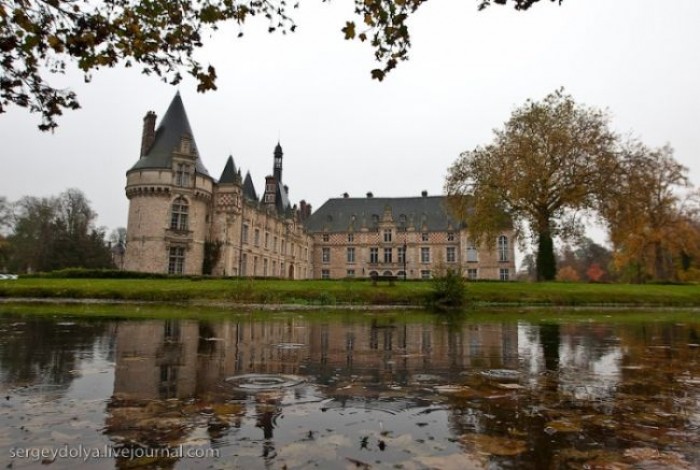
The photo captures this magical effect perfectly.