**Verschwundene Reihen**13 Fotos
**Vanished Row Houses**
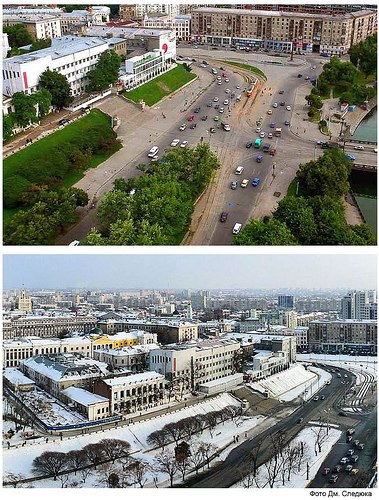
Approximately 100 years ago, this relatively small area between the river and the University Hill was one of the most bustling commercial districts in the city. It was once called Market Square. Later, in honor of Governor Sergey Kokoshkin’s contributions to the common good, it was renamed Sergeyevskaya Square.
Organized commerce replaced the informal trading activities that took place on Market Square, and this change was largely thanks to the well-established system of row houses along the streets. These row houses did not appear all at once; their construction spanned several decades. By the end of the 19th century, when the last one in this series – the Fruit Row House – was completed, there was no more available land for new constructions.
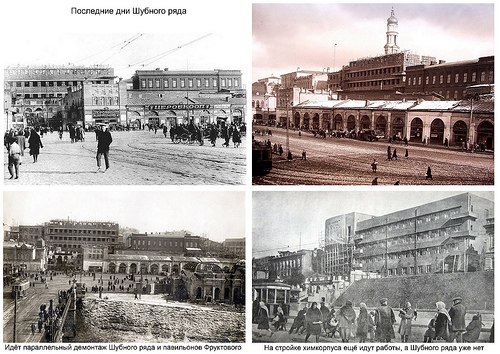
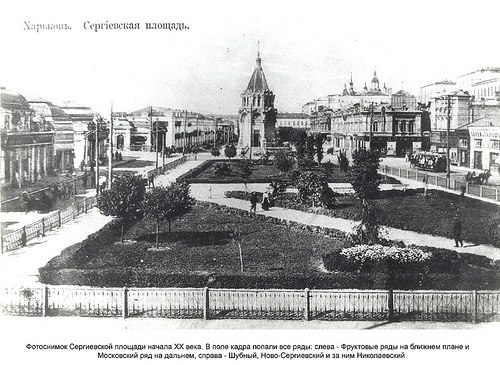
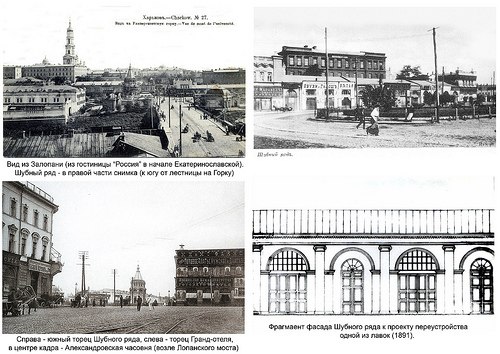
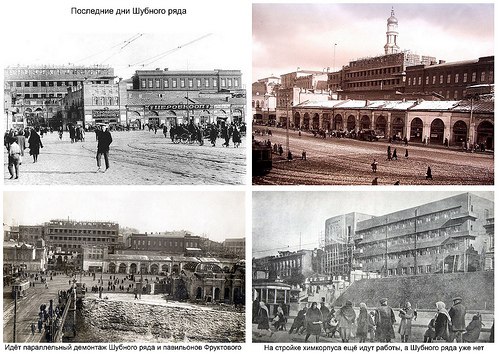
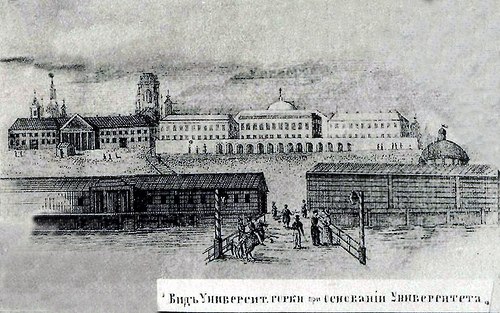
The first row house complex appeared on Market Square back in the late 18th century. It is depicted in the engraving “View of University Hill at the Time of the University’s Establishment.” This was the first stone-built row house complex in Kharkiv, named the Fur Row House. Designed by architect P.A. Yaroslavsky, it was demolished during the Soviet era, during the reconstruction of the square in the early 1930s.
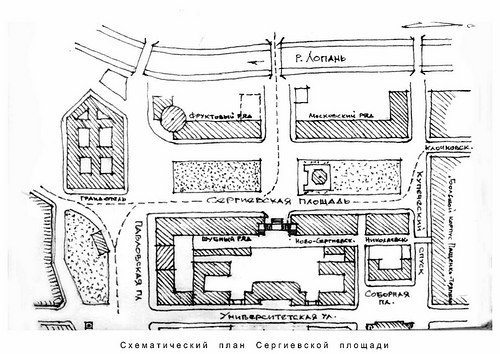
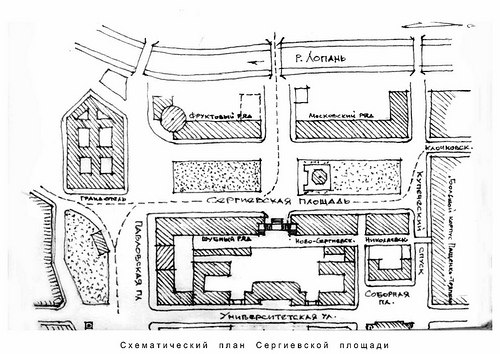
The layout of the Fur Row House complex on the square can be easily understood by looking at the schematic plan of Sergeyevskaya Square from the beginning of the 20th century. This plan reflects the appearance of the square at that time.
The final days of the Fur Row House complex were also the beginning days of the new university chemical building, which is visible in the background of many photographs from that period. The lower right photograph comes from the album “Kharkiv is Being Built,” published in 1931.
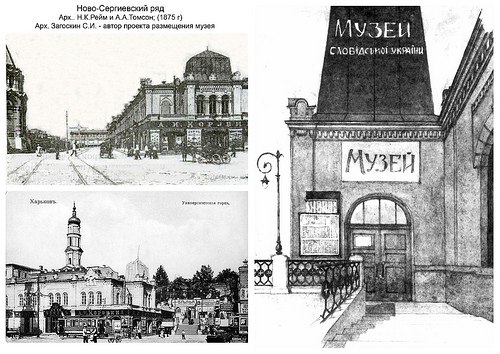
In the 1850s, the Sergeyevsky Row House complex was built beneath the hill near the Merchant’s Slope. In 1875, the Novo-Sergeevsky Row House complex appeared on the section of road between the staircase and the Sergeyevsky Row House complex. It was designed by architects N.K. Reim and A.A. Thomson; according to a decision by the city council on November 2, 1882, the second floor of this building was allocated for use as the city’s industrial and art museum. The museum opened on December 14, 1886 and became the second provincial public museum in Russia (after Saratov) and the first in Ukraine. Its facilities were located on the second floor, and the entrance was situated on one of the stairway landings. During the Soviet era, the museum was renamed the Museum of the History of Free Ukraine named after G.S. Skovoroda.
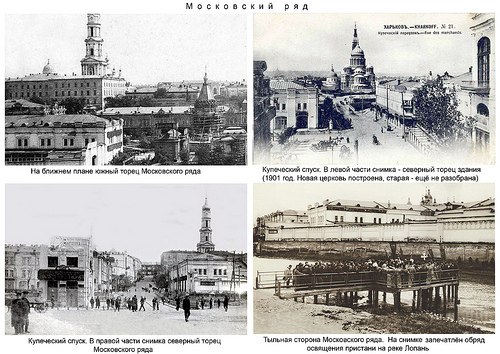
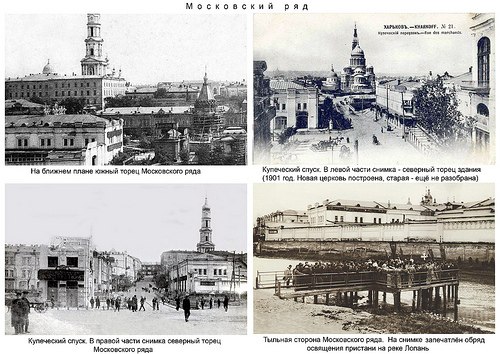
Around the same time, on the western side of the square, along the banks of the Lopan River, between the Merchant’s Bridge and the Lopan Bridge, the Moscow Row House complex was constructed. It was designed by architect B.S. Pokrovsky.
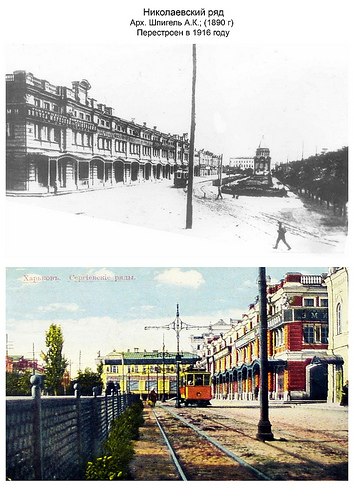
During the development of the square, unfortunately, some existing structures were also demolished. For example, the one-story brick shops in the Fur Row House complex were soon replaced by a new version of the same complex designed by architect P.A. Yaroslavsky. At the end of the century, a fire destroyed the Sergeyevsky Row House complex; in its place, the Nikolai Row House complex was built according to the plans of architect A.K. Shpigel. In 1899, four stone pavilions were constructed along the Lopan River between the Lopan Bridge and the Kontorsky Bridge.
Several names are mentioned in connection with the design of these row houses. Regarding this topic, E.V. Solovyov wrote on the Mediaport website “Myths about the Development of Kharkiv”: “Many websites, as well as printed materials, contain the misconception that the Fruit Row House complex on Sergeyevskaya Square was built in 1896–1898 according to the designs of architect A.N. Beketov. To correct this historical inaccuracy, it should be noted that the construction actually took place in 1898–1899, and the true authors of the project are architects M.I. Dashkevich and M.S. Komornitsky.”
A.N. Beketov was indeed involved in this project; his design was approved in June 1896. The initial cost estimate for the construction was 60,000 rubles, and the buildings were intended to be wooden structures on stone foundations. Brick materials had already been purchased, but after the existing wooden structures were demolished, the plans for this area of the square were changed – the idea of creating a square garden and moving the row houses closer to the river emerged. At a meeting of the city council on October 4, 1896, it was decided to form a special committee to develop a new design. Subsequent design work was carried out by M.I. Dashkevich, who prepared two versions of the project in 1897, costing 91,000 and 119,700 rubles respectively. The second version was ultimately chosen for implementation. In 1898, Dashkevich made further adjustments to the design, moving the entire complex closer to the river. Construction began in that same year. The work was supervised by architect Mechislav Silvestrovich Komornitsky, who made numerous on-site adjustments during the construction process, which were approved by the city council on September 15, 1988. The inauguration of the completed building took place in September 1899, as mentioned in the “Kharkiv Governor’s Gazette” on September 13, 1989.
From an economic perspective, the Fruit Row House complex was not particularly successful. For example, the corner pavilion near the Kontorsky Bridge remained unused for a long time, and its basements were constantly damp.
It is worth noting that A.N. Beketov’s initial design plan likely had a significant influence on the final appearance of the building, but this can only be confirmed by examining his original designs if they still exist.
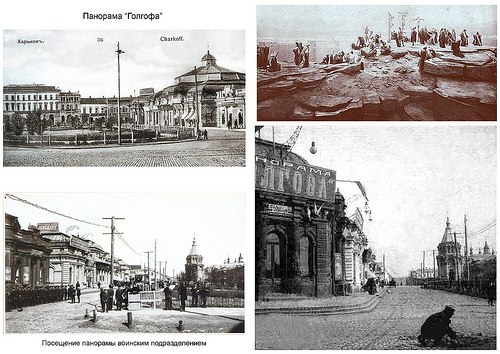
Finally, there was one more structure that appeared on the square during those years – although it was not intended for commercial use. It was a pavilion built in 1908 for the “Golgotha” panorama. The authorship of this pavilion is also sometimes attributed to A.N. Beketov, but there is no documentary evidence to support this claim.
By the time the “Golgotha” panorama arrived in Kharkiv, its various versions had already been displayed in European countries for over 20 years. The “Our” version of this panorama spent nearly a year and a half in Kiev before being transported to Odessa and then installed in Kharkiv in 1908. Just as it had happened in Kiev, initial interest faded after the first few months, and soon the commercial operation of this attraction faced financial difficulties. Consequently, the Kharkiv authorities, since the pavilion was owned by the city, decided to follow the example of other cities and invite another panorama to operate there. There was no shortage of candidates available.
“In a special building for panoramas on Sergeyevskaya Square, a new enormous painting by the famous Polish artist Jan Styka entitled ‘The Martyrdom of Christians in Nero’s Circus’ will be displayed. This painting is part of the illustrations for Sienkiewicz’s famous novel ‘Quo Vadis’. Jan Styka’s panorama is not only an outstanding work of art but also a valuable historical document – it provides a vivid depiction of an entire era that left such a profound impact on human history. The impact of this painting is immense, both in terms of its dramatic intensity and the artistic quality of its execution. The scene depicted is the crucifixion of Apostle Peter in 68 AD, when Nero’s brutality reached its extreme. The setting is the Vatican Circus. Apostle Peter appears on the opposite side of the arena, leading his followers. In the Caesar’s Loge are various historical figures, such as Burrus, Senecion, Petronius; and in a separate gallery, above the area where the Roman beauties pose for the artist, there are representatives of Poland’s theatrical arts and the literary giants Henryk Sienkiewicz and Maria Modrzejewska, who inspired Styka to create this masterpiece. This panorama was exhibited abroad before being shown in the capitals of Warsaw and Odessa, where it achieved tremendous success. The extraordinary talent of its creator is evident in every aspect of this remarkable work of modern art.”
——《Southern Edge》 magazine, March 8, 1909
Two years later:
“The enormous ‘Golgotha’ building, which has been vacant for two years, has been rented by a local engineering company for a period of 10 years. They plan to install a large skating rink inside it, similar to those seen abroad.”
——《Kharkiv News》 newspaper, January 16, 1911
However, in 1915, the pavilion was converted into a cinema called “Mayak” and continued to serve in this role even after the revolution.
Under the new regime, the commercial row house complexes did not have a long lifespan. It had already been mentioned earlier that the Shubny Row House complex and the Fruit Row House complexes were demolished during the reconstruction of the central areas of the city in the 1920s and 1930s. After the war, it was decided not to rebuild the remaining row house complexes either – the Novo-Sergeevsky, Moscow, and Nikolai Row Houses.
Source: ngeorgij.livejournal.com
#1stolica_history
Finden Sie die besten Fachleute für Ihr Projekt
Reparatur-, Bau- und Renovierungsspezialisten stehen Ihnen jetzt zur Verfügung
Empfohlene Galerien
Empfohlene Artikel



Mehr Galerien
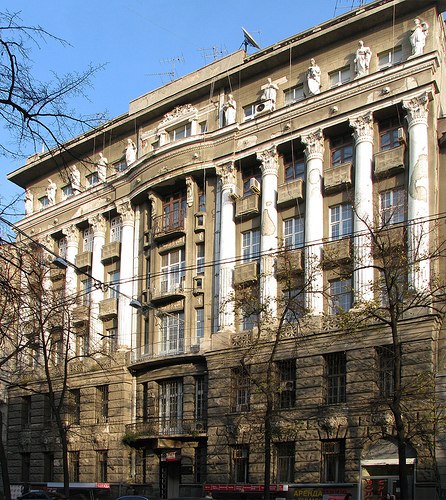 Umschlagstraße Sumskaja, 82. Ehemaliges Mietshaus von Moschkewitsch (1914).<br>(Stil: Neorenaissance.)
 Auf dem Gebiet der Bildung
 Geschichte eines Hauses in der Sumskaja-Straße 14 --- Return ONLY the complete translated text. No additional elements shall be added.
 Kiew in den Jahren der Besatzung.
 Улица Октябрьской Револutionи, Haus Nr. 20 --- Return ONLY the translated text. No additional elements shall be added.
 Конторская – der Schutzgebiet des alten Charkiw<br>(Wie Zalopan’ aus einem ländlichen Gebiet<br>zu einem prestigeträchtigen Geschäftsviertel wurde.)
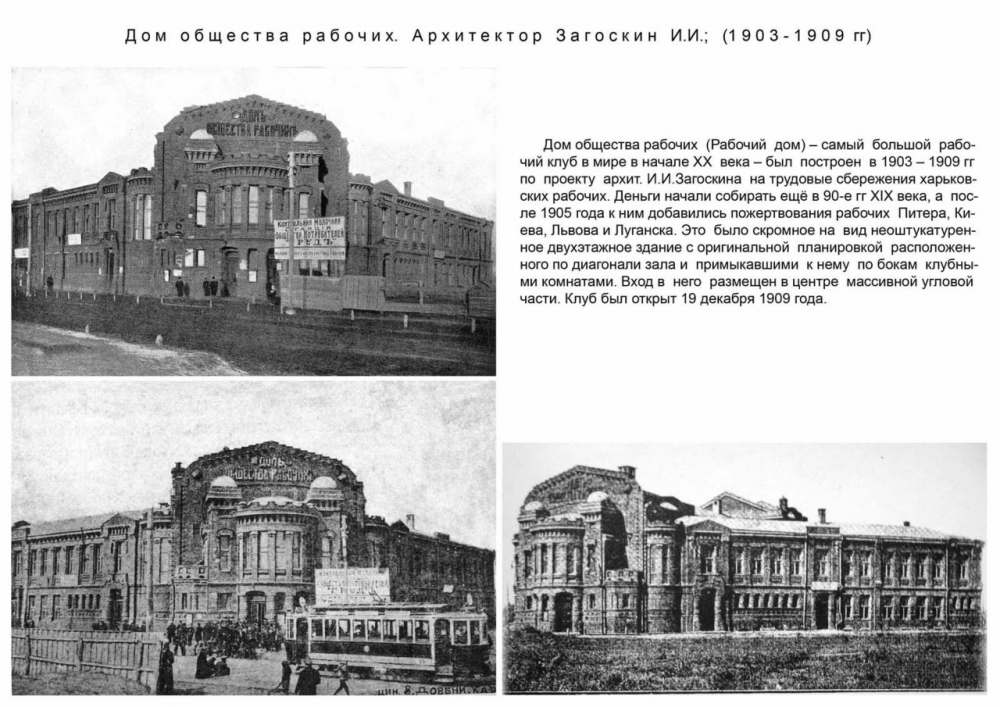 „Haus der Arbeitergesellschaft“
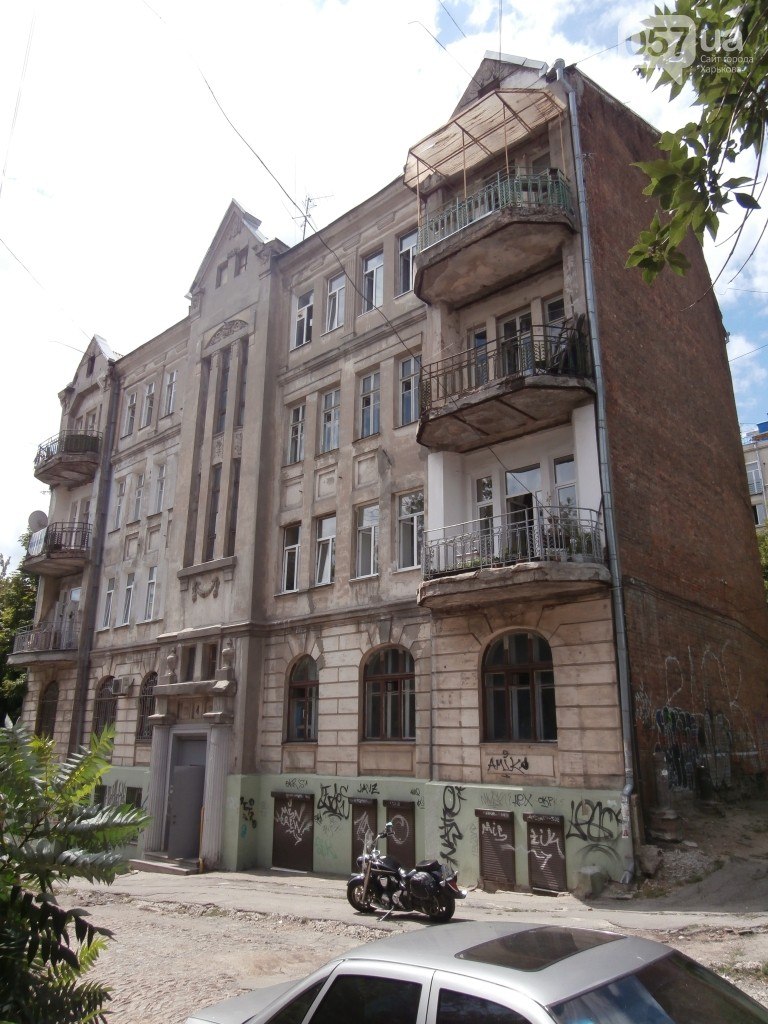 **Haus mit Mini-Gefängnis – das „beteiligte“ Gebäude<br>(Übersetzung von Worobjewa, Teil 2)**
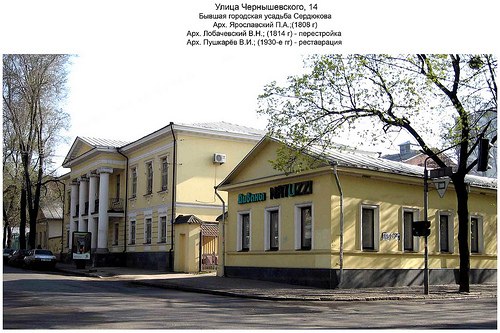 assistant
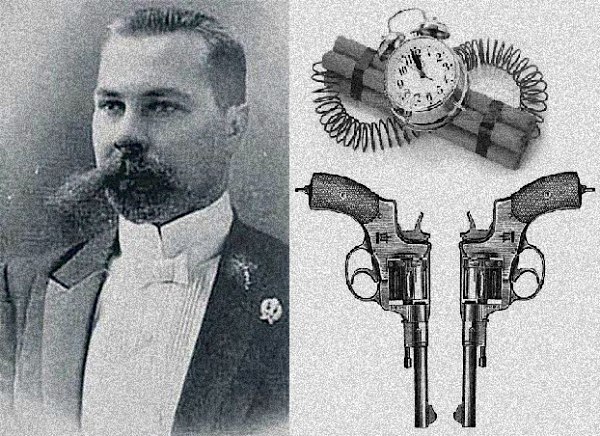 „Die Verteidigung der Ukraine“ und Nikolai Michnovsky
 Öffnung der Märkte
 Bedeutung der Pronomen