Dialogue with nature: Hundertwasser's biomorphic house in Vienna
Conservative residents of Vienna consider this house a tawdry avant-garde kitsch, others, on the contrary, admire the genius and boldness of the architect Hundertwasser, who embodied his ideas among classical residential buildings about ecological compatibility and inalienable human right to individuality, non-admission of imposed norms and freedom of expression.

"First of all, you need to abandon the whole set of rules. These rules, laws and regulations created at other times in other conditions for the benefit and protection of people, now in the light of new requirements and restrictions are directed against the environment and man. Without an environment suitable for human needs, and without harmony with nature, our existence is simply impossible. Peaceful interaction with nature is worth starting in the near future, before it's too late. With authoritarian control and self-discipline, it will be able to work for some time more or less, as it may end. But then the body and soul will protest, and we do not know why. This house is created to serve as the first attempt to conduct a dialogue with nature, a dialogue in which we and nature are equal partners; one side does not hold superiority over the second. "
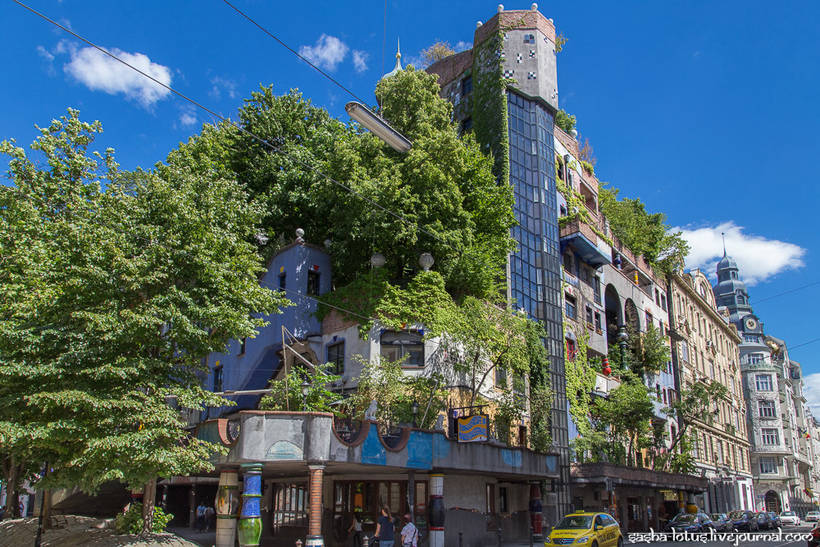
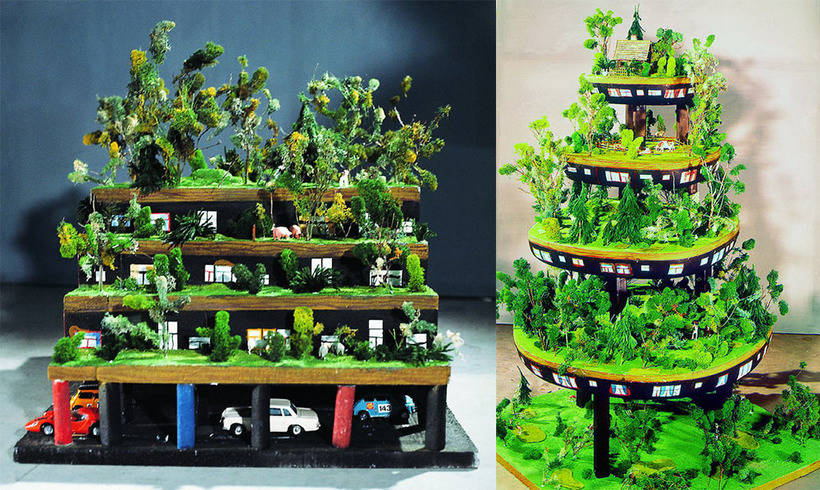
Photo: hundertwasser-haus.info
At the end of 1977, the Austrian Federal Chancellor, in a letter to the Mayor of Vienna, Leopold Gratz, suggested allowing the Hundertwasser to realize his ideas in the field of architecture and allow to design and build a residential building. Development of the concept took several years, and since Hundertwasser was not a certified architect, he asked the city council to find a professional who would be interested to transfer his drafts to the format of drawings and technical documentation. The authorities of Vienna attracted Josef Kravin, later he was replaced by Peter Pelikan, which resulted in a long cooperation in subsequent projects.

Photo: Friedensreich Hundertwasser and Mayor of Vienna Leopold Gratz at the presentation of the model of the house (hundertwasser-haus.info)
In addition to concern for nature, the architect was concerned about freedom and the uniqueness of man, he even in when thou walked in different socks, being an opponent of common standards, rules and uniformity. Hundertwasser believed that monotonous house-boxes, typical layouts and the lack of possibility to change anything in the external appearance of their home are detrimental to mental health. That is why in his house all apartments have unique layouts, there are one and two-storey apartments with loggias, balconies and canopies pergolas that do not repeat each other. Having lost almost all his relatives during the Second World War and the persecution of Jews by the Nazis, Hundertwasser often compares standard apartments with concentration camps in his statements.
"External walls of modern buildings - walls of our prisons, they are faceless, emotionless, aggressive, heartless, cold and bored to empty. These are the characteristics of prison walls that suppress human freedom, behind which the inhabitants of the concentration camps crowd ... Architects are now building prison cells where the human soul is being destroyed. Today we are witnessing the triumph of rational technologies and at the same time we are faced with an emptiness that does not exist. Aesthetic emptiness, a desert of uniformity, murderous sterility and creative impotence. "
"A man in a rented apartment should be able to lean out of the window and scrape off a stone how far will it reach. He should be allowed to take a long brush and draw something on the facade, so that it can be seen from a distance from the street. For passers-by to understand that outside the window there is not an ordinary man living, but different from his captured, enslaved and standardized neighbors. "
" Some people say that houses consist of walls. I would say that houses consist of windows. When different buildings line up one after another on the street, when everyone has a different style of windows, that is, they belong to different races, for example, an Art Nouveau house with Art Nouveau windows adjoins a modern building and its ordinary-looking square windows, and then there is a baroque house with baroque windows, all without a difference. And if all three types of windows could be seen on the same building? This would be regarded as a violation of the racial division of windows. Why? Every window has its right to life. Repetition of identical windows one after another in a line and one above the other, as in a grid is a feature of concentration camps. Windows, burdened with a clear position and order, are sad, but they would like to dance. "
"A person has three layers of skin: his own, his clothes and his home. All three layers must regenerate, grow and change. However, when the third layer, that is, the outer wall of the house, does not change and does not grow like the first layer, this layer dies off. "
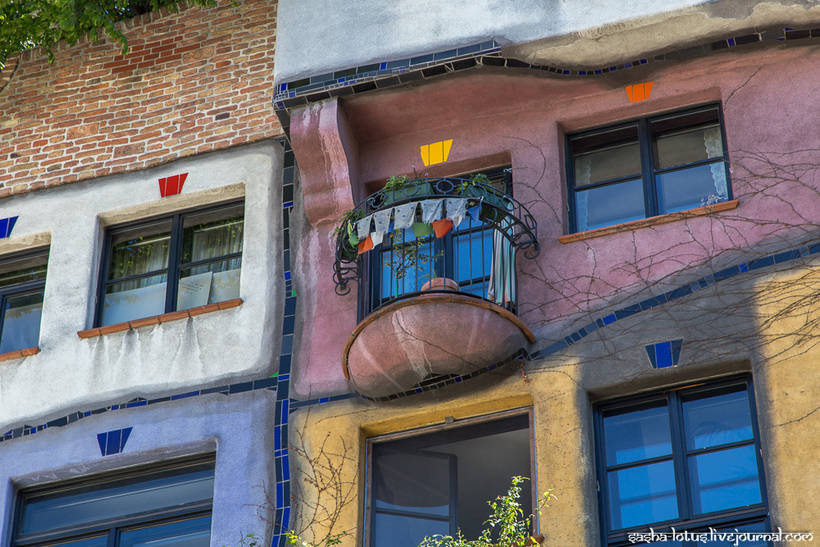
"Fundamental significance is the individual organic design of the external wall of the building for each apartment, so that its owner identifies himself with his house already outside. My non-conforming design of the exterior of apartments is not protected from changes, like historical monuments of architecture, but it should be regarded as a harbinger of the "window freedom" of each individual. "
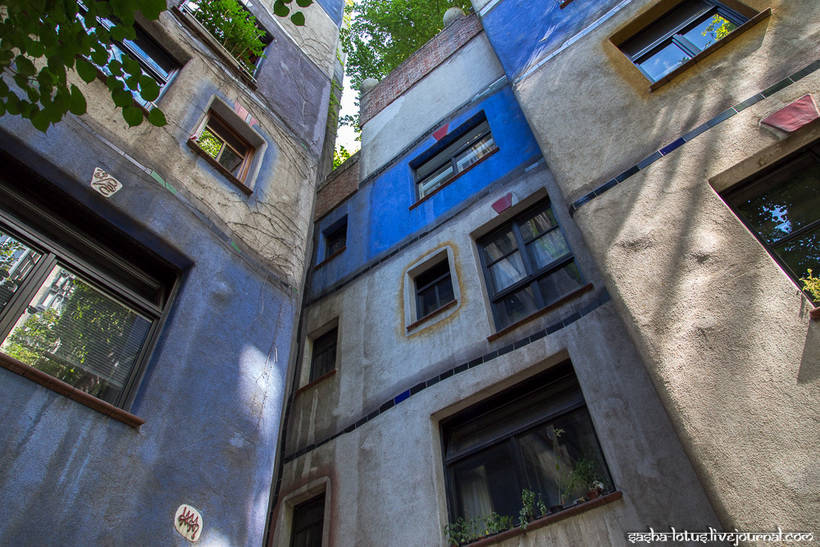 " If, for example, vertical streaks from rain or streaks of rust, or even dirty spots enliven the facade or create some form on it, all such improvements are welcomed. A lot of homeless people slept inside the house, anonymous "artists" scratched and dirty the walls. Traces of such illegal actions have the right to remain, as well as nests of swallows and other birds, trees and grass growing in places where it was not originally planned. Impressions of the hands of bricklayers on wet plaster should be left, like any other decorative detail, someone once left on the facade of the house or inside it. "

After renting the house, the tenants were not allowed to be immediately populated so that they did not interfere with the natural growth of plants and shrubs on organized terraces. Within a year, trees, bushes, grass and house became a single whole. To create 14 large terraces and many small gardens, it was necessary to raise 900 tons of land to a building with a hilly floor. Hundertwasser believed that from a bird's eye view the house should remain invisible under the tree crowns.
"The hanging gardens of the Semiramis in Babylon were most likely terraces with greenery. Terraces are not hidden in the backyard, and those going to the streets are a gift for all people, not only for those who live behind their protective layer, but also for those who may never rise on them. External terraces erase the vertical aggressiveness of buildings, the level of street noise is reduced, as the echo no longer spreads between rows of buildings. If the trees grow on the terraces, the house resembles a natural hill on which people live. Walking around the city with open terraces on the facades of buildings can well be compared to traveling through the green valley. "

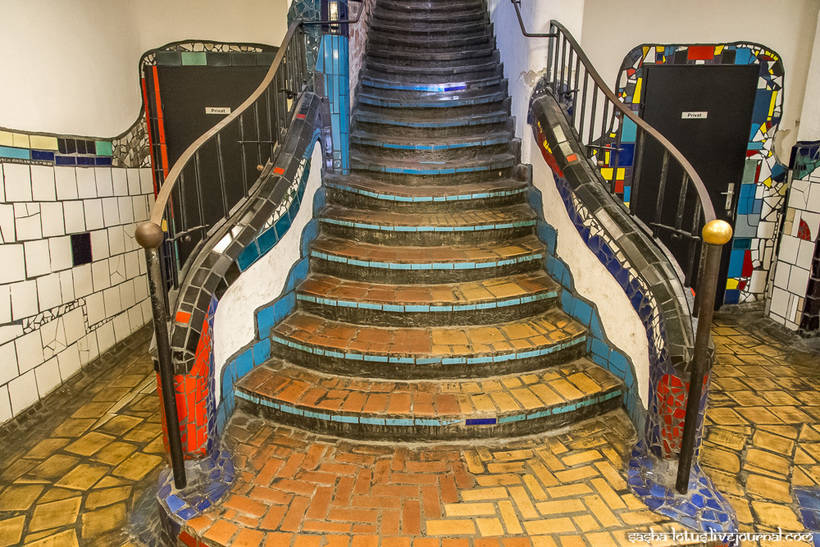
The way to decorate the apartments at home is allowed by the ladder leading to the toilet. The entrance is paid, but the overall style can be fully understood on the hall. Because of the use of mosaic and broken tiles, Hundertwasser is often compared to Antonio Gaudi.
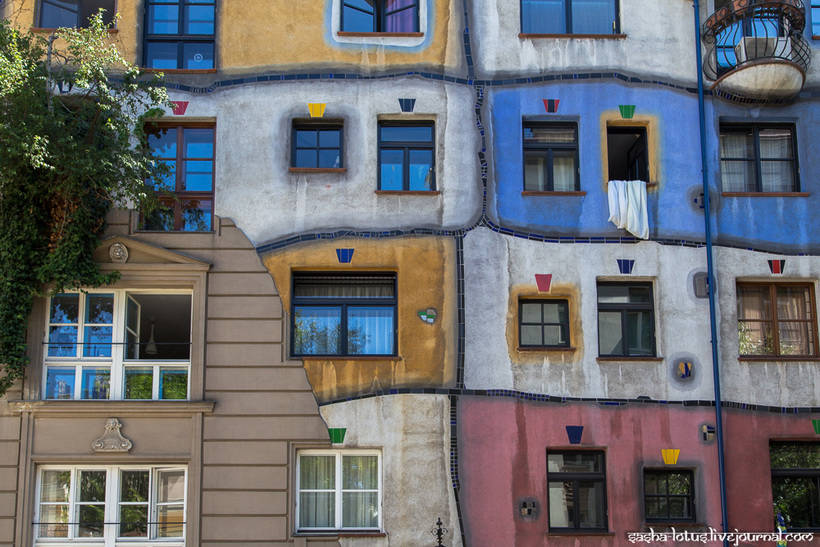
A genius or a madman? Some ideas of Friedensreich Hundertwasser and after 30 years look utopian. Do not just break the garden or the garden next to the house, but actually make the trees your neighbors. Allow tenants to paint facades. It is hard to imagine that such principles will ever be adopted on a global scale. It is much cheaper and easier to build residential buildings-boxes for basic projects, to sell standard apartments to standardized people.
"Sterile cleanliness, regulation and equalization policy, forced uniformity and monoculture all manifestations bear not only death to all forms of life, but also are a symptom of the degradation of our civilization. "
The Austrian architect-rebel did not stop at home in Vienna's III district. It is worth to go and see the exterior of the waste incinerator plant in the north of the city.
Find the Best Professionals for Your Project
Expert repair, construction, and renovation specialists ready to help you right now
Recommended articles
More articles:
 How the famous places of the world have changed since the time when the photo was black and white
 10 fantastic photos of Tokyo that return love to life and travel
 The most intelligent beauties of Hollywood
 30 beach images-2017
 19 most exciting cinemas from around the world
 10 countries from which it is better to stay away in the summer
 Interesting facts about the Sphinx, which are not in history textbooks
 The best roles of Benedict Cumberbatch