Some scientists consider the homeland of tea Vietnam, others - China. Definitely, in the culture of China tea occupies a special, honorable place. It is drunk without sugar and milk, while preferring green. Three large provinces are engaged in the cultivation of tea bushes, and now China supplies one-fourth of all tea in the world.
The green seas of Chinese plantations, where they produce a quarter of all tea in the world

One of the smallest provinces of Zhejiang is almost completely covered with mountains, which is why it is of little use for anything. There are tea plantations on numerous hills.

During World War II plantations declined and were restored only after the 1950s.

Soil, subtropical climate - everything here is ideal for maturing tea leaves.

Zhejiang Province produces mainly green long leaf teas. Famous tea varieties Maofeng, Huantang, Chaocin, Meicha and others, are produced here. King of green baihovyh teas, Longjing, also grows here.
There are often tourists on tea plantations, if only because here beautiful and atmospheric. Infinite tea plantations seem to be created for contemplation and meditation, in them the spirit of God.

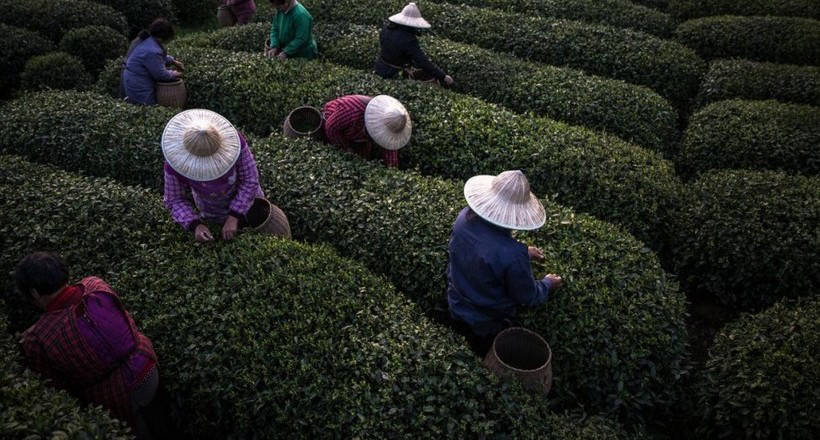
Tea plantations look like green waves. This impression is created because the bushes are planted almost without gaps and are specially trimmed at the sides so that the collectors can collect the leaves from above as from a table.
 In the season of gathering tea leaves on the plantation temporary workers come. h2>

At the base they are women, and their labor is not easy. Special houses are built for "seasoners", where they eat and sleep.

The way of cultivation, collection and processing of tea leaves has not changed since time immemorial.
First, the leaves are steamed to prevent further unwanted fermentation. Then the tea is laid out in small piles and dried for about 10 hours.

Tea leaves dry and curl, acquiring a certain shape and size. After that, they are sorted.

There is a legend that in the highlands of China there are several "Sacred Gardens", such secret plantations, where a special tea for senior officials is collected. There are no visitors allowed, and the perimeter is guarded with dogs.
Production cooperatives are engaged in production of tea for ordinary mortals. They make standard tea by mixing different leaves.

In Japan, these operations are mechanized, and in China it is done by human hands.

To start understanding tea, it is not enough to try different varieties. They just mix like glass in a kaleidoscope. A real tea specialist should drink a lot of tea, different tea, and only then he can choose and evaluate the tastes of taste.
A real Chinaman to tea selection is responsible. Regular exhibitions are held where you can try a new crop of tea and choose something to taste.