Is it really important that the science fiction film is "from" and "before" accurate and believable? Rather no, than yes - and a multimillion army of fans of the genre will confirm this.
10 most scientifically accurate science fiction films
However, it is through attentive attention to detail that you can create a truly "futuristic" cosmic atmosphere and allow the viewer to literally dive in what is happening on the screen (and sometimes pull up their knowledge of some kind of exobiology). In our collection - 10 films, which, according to experts, are closest to the title of "the most scientifically accurate."
"The Day the Earth Stood" (1951)

A shot from the film "The Day the Earth Stood Still" (1951)
And although ufology is (according to most scholars) pseudoscience, the tape "The Day the Earth Stood Still", filmed after the famous Roswell incident 1947, scientists find in some moments very plausible. For example, according to some representatives of NASA, if the alien form of life exists and with something suddenly decides to make contact with earthlings, then, most likely, only to warn that people destroy themselves and their priceless planet. Also, experts considered it quite possible the idea of creating "a substance that will be able, like living tissue, to heal its damage, leaving behind a solid surface." The perspective of the "streamlined" design of the flying saucer created by the architect-innovator Frank Lloyd Wright was also noted.
"The Space Odyssey of 2001" (1968)

Shot from the film "Space Odyssey 2001 year "
The film, shot by Stanley Kubrick in 1968, still looks like it came out yesterday (do I have to say what a sensation the" Space Odyssey "made on its contemporaries?). Kubrick, who was famous for his cautiousness and meticulousness, spent much time studying all the "space" materials available to him and consulted with specialists from the United States and Great Britain. (There is nothing definite about Soviet advisers, but there are also such theories.) According to the memoirs of the filmmakers, if someone suggested Kubrick "a little fantasy", he immediately declared that "science has no place for fantasy" and insisted on the maximum realism and technical accuracy, even if it was difficult to integrate. Specialists from NASA participated in the creation of the interior of the spacecraft and even wrote a whole 500-page "reference" on what could be the "artificial intelligence" of HAL and how people of the future will interact with "smart machines."
" Strain of Andromeda »(1971)
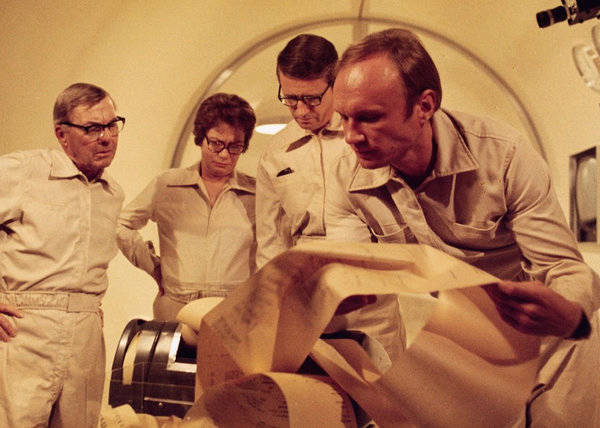
A shot from the film "Andromeda Strain" p>
If the realism of the "Jurassic" novels of Michael Crichton, scientists still do not have a single opinion (by the way, the film "Jurassic Park" by Steven Spielberg NASA also considers "scientifically accurate"), here's the "Andromeda Strain" and his screen version of Robert Wise opinions converge: this is quite real. The tape tells how, due to a fatal accident, microorganisms from space came to Earth, because of which a large-scale epidemic began, looks, from the scientists' point of view, plausible, as well as the methods of struggle against them. The only thing, the experts noted, is that hardly any cosmic strain can really process nuclear energy (and if suddenly such one shows up, they would like to look at it), so scientists agree with the ribbon in general terms.
"Gattaca" (1994)
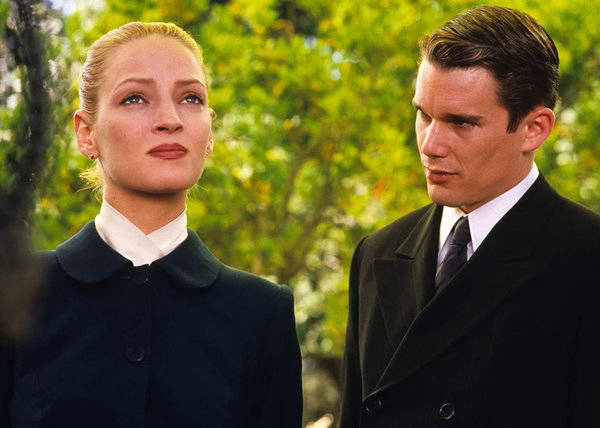
A shot from the film" Gattak "
In 2011, NASA experts named the tape "Gattak" (1994) Andrew Nikkola one of the most reliable in the scientific sense, because almost all genetic theories and technologies are quite plausible and can "happen" in the near future. Already now, in 2017, scientists with special procedures can not only know in advance which hereditary diseases a child of one or another pair will predispose, but also with the help of complex manipulations (including the use of laser technologies) to "choose" the sex of the embryo, thus planning a boy or girl. While it is difficult to say how far the modern society is before eugenics and whether we are threatened with "genetic separation" with all the ensuing consequences, but looking back at history, if such an opportunity arises, humanity will still come to these "rakes".
"Apollo 13" (1995)
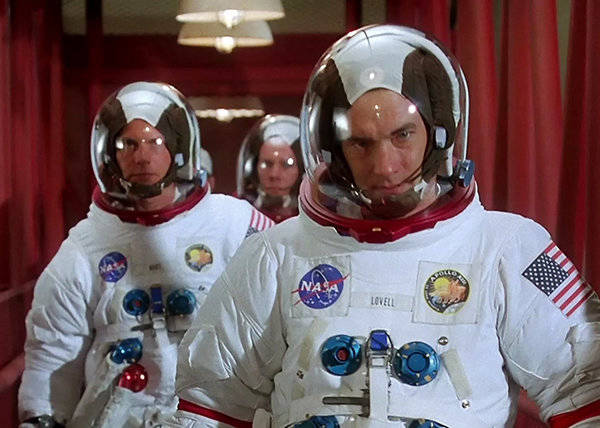
A still from the movie "Apollo 13" The Ron Howard film, which tells of the unsuccessful lunar mission of the Apollo 13 spacecraft, pays much attention to scientific and technical aspects, due to which sometimes the audience may feel that they are shown a documentary tape. "Space" drill in full program were the performers of the main roles (including Tom Hanks) - they were taught not only the basics of astrophysics, but also the management of spacecraft (on models, of course). It is curious that those scenes on the ship that "took place" in zero gravity were lifted in conditions of real weightlessness - for this NASA provided the crew with its airplane-laboratory, which flew along a parabolic trajectory (kabirirovanie-leveling-dive). Also inside the aircraft were two close cabs, exactly recreating the interior spaces of the Apollo.
"Contact" (1997)
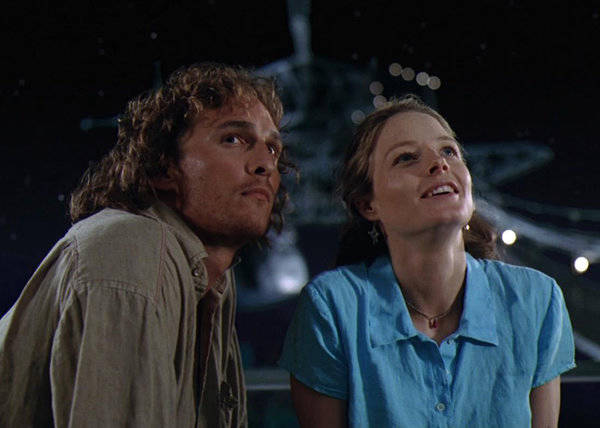
Shot from the movie "Contact"
Robert Zemeckis' "Contact" was based on the eponymous novel by the famous American astrophysicist and exobiologist Karl Sagan, who devoted most of his life to the study of outer space and the search for "traces" of extraterrestrial life. In the novel "Contact" Sagan tried to imagine how the people themselves would react to the news about the first contact with extraterrestrial intelligence in the history of mankind, and not only "official" persons, like scientists and officials, but also ordinary citizens. Zemeckis made sure that every detail related to the alien cipher and the work of telescopes was shown as accurately as possible. Impressive and dialogues in the tape, which for the sake of authenticity are saturated with the most intricate scientific terms, but, nevertheless, remain understandable and even emotional. As for the "eternal" conflict between science and religion, "Contact" shows that these two paths can "live together."
"Confrontation with the Abyss" (1998)
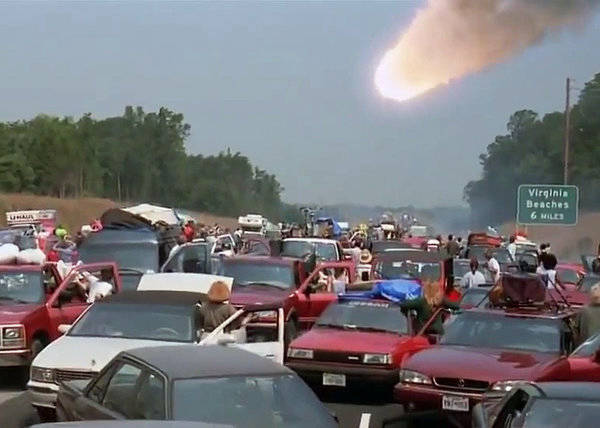
Shot from the film "Collision with the Abyss"
One of those catastrophe films, which were enthusiastically accepted by scientists, not critics. "Confrontation with the abyss" Mimi Leder talks about a huge comet that approaches the Earth and threatens the planet if not complete destruction, then the death of all living things for sure. In the tape, the physics of the asteroid is very accurately shown, and the methods by which it is possible to destroy the comet are also thought out and theoretically feasible in practice (if absolutely necessary). However, NASA scientists, commenting on the "scientific research" displayed in the "Collision with the abyss", remained true to themselves and stated that the first and main "reliability" of this film is ... that a comet can really fall to Earth. In a specific sense of humor, these guys will definitely not refuse.
"Special Opinion" (2002)
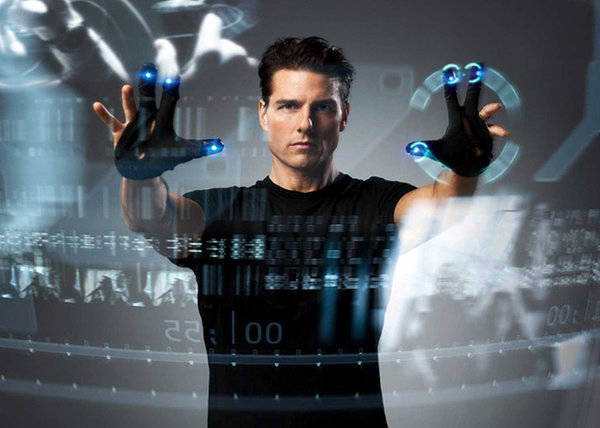
A shot from the film "The Special Opinion" p>
It's not that Steven Spielberg's movie about "prophetic policemen" was any plausible in the eyes of scientists, but as for the technology of the future, it's almost flawless. Cars with the "autopilot" system, holographic operating systems, devices for scanning the retina of the eye and so on, and so on - some of it already now exists, and the rest, perhaps, will be tomorrow. However, with regard to the system of "prediction" of crimes, some scientists make cautious assumptions that with the development of psychiatry it will be possible to calculate potential repeat offenders among the convicted and take timely measures in time. Others, however, see the future of security exclusively in the development of a network of security cameras.
"The Moon 2112" (2009)
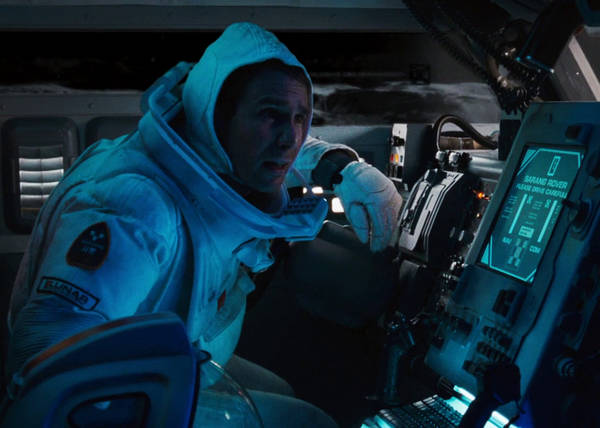
A shot from the movie" The Moon 2112 "
You can try with some scientific theory to find out why the movie "The Moon 2112" is still so underestimated. Duncan Jones' tape, which tells of the distant future of mankind, where mining is already happening on the Moon, concentrates on what happens to a man who has been alone for a long time alone with a robot named GERTY. The very idea that the extraction of helium-3 occurs on the Moon can well be realized in the future, because under the surface of the satellite there are indeed significant reserves of this gas. As for the lunar station itself, harvesters, robots and lunar rovers, then at their creation the crew consulted with space engineers and robotics, and was inspired by the designs of various real spacecraft. When Jones showed "Moon 2112" to specialists from NASA, they, oddly enough, asked only one question: "Why is the production of helium-3 on the reverse side of the moon, if there is more in the visible part of helium-3?" Later, the director said that according to his information received from consultants, the production of helium-3 on the visible side of the Moon could affect the role of the Moon on Earth (tides, for example).
Europe (2013)
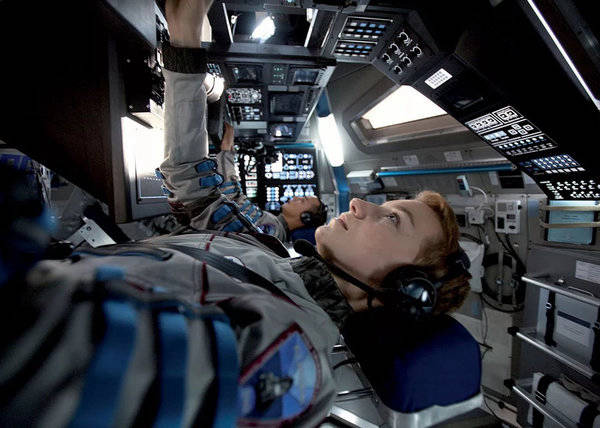
A shot from the movie "Europe"
The sci-fi tape "Europe" (which, as you might guess, occurs on the satellite of Jupiter Europe), shot in a pseudo-documentary style (the format of the film found), tells about an expedition during which an international group of scientists discovers an aggressive extraterrestrial life . Critics noted that "Europe" "returns faith in science fiction", and scientists, in turn, admired realistic images of the cosmos and of Europe itself (although the appearance of the "alien" caused controversy). Actors who starred in the film, studied real video from the ISS and space launches. The spacecraft itself, although it looks naturalistic, was actually drawn using computer graphics (although the real model was built for the flooding scene). Weightlessness because of the limited budget was simulated in the simplest way - with balls and hanging actors and items on cables.
"The Martian" (2015)

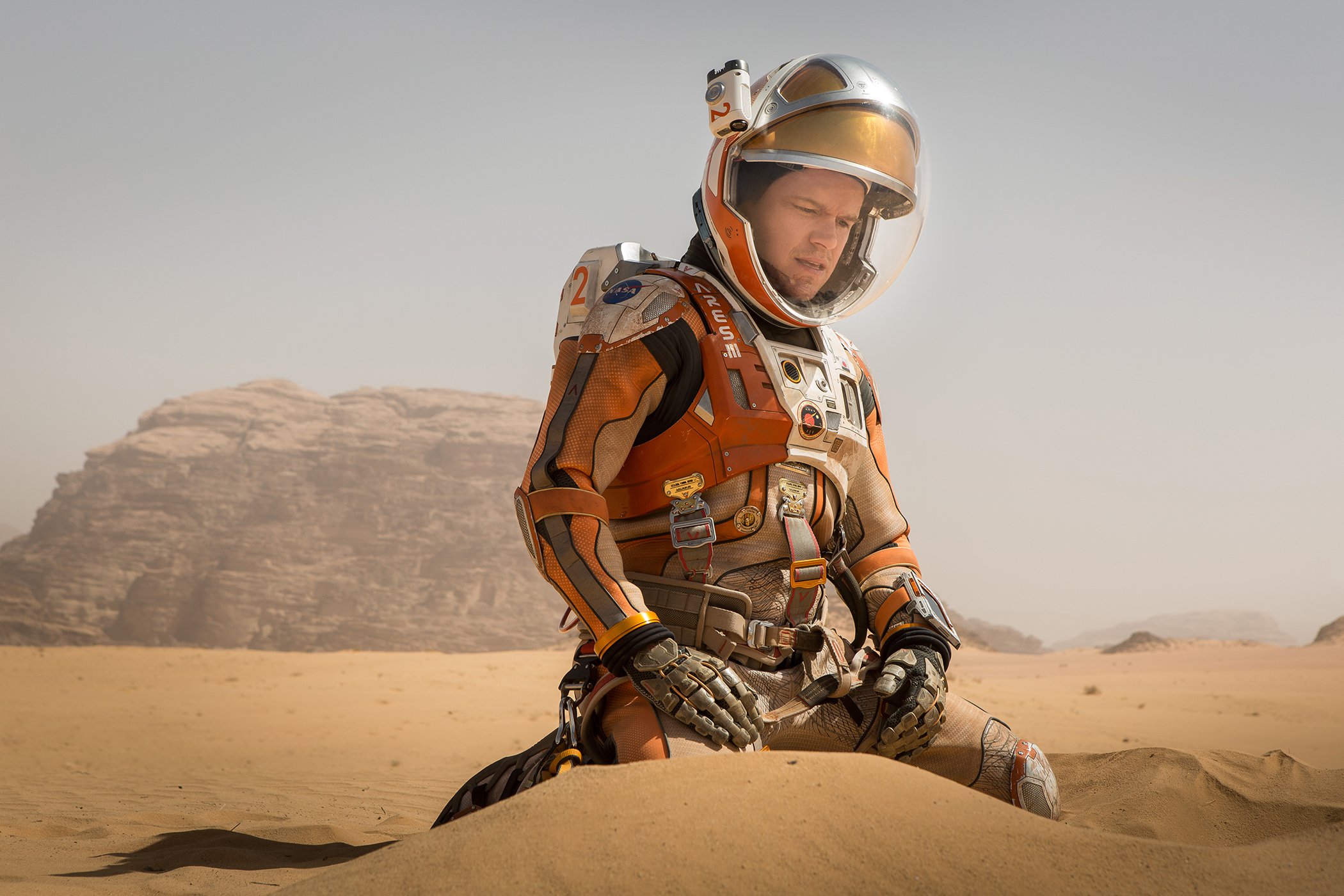
Shot from the movie "The Martian"
When writing the novel "The Martian", the science fiction writer Andy Weir consulted various scientists, and Ridley Scott, when on screening, also invited James L. Greene, Director of the Department of Planetary Science, NASA's Scientific Mission Department, as advisor. So, no matter which side you look at, the "Martian" is one of the most scientifically accurate films at the moment, where it's almost impossible to find fault with either the way space technology is shown or how astronauts "use" the really existing and potentially possible space science. As for the dust storm, which can not be so destructive, Andy Weir admitted that he deliberately made such an inaccuracy, because this was the most convenient way to push the foreheads of man and nature.
The best in terms of reliability of science - Fantastic films according to NASA (as of 2011):
- "Gattak" (1997)
- "Contact" (1997)
- "Metropolis" (1927)
- "The Day the Earth Stood Still" (1951)
- "Woman on the Moon" (1929)
- "Something from a Different World "(1951)
- " Jurassic Park "(1993)
The worst in terms of dos (in 2011):
- "2012" (2009)
- "The Earth's core" (2003)
- Armageddon (1993)
- The Vulcan (1997)
- The Chain Reaction (1996)
- The Sixth Day (2000)
- Covered in mystery (2004)