Diving - a favorite pastime of many tourists visiting the Red Sea. Coral reefs beckon with their iridescent colors and exotic inhabitants, some of which may not be as friendly as they seem at first glance. Let's look at the most common dangerous creatures that live in the Red Sea and can meet you on underwater walks.
What dangers await inattentive divers in the coral reefs of the Red Sea
Diving - a favorite pastime of many tourists visiting the Red Sea. Coral reefs beckon with their iridescent colors and exotic inhabitants, some of which may not be as friendly as they seem at first glance.
Fish Surgeon

These lovely fish live in many aquariums, but in the wild with them it is better not to meet. Despite the small size, fish surgeons are dangerous predators and can even attack a person. They have sharp fin-like fins, hence their name. In addition, the fins are provided with poison, so dangerous that contact with them can lead to serious injuries. Inexperienced divers can accept the aggressive behavior of these fish for an innocuous game and not even suspect how dangerous creatures swim around them.
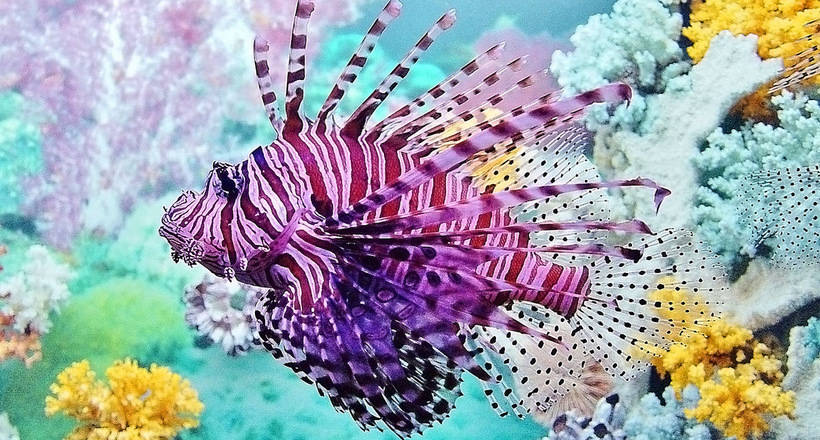
Lionfish, or lionfish

Another beauty, which is better not to approach. These fish have long dorsal and pectoral fins in the form of rays, at the ends of which there is a poison. The lionesses with all their kind warn the people around: "Do not touch me!". They are non-aggressive and do not attack people, but divers can accidentally touch them by carelessness or by trying to pet. The result can be a general poisoning of the body, seizures, nausea and an allergic reaction up to anaphylactic shock.
Fish-stone

These virtuosic maskers are often demonstrated at exhibitions of marine inhabitants. In addition to the talent of merging with the surrounding reefs, this gloomy creature has dorsal fins, provided with poison. Thorns are very sharp and can easily puncture a suit and shoes. Fish is very difficult to notice, so the meetings occur mainly due to inattentiveness of divers. The injection is perceived as very severe pain. In case of contact with this fish, you should immediately seek medical help, since the death in such cases is not uncommon.
Scuttail

This fish is dangerous because of its tail, on the end of which there are thorns with poison. The rays themselves never attack people first. And the use of a poisonous tail can be a protective reaction to the careless behavior of underwater tourists. Poison poison causes severe pain, convulsions, and the thorn often breaks off and stays in the body, so medical care should be taken immediately. The lethal outcome is extremely rare, but in 2006 a well-known Australian naturalist and TV presenter Steve Irwin died from contact with the poisonous stingray-tail.
Spinorogs: blue-browed balistod and yellow-faced pseudo-sheet


Large fish, from 50 to 70 cm in length and weighing up to 10 kg. Dangerous for divers during the breeding season. The triggerfish become aggressive and protect their nests, which swimmers can inadvertently approach. These fish are not poisonous, but the bite causes unpleasant pain.
Scorpions

It unites several species of one family living in the Red Sea, contact with which occurs most often through negligence. The fact is that they are fine maskers and are able to lie motionless for hours, waiting for their sacrifice. At the ends of the fins are poisonous needles. The injection causes severe pain, which does not abate for a long time and can manifest even after several months.
Starfish starfish

The danger is represented by their thorns with poison, so it's worth to be especially careful when examining coral reefs or trying to take a piece of coral for memory. In addition to acute pain and dizziness caused by poison, fragments of thorns of these reef inhabitants can become stuck in the body.
Fire Coral


In fact, this is not a coral, but an organism from the polymemedus class. It is strictly recommended not to touch these animals, as contact with them can lead to severe intoxication of the body. Their colonies are very extensive in the coral reefs of the Red Sea, and the corals themselves can have a different color. In addition to the prevailing yellow-brown color, white, yellow, orange and violet species can be found.
Barracuda

In the Red Sea, there are eight species of these fish, which grow to 2 meters in length. These aggressive predators can also attack a person, although most often this occurs at dusk or in troubled waters. These fish can attract scuba divers or bright, shiny items of divers' equipment. The result of a meeting with them can be lacerations and damage to blood vessels.
Sharks


In the Red Sea, you can meet two species of these fish: tiger shark and gray reef sharks. In both cases, do not approach predators, and also try to photograph them, so as not to cause aggression.