





Self-propelled barn-champion and four houses that can move themselves
 Этот материал вы можете прочитать на русском языке
 Цей матеріал ви можете прочитати українською мовою
The British gardener managed to disperse his barn on wheels to more than 160 kilometers per hour. On this occasion we remember other insane self-propelled structures.
Kevin Nicks with his self-propelled barn
News of mundane technologies: On May 12, British Kevin Nix set a speed record on his self-propelled barn. The 53-year-old gardener managed to disperse a wooden house, built in 2015 on the basis of the old Volkswagen Passat, to 101 miles per hour (more than 161 kilometers per hour) on Pendine Sands beach in Wales.
In total, in the implementation of the idea of Nix had to invest more than 13 thousand pounds sterling - almost 1,100,000 rubles at the current rate! "I did everything: I built a barn, put the engine, built a chassis," says the homebrew automaker in an interview with the BBC. "I just covered the roof with a roofing felt." And then I thought: I wonder, but how fast can this thing be accelerated? I took part in several competitions and, in general, all of them won. I exceeded the speed of 80 miles per hour (129 kilometers per hour) and broke all records, including the Guinness Book record. But, unfortunately, I screwed up the engine, and I had to tinker with it. " So the tent had a 400-strong engine from the Audi RS4 and an improved suspension: now, according to the owner, it "just rips from the spot."
The place for demonstrating new opportunities for the car maker was chosen not accidentally. It was in the Pendine Sands that the legendary racer Sir Malcolm Campbell dispersed the Blyuberd car in 1924 to an unbelievable speed of 235.17 kilometers per hour - since then this sand track has become one of the main ranges for high-speed records on land.
"BETTER AND IT WAS NOT HAPPY, I AM SO HAPPY," NIKS SAID AFTER ITS TRIUMPHAL FINISH.
It is noteworthy that initially Kevin did not plan to make his barn racing. He wanted smartly to realize the "trade wind" that is decaying in the yard, and then to carry the daughter to school in this miracle and frighten people in the parking lots. We decided to see what other unusual ideas of self-propelled houses came to the minds of engineers and amateur enthusiasts.

Victorian motor home Neverwas Haul
Amazing construction was born in 2006 - a self-propelled three-story house, inspired by the works of Jules Verne and Herbert Wells, was built by the team of the Academy of Unnatural Sciences under the direction of Shannon O'Hara. For the first time the house was presented to the public at the Burning Man festival, after which he went on a journey to the USA. Neverwas Haul is built on the basis of a tourist trailer, length and height - 7.3 meters, width - 3.7 meters. From the steam engine (which, of course, would ideally fit into the overall steampunk concept) had to be abandoned: the house sets in motion a diesel unit, which allows the speed to reach 8 km/h, and control is carried out using the ship's steering wheel.
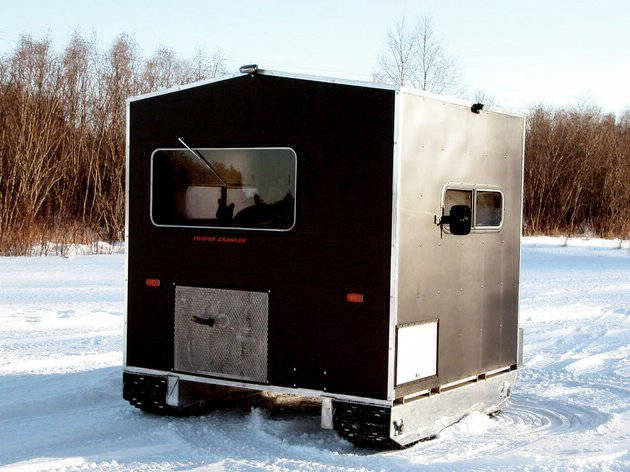
Caterpillar house for winter fishing Yooper Crawler
An excellent project that allowed fishermen and hunters to solve two important tasks at the same time: a wagon moving on caterpillars takes you to the place where you started fishing, in it you can always rest or even spend the night. The idea is not new, but more often it is realized with the participation of an external source of traction - a snowmobile or something like that - and then the owner received a complete set in one package. All would be well, but these self-propelled sledges turned out to be too heavy (almost 1,750 kilograms) and very expensive - more than $ 7,500. As a result, from Yooper Crawler there are only pictures and endless discussions on the Internet. But, as we think, this startup still remains an excellent source for inspiration.
Walking house from Denmark
At first glance, the scary work of art group "N 55" was originally invented for seasonal workers. Instead of trudging to the place of work on their own, and then living in a rented dwelling or at all in tents, they could go to work with their own house. On this idea, the Danes were inspired by the Roma, wandering from place to place in equestrian kibits. Highly ecological project - energy for the engine and all communications this "spider" takes from the environment. He turned into a prototype and even took the first steps (with the speed of a pedestrian - about 5 kilometers per hour), but then the matter got stalled. While the walking house is too expensive for the series, but the authors do not despair and the idea is not written off to the archive.
Floating Pyramids Wayaland
When a person finally destroys the land, he will have to look for a new habitat. In space, we will definitely not move for a while, but flight to the ocean can be organized much easier. Engineer and designer Pierpaolo Lazzarini has been developing this idea for a long time: first he collected money for the implementation of the floating UFO 2.0 capsule (like "floating plate" should come down this year), now he went further and suggests building entire cities from water modules Waya pyramids, built of fiberglass, carbon and steel. In buildings Lazzarini offers to place not only houses, but also hotels, cinemas, restaurants - anything you like. How did the Italian come to mind? The concept is based on the culture and building traditions of the Japanese and Maya Indians. Well, without a healthy escapism, there clearly was not.









Комментарии
Комментарии доступны только авторизированным пользователям!
Авторизоваться или зарегистрироваться вы можете нажав на ссылку
Ваш комментарий будет первым!