Sightseeing Berehove
Undoubtedly, the main attraction of Beregovo is the thermal water basin, which is located on the territory of the educational and sports base of Transcarpathia.

This pool was built 50 years ago for the needs of athletes. The leadership of the Soviet sport believed that it would be very useful for future Olympians not just to go in for sports, but also to get well again. After all, the pool is built on thermal springs - the water here rises from a depth of 1600 m. And in summer, and in winter there is almost the same, warm water - +32 degrees. However, in the winter - it is warmer. The water itself is dark brown, almost brick. Bathing in the pool is recommended for the treatment of organs of the musculoskeletal system, nervous system, cardiovascular diseases, etc. Similar thermal baths are found only in New Zealand.
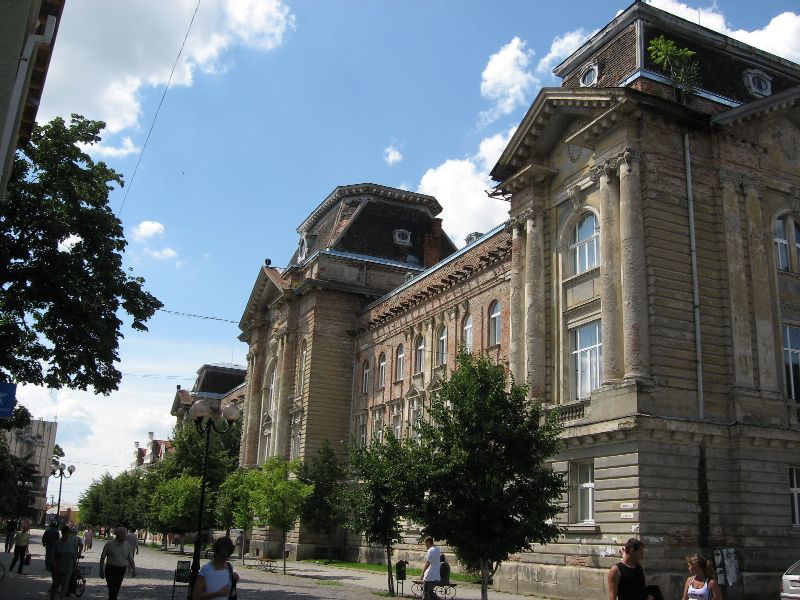
The most famous building of the city, undoubtedly, is today's premises of the Transcarpathian Hungarian Pedagogical Institute. Ferenc Ragoczy II, in the past - the Palace of the Comitat court. It's hard to imagine that this architectural ear was built in just two years. In 1907, after the government announced the Royal Hungarian competition, the project of the architect Miklos Ibla - in the style of the French Baroque - was chosen. Over the next two years (1908-1909) the project was implemented. The Austro-Hungarian Empire did not yet know that it was only a few years that she lived, and was spent on a grand scale. Today you can wonder why in a small town to build such a huge court? I can imagine with what fear a stranger came into this building, even if he was not to blame for anything, but came for some help. What can we say about the culprits (in the back of the three-story palace there was a prison) ... During the Soviet era, the barracks were temporarily placed in the historical building, and then, for a long time, the Factory of Precise Mechanics. At the beginning of independence, several administrative institutions were located in the part of the palace, later a children's library. Since the beginning of the new millennium, the only Hungarian pedagogical institute in Ukraine has been located in the former Palace of the Court of Commit.
The Count's court of Gabor Betlen was built on the site of a Dominican monastery, which, during the religious wars in 1573, was destroyed by the reformers. On the facade of the building the date 1629 was stamped - apparently, then the Hungarian Count Gabor Betlen completed his summer residence in Beregsas. This was the time when the city belonged to the Principality of Transylvania, by which Count Betlen was in charge from 1613 to 1629, until his death. Obviously, to live in a newly-built residence the first owner was not destined. In a modest palace, there have been many important events. In 1686, during the uprising of the Hungarians under the leadership of Imre Tekeli, he burned down, and was rebuilt by Ferenc Rakoczi II. From this castle the rebellious prince urged the citizens of Beregsas to join the anti-Habsburg uprising. Rakoci's uprising has lost - he lost a lot of property, including the palace, which went to the loyal Count Karl Shernbourne-Buchheim. He also renamed the palace to a county court, and built a hunting house in it (the Bereg region, with un-cut oak forests and dried up swamps, was in those days a game.In the times of the Spring of Nations (a series of national uprisings in 1848), a local people formed in the palace yard detachment of the Hungarian National Guard.
The Count's courtyard has a modest appearance, and only one who is familiar with the history and basics of architecture will appreciate it immediately. Once the red building opposite the ancient Catholic cathedral was more presentable - above and with typical buttresses-buttresses, which were demolished in the Soviet era, so as not to interfere with the passage on the sidewalk. Demolition of powerful stone supports immediately affected the condition of the building - in addition to losing the medieval appearance, it began to crack.
The not very presentable appearance of the count's court compensates for its filling. In part of the building in 2002 the Museum of Beregovshina was located. Those who decide not to regret the hour from traveling around the city will not regret. The director of the museum, Ivan Shepa, refers to the case with a soul, therefore the Beregov museum differs favorably from many of its counterparts. Here, the exposition changes and replenishes, and excursions in the performance of the director are distinguished by an informal approach to the matter.
Summer residence of the Counts of Schönborn - a romantic kind of palace, built in the XIX century. at the foot of the mountain on the north-eastern outskirts of the city. On the medieval castle it makes like a tall tower with a peaked roof. Nearby was a cozy park. In 1913, the Hungarian State Wine Farm was opened here, which in 1920 was taken over by the Czechoslovak Wine Union. In 1954, the state farm-plant "Beregovsky" was created on the basis of the residence, producing famous vintage wines "Troyanda Transcarpathia", "Promenasty", "Beregovsoye."
The old wine cellar in Beregovo, which is more than 300 years old, is again used for its intended purpose thanks to the family of enthusiasts of the revival of the Beregovo winemaking: Oleg and Tatyana Gavrilchenko. According to legend, it is carved into the thickness of the rock by hand by captive Turks. The restored cellar is one of the few preserved in Berehove from the XVII century. According to traditional technologies, vintage wines from local grape varieties of the Beregovsky Vine Region are produced here: Müller-Thurgau, Zengo, Limberger, Zweigelt, Muscat Ottonel, Cuvée, etc. The program of visiting the cellars includes acquaintance with the production technology and tasting of the Beregov wines.
Find the Best Professionals for Your Project
Expert repair, construction, and renovation specialists ready to help you right now