< div>The easternmost citadel of the principality Theodoro was built presumably in the 13th century. In the remains of the fortress, the outline of the castle and the ruins of the Christian church of St. Theodore Stratelates, as well as residential and outbuildings. The existence of this fortress was known to scientists, but excavated it relatively recently, in the 80s of the last century. Horse rides are now organized in the fortress. There is an opportunity to examine the ruins of fortress towers and walls, arched overlaps of internal buildings and corridors. In the fortress was found a plate with five arms, four of them & ndash; the birth coats of arms of princes, and the fifth & ndash; The Byzantine symbol, which later became the emblem of the Russian Empire. The plate with a two-headed eagle is known in the archaeological world, its image is included in dozens of books on ancient history. It was all the more surprising to see this slab simply leaning against the ancient masonry lying near the earyes in the fortress under the open sky. You can take a picture of it yourself if you come to Fune.
There is a poetic legend connected with Funa, in which, as in any national tradition, traces of real historical events can be found. In ancient times, the legend tells, these regions were captured by cruel nomads. The locals resisted. To keep them in obedience, the conquerors staged a huge smithy on the top of Funa, where a ferocious blacksmith forged for them. Here for men's work drove the men from the surrounding villages, and they died from hunger and overwork. The flame, kindled in the smithy, exterminated all living things around: rivers were running out, forests, vineyards, crops were burning. And then Maria, the daughter of one of the elders living in the village, decided to go to the blacksmith in the hope of softening the heart of the villain, pleading with him not to ruin people. Sinister laughter met Mary. The smith was deaf to her pleas. He demanded that the girl would become his wife and, having refused, killed the beautiful woman. And immediately Mount Demerdzhi trembled, flashed fire, and dared the smithy. The grim smith and his henchmen rushedbut fear locked them, and they were forever frozen on the mountainside by stone ugly statues that can now be seen in the famous Valley of Ghosts.
Not far from Alushta are the famous caves of Chatyr-Dag. Already ancient travelers have paid attention to the original form of this mountain. It reminded them of a table, and on ancient maps of Chatyr-Dag it is called Trapezus. When you drive to Simferopol from the north, from the flat Crimea, or along the Black Sea, you approach Alushta, it seems as if a giant tent stretched among respectfully parted mountains.
This explains the name of the array - Chatyr-Dag, or Shater Mountain. The crater funnels on Chatyr-Dagh in some places reach 250 m in diameter and 50-60 m in depth. And inside the limestone layer, caves, mines, deep wells were formed. 137 underground cavities are known on Chatyr-Dag. The most famous of the caves are:
Binbash-Koba (Millennium Hill) - a famous cave in which human bones were found, which was the basis for ancient legends. Here is how it describes it in 1886. E. Markov: "On the floor ... human skulls are stuffed with a terrible pile ... They lie without counting and gaiety, like the hawks in the Little Russian bazaar." Perhaps it was a burial vault, a burial ground, where the dead were buried, and perhaps peaceful civilians sheltered from the enemy were killed here.
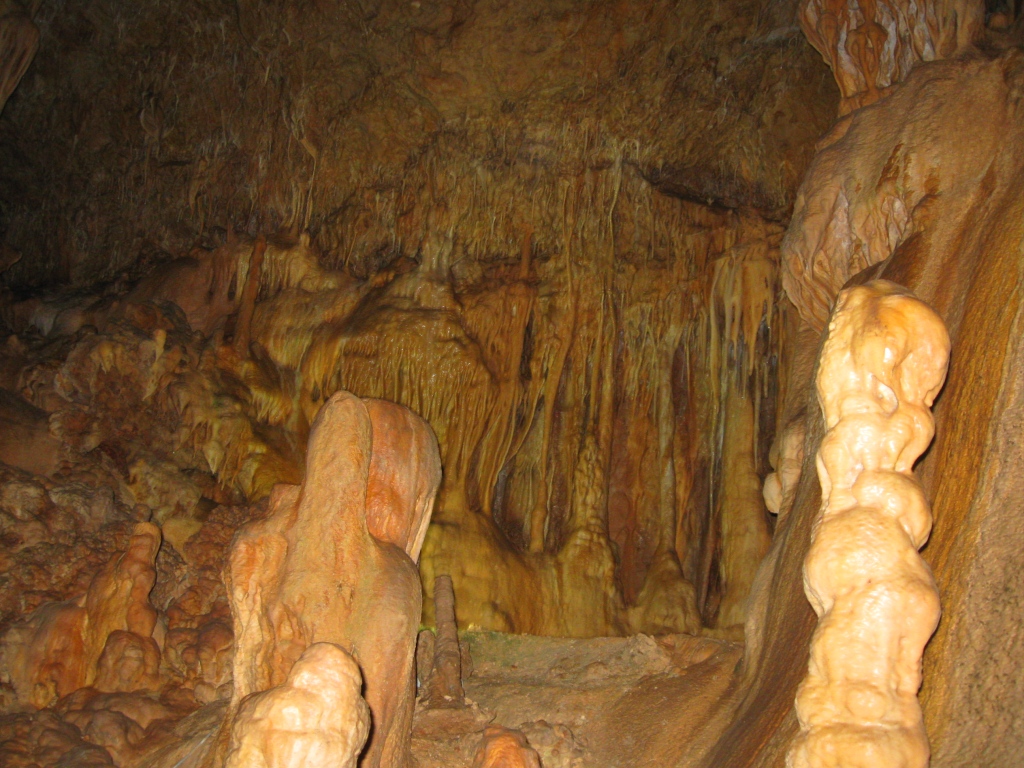
Emine-Bair-Khosar - a cave with rich, stale forms and with complex continuations of underground passages. In translation from the Turkic Amy & ndash; Oak, Bair & ndash; slope, Josar & ndash; Well, all together it means: well on the slope near the oak. The length of the magnificent cave & ndash; more than two kilometers. She has five levels. The halls of the uppermost about thirty meters from the surface of the earth, the lower & ndash; at a depth of one hundred and eighty meters. In Emine-Bair-Khosar you can see the skeleton of a mammoth that fell here a thousand years ago, an underground lake. The cave is equipped with safe paths for excursions, well lit.
Marble - open and explored it was relatively recent & ndash; in 1987. The name of the cave is due to the fact that it is laid in rocks of marble limestone. Here is the "Ballroom" & raquo; or "The adjustment hall & raquo; - the largest in the caves of Crimea. Its length reaches 250 meters, height & ndash; 28mi. About one million years ago, there was a collapse of the floors between the second and third floors of the underground galleries, resulting in the formation of this stone chaos. The lateral branch from the cave & Marble & raquo; is the gallery & la Tigrette & raquo ;. Cave explorers discovered it one year after the discovery of the cave, because the passage was hidden beneath a layer of calcite. The tiger's turn is about one and a half million years older than the Marble & raquo; and its incrustations are more diverse. Perhaps, standing in front of the maze of these numerous passages, which invariably turn into a dead end, the speleologists often think of continuing further riotsthe new ways of running, because the system of the Chatyr-Dag caves has not been fully studied yet. It is possible that all of them can constitute a single system, separated by clay plugs, powerful cracks, and blockages.
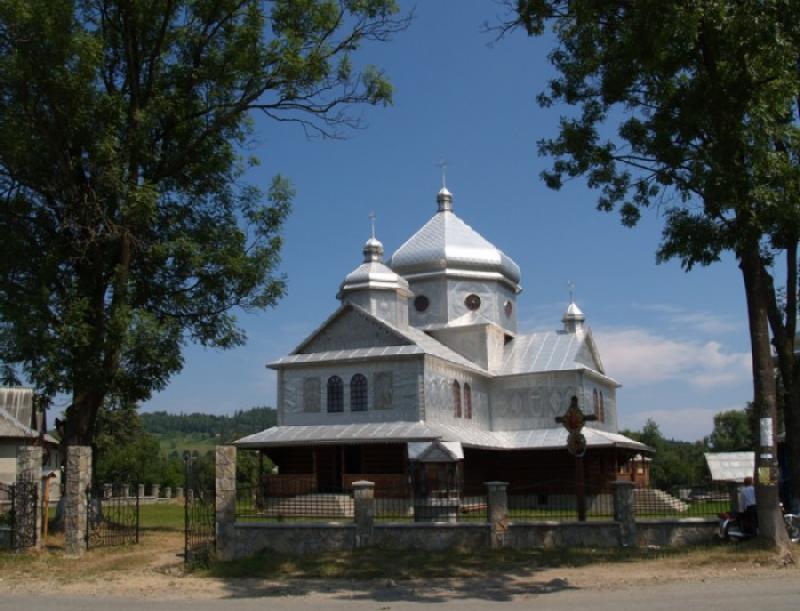
Another unique attraction of Alushta is the Mayak church. The church of St. Nicholas refers to the Moscow Patriarchate, dedicated to the memory of the dead on the waters. It is located in with. Malorechensk (directly on the 26th kilometer of the Sudak highway). From Alushta, you can get here by any shuttle bus to Rybachye. Just go for a fixed-route taxi or at worst "passing" & raquo ;. New temple — the highest in the Crimea, its height — 65 meters. The design uses ship anchors and anchor chains, under the main cross, inside the gilded ball, which symbolizes the planet Earth, a lighthouse lamp is installed. The lighthouse is not yet included in the ship's sailing directions, but this issue will be resolved in the future. Also in the basement of the church there is a museum of sea accidents, which in the Black Sea was not small. For example, did you know that in the last century, near the southern coast of the Crimea, a catastrophe occurred, much larger than the famous Titanic & raquo ;. Passenger motor ship & laquo; Armenia & raquo; from the sanitary transports of the Black Sea Fleet under the command of Captain V. Ya. Plaushevsky November 7, 1941 was attacked by a fascist torpedo aircraft. Sank at 30 miles from the shore. About 7000 people died. There are no more lighthouses in Ukraine. Similar built on the Solovetsky Islands in Russia and in Finland. Both — Orthodox.
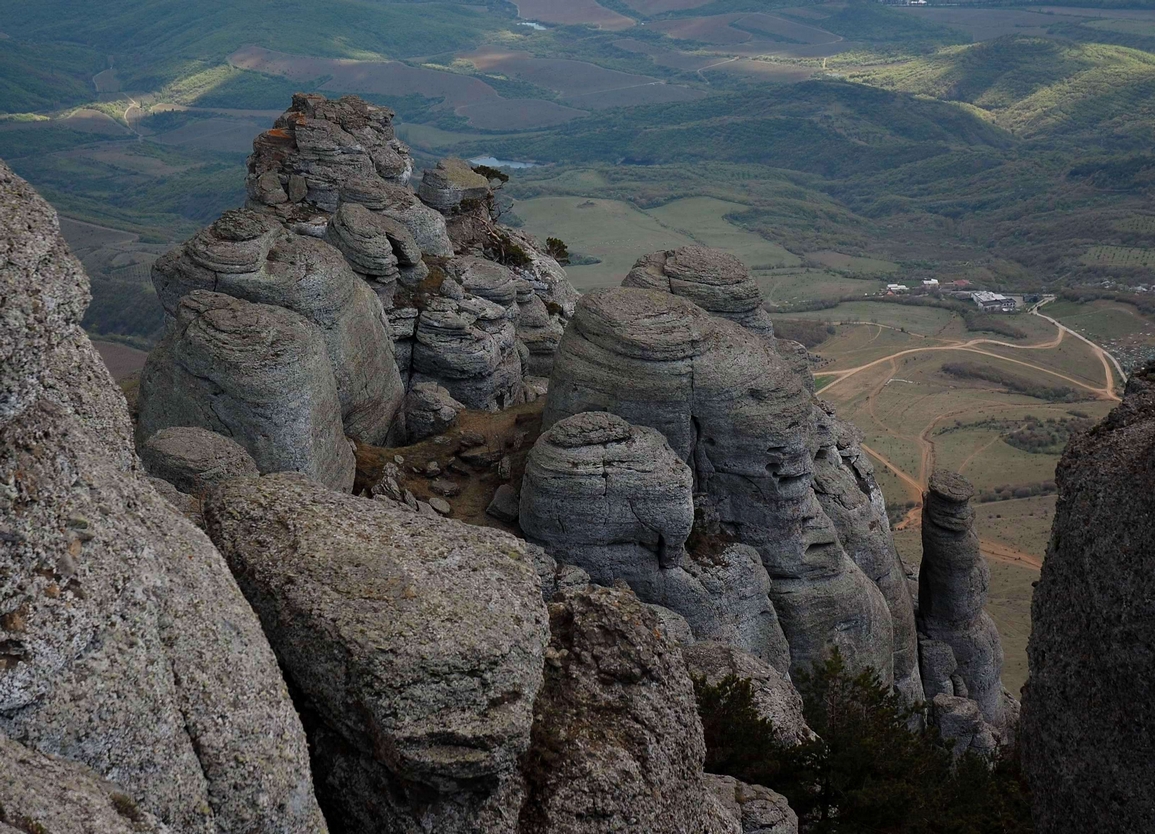
Mount Demerdzhi, to be more precise, its slopes & ndash; This is a unique heap of rocks that are commonly called block chaos. The shape and dimensions of the blocks are so bizarre that they can guess the figures and portraits created by nature. By giving long shadows, these shapes change their outlines, and you can see new and new images if desired. That's why the valley is called the Valley of Ghosts. Here you can find out the frog, the warrior's head, and even Yeltsin's portrait.
In addition to the legends associated with the valley, there were events that were closer to us and no less interesting. Everyone remembers the Brothers Grim, their magnificent tales, which have become classics of world literature. But few people know that they died on the slopes of Demerdzhi, crashed on a motorcycle. The road leading to the top is really barely passable, even for special transport. A lot of warm feelings will cause our compatriots to visit the trail, on which the scenes from all the beloved film & laquo; Caucasian captive & raquo; were shot. It is known that part of the film was shot in the Caucasus, and part of it was " in the Crimea, namely in the Valley of Reductions. & laquo; Nicus Nut & raquo; - this is one of the famous trees of Crimea, which has its own name. Here we shot a scene of falling from a tree. The branch was filed, the place of the fall was prepared, but the branch broke completely in another place, and when Yuri Vladimirovich fell, he broke his arm. And what about the opportunity to be photographed on a rock, in which Natalia Varley danced under the "laquo;Somewhere in the white world & hellip; & raquo;?! Interestingly, this stone is not so small. The block has the shape of a regular parallelepiped, and its height is about two meters. But the staircase is prudently attached to the stone. And if you have a half or two hours of time, then do not be lazy, and go on a narrow path to the site at the top of the mountain. From here a magnificent view opens: mountains, sun-splitting clouds, a city lying in the valley, and a sparkling sea. Just for the sake of a few pictures it is worthwhile to climb here.
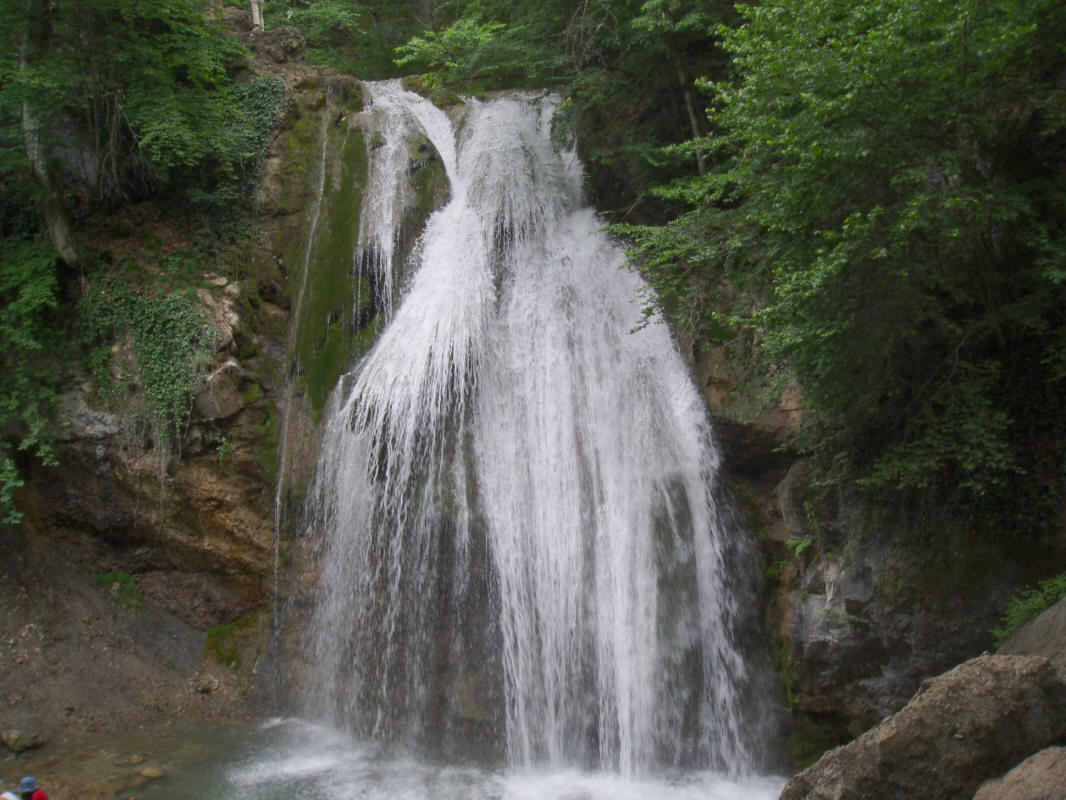
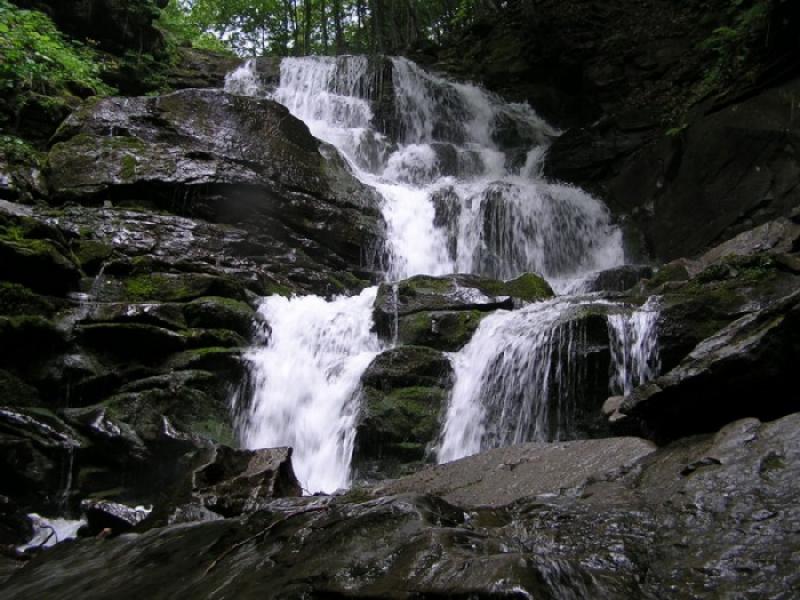
Jur-Jur waterfall is the most powerful and inimitably picturesque waterfall in the Crimea. It does not dry out even in the most arid years. In the gloomy gorge, the Ulu-Uzen River runs along a three-stage threshold, falling from a hundred-meter height. From the limestone ledge, which is 15 meters high, the water is sweeping a wide 5-meter steep stream into a deep foundation pit, and from there it rushes into the river bed. The waterfall justifies its name (the Greeks called it Kremasto Nero - "hanging water"): it does not rumble, it does not rustle, it's gurgling, the streams of water do not fall swiftly, but as if they slide down, breaking at the foot of the ledge and forming in the ice dust playing a rainbow. The grandeur and severity of the surrounding mountains, the Jur-Jur frothy jets, colored by the rays of the sun and beautifully stand out against the greenish background of rocks covered with moss, enchant the traveler; far around the noise of falling water is heard ... Having passed from the Jur-Jur waterfall upstream of the river about a kilometer, one can see a whole series of picturesque rapids-kascadres. The most beautiful of them are the upper ones - the penultimate and the last, with a height of about 30 and 60 meters. Nearby - a cave Jur-Jur length of 750 m. And around - an old high-growth forest of beech, hornbeam, with an admixture of oak, linden, mountain ash, cornelian, hazel. The dusk of the beech pad is in harmony with the gloomy cliffs of the surrounding mountains. The sites of the old 200-year-old forest from the rock oak, the groves of the Crimean pine are of special scientific value in the reserve.