Batalha: a mystical monastery with a royal chapel and a Gothic wonder of Portugal
The Batalha Monastery looks as if it was designed by a mad architect who was tasked with building a Gothic cathedral on a full-scale scale. Each tower is more towering than the last, and every stained glass window glorifies the greatness of the Portuguese dynasty; yet the silent stone colonnades seem to exude more political ambition than religious devotion. This is not just a monastery—it is the tangible triumph of the Portuguese at the Battle of Aljubarrota in 1385, immortalized in stone over four centuries of construction.
Batalha is located in the Leiria region, about 120 km from Lisbon {GOOGLE=39.6590,-8.8178}. When King John I defeated the Spanish fleet and secured Portugal’s independence, he vowed to build a monastery worthy of such a victory. He kept his promise: construction began in 1386 under the patronage of the Dominicans. What was originally planned as a modest monastery turned into a monumental religious project that consumed the kingdom’s resources and occupied the lives of architects for 200 years.
Interesting fact: The construction of the monastery lasted so long that 18 Portuguese kings succeeded one another during its completion. Each monarch made additions of his own: In the early 16th century, Manuel I deemed the Gothic style insufficiently extravagant and ordered the addition of chapels in the Manueline style—a Portuguese variant of Baroque with maritime motifs. The result looks as if a Gothic cathedral has been shattered, and from its ruins have grown stone “corals”.
The Royal Chapel of Batalha: Where Heroes Were Buried
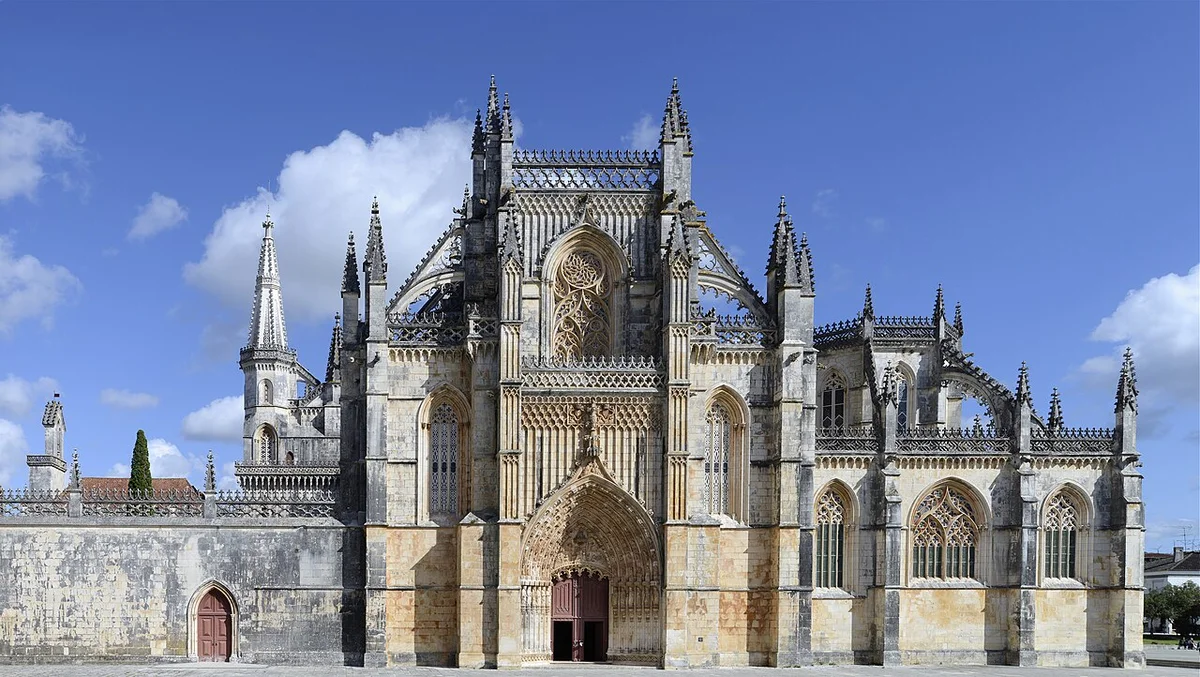
The Chapel of the Founder (Capela do Fundador) is the very heart of the monastery {GOOGLE=39.6593,-8.8182}. Built in the 1400s, it houses the tombs of King John I and his wife Philipa of Lancaster, daughter of an English duke. Beneath its vaults are also buried their son Henry the Navigator (the very prince who organized Portugal’s expeditions) and other members of the royal family. The walls of this chapel are not just stone; they are a tribute to the Portuguese nation, embodied in its very architecture.
What few people know is that the Chapel of the Founder features a unique architectural element: its vault does not rest on any columns. Such engineering audacity was unprecedented in the 14th century. The architects created a space where the air itself seems to support the ceiling. The diameter of this vault is nearly 10 meters, and its proportions are precisely calculated so that every ray of light entering through the stained glass falls directly on the royal sarcophagi.
Admission to the chapel is included in the regular monastery ticket. The cost is €15 for full-price tickets, €7.50 for seniors and children aged 6 to 17, and free for children under 6. The chapel is open from Tuesday to Sunday, from 9:00 AM to 6:00 PM during the summer season (May to September) and from 9:00 AM to 5:00 PM in the winter. Mondays are closed.
Gothic architecture: a parade of pointed arches and stone lace
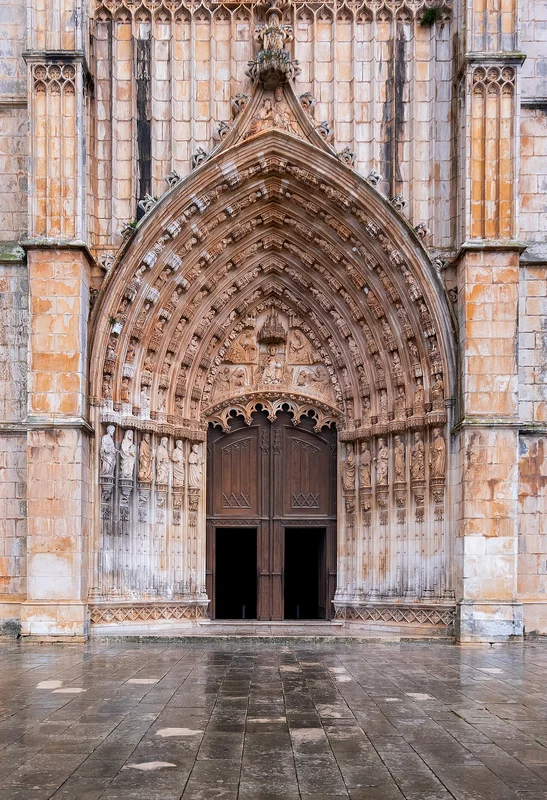
The facade of the monastery is a sculptural manifesto of Gothic art, where every stone seems to shout about wealth and power. The main portal, known as the “Portal of Kings,” is adorned with statues of 15 Portuguese kings, each wearing their own crown and having an expression of pride on their face. The portal stands 35 meters tall—roughly equivalent to the height of an 11-story building, all crafted from a single architect’s vision.
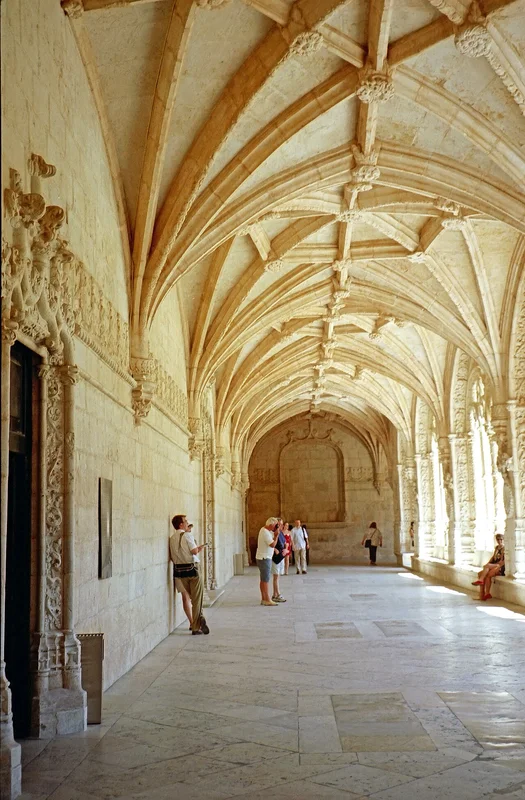
The cloister of King John III ✪0✫ is a square enclosure surrounded by vaulted galleries where monks would walk in circles, contemplating the meaning of life and royal authority at the same time. The arches of the cloister are intricately carved, and each stained-glass window creates patterns of light that change every hour. This place is the most tranquil part of the entire monastery, where one can lose themselves in its details for hours on end.
Interesting fact: The architect Afonso Domingues, who led the initial phase of construction, began his career as a humble stone mason. He was so talented that King John I personally appointed him as the chief architect for all royal projects—an unprecedented move in the 15th century, when architects were usually members of the nobility or clergy.
The Unfinished Chapels: A Gothic Manifesto That Remained Uncompleted
On the eastern side of the monastery stands a structure that resembles an architectural phantom: the Chapels of the Immortal Kings (Capelas Imperfeitas) {GOOGLE=39.6593,-8.8188}. In the 1500s, King Manuel I decided that ordinary chapels for kings were not grand enough and ordered the construction of something more ambitious. He wanted 15 chapels, each a separate masterpiece, each with its own roof. However, by the end of the 16th century, interest in the project faded, and construction ceased. Today, these chapels stand without roofs, like ancient Greek ruins amidst Portugal’s medieval landscape.
This unfinished state actually works to the advantage of tourists: without roofs, the view of the sky from within the chapels creates an effect that no architect had intended, yet it appears perfectly natural. The best time to photograph these sites is at sunset when the orange light bathes the gypsum columns, giving the entire structure an almost magical appearance as if the history of Portugal is literally embedded within the stones.
Best spots for photography: GPS coordinates and timing recommendations
If you visit the monastery solely for photography (and many people do just that), here are some key tips:
View from the main portal {GOOGLE=39.6588,-8.8180} is the most classic perspective. It looks its best around 10:00–11:00 in the morning, when the sun is to the left of the portal, casting dramatic shadows on the Gothic carvings. Arrive early to avoid crowds of tour groups.
The Immortal Chapels Against the Dusk Sky {GOOGLE=39.6593,-8.8188} – this is a moment worth waiting for. An hour before sunset, you should be by the eastern wall, where these roofless chapels transform into a testament to absolute Gothic beauty. The water in the small pond in front of them reflects the columns, creating an effect that makes the architecture seem to double in number.Juan III’s Cloister {GOOGLE=39.6595,-8.8175} at noon – an unexpected choice, but the light at this time is at its brightest, creating striking shadows that bring the intricate carvings to life. Shooting in black and white is ideal for this setting.
Few people know that the best time to visit without crowds is on Tuesdays or Wednesdays, between 2:00 PM and 4:00 PM. The main tourist groups usually arrive either in the morning (9:00-11:00) or in the afternoon after lunch (4:30-6:00). Midday is the time when you’ll have almost the monastery to yourself.
Local Traditions, Cuisine, and How to Spend a Day in Batalha

Batalha is not a tourist town like Sintra or Lisbon. It’s a real Portuguese city with 8,000 residents living beyond the monastery walls. And that’s precisely what makes it so charming.
The main form of entertainment here is dining at the local restaurants surrounding the main square, Praça 8 de Maio {GOOGLE=39.6600,-8.8165}. The prices here are half those in Lisbon’s tourist areas. Caldeirada (fish soup with tomato sauce) costs €8-12, and francesinha (a Portuguese sandwich with meat and cheese) costs €7-10. The restaurant Dom João, located near the monastery, specializes in traditional Portuguese cuisine: rice with squid, chicken piritaú (stewed meat with country potatoes), and Portuguese wine from Central Portugal. Interesting fact: Every August in Batália, a historical reenactment festival of the Battle of Aljubarrota is held. People dress up in 14th-century costumes, perform battle scenes, and set up medieval markets. It’s a true immersion into the era when King John I vowed to build this monastery. If you plan to visit in August, book your hotel in advance.A one-day itinerary: Arrive in Batália early in the morning (9:00), spend 2-3 hours exploring the monastery, have a snack at a local cafe (lunch is available from 12:30 to 14:00), stroll around the town from 15:00 to 17:00, watch the sunset at the Hermitage of the Immortals (18:00-19:00), and have dinner at a local restaurant (20:00). A full day without rushing.
How to get there: Transportation and practical details
Batália is located in Central Portugal, between Lisbon and Porto. Distances are as follows: 120 km from Lisbon, 160 km from Porto, and 130 km from Lisbon’s airport. By car: This is the most convenient option. From Lisbon, take the A1 highway north and then exit onto the A17. The journey takes about 1.5 hours, and parking near the monastery is free. Car rental in Lisbon costs €25-40 per day. By bus: FlixBus operates buses to Batália twice a day from Lisbon at 07:30 and 14:30. The one-way fare is €5-8, and the journey takes 1 hour and 45 minutes. The bus station in Batália is located in the town center {GOOGLE=39.6605,-8.8160}, just 10 minutes walk from the monastery.By train: From Lisbon (Santa Apolonia station), a regional train goes to the town of Calvaria, after which you need to take a minibus or taxi to Batalha (an additional 15 km). The total travel time is approximately 3 hours. The ticket costs €8–12. This option is less convenient than taking a bus.What few people know is that in Batalha there is a small hotel right next to the monastery—the Hotel Batalha. A double room there costs €60–80 per night. This allows you to stay overnight and return to the monastery the next morning, when there are fewer tourists around. The best views of the monastery from the hotel are available in the rooms on the second floor.
Opening hours of the monastery: Tuesday to Sunday, 9:00–18:00 (May to September); 9:00–17:00 (October to April). Mondays are closed. Admission fee: €15 for adults, €7.50 for seniors and students; children under 6 years old enter for free. Audio guides (in English and Portuguese) are available for €3.
Interesting fact: In 1983, the Batalha Monastery was inscribed on the UNESCO World Heritage List. It is one of the first Portuguese sites to receive this distinction. The UNESCO Committee recognized it as “an outstanding example of medieval art of Portuguese origin, representing the transition from Gothic to Manueline styles.”
Find the Best Professionals for Your Project
Expert repair, construction, and renovation specialists ready to help you right now
Recommended articles
Lutsk and Volynia: the Lubar Castle and St. Protection Church – a journey to the historical heart of Ukraine
The Golden Hoof: Castles of the Lviv Region – Olesko, Zolochiv, and Podhortsy
Ostrozhskaya Academy: the first higher education institution for Eastern Slavs
Kremenets: Polish and Ukrainian in the heart of the Ternopil region
More articles:
- Lutsk and Volynia: the Lubar Castle and St. Protection Church – a journey to the historical heart of Ukraine
- The Golden Hoof: Castles of the Lviv Region – Olesko, Zolochiv, and Podhortsy
- Ostrozhskaya Academy: the first higher education institution for Eastern Slavs
- Kremenets: Polish and Ukrainian in the heart of the Ternopil region
 Khortitsa: Reconstruction of the Zaporozhian Sich and an open-air museum
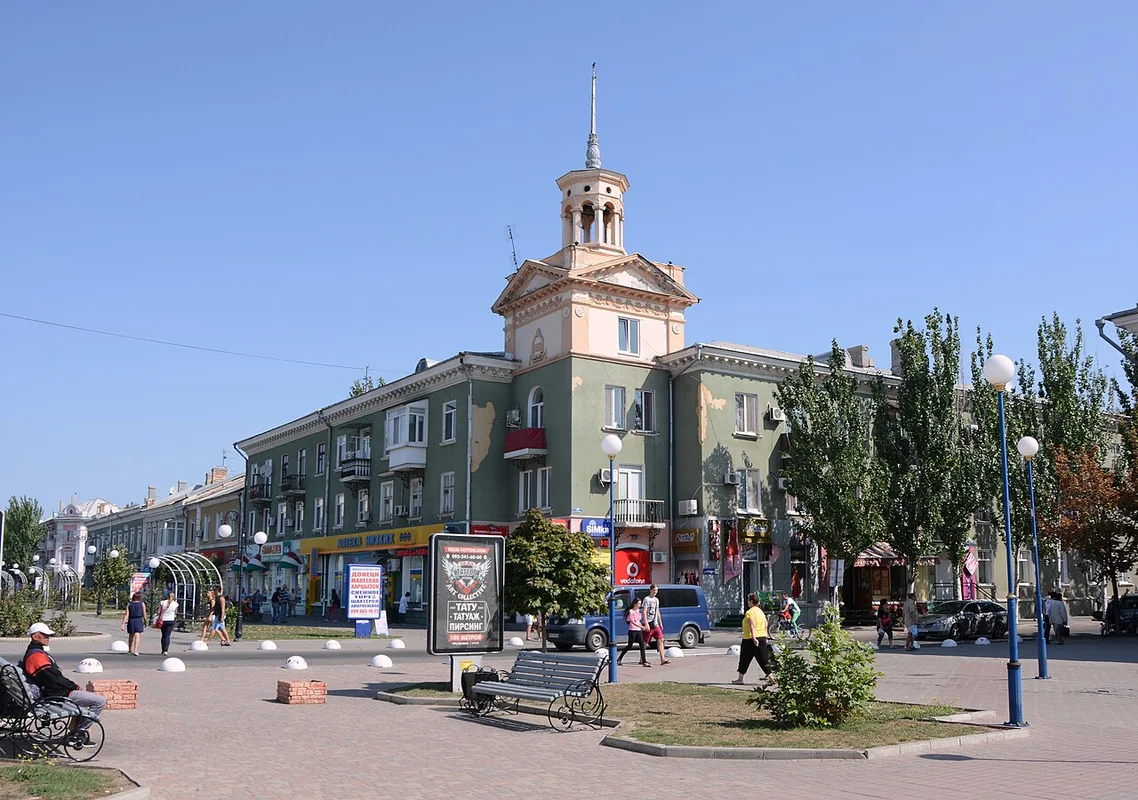 Berdiansk and the Sea of Azov: Shallow Waters, Mud, and Sunshine – A Guide for Tourists
 Pirogovo in Kiev: an Ukrainian scène featuring windmills and wooden houses from the 18th–19th centuries.
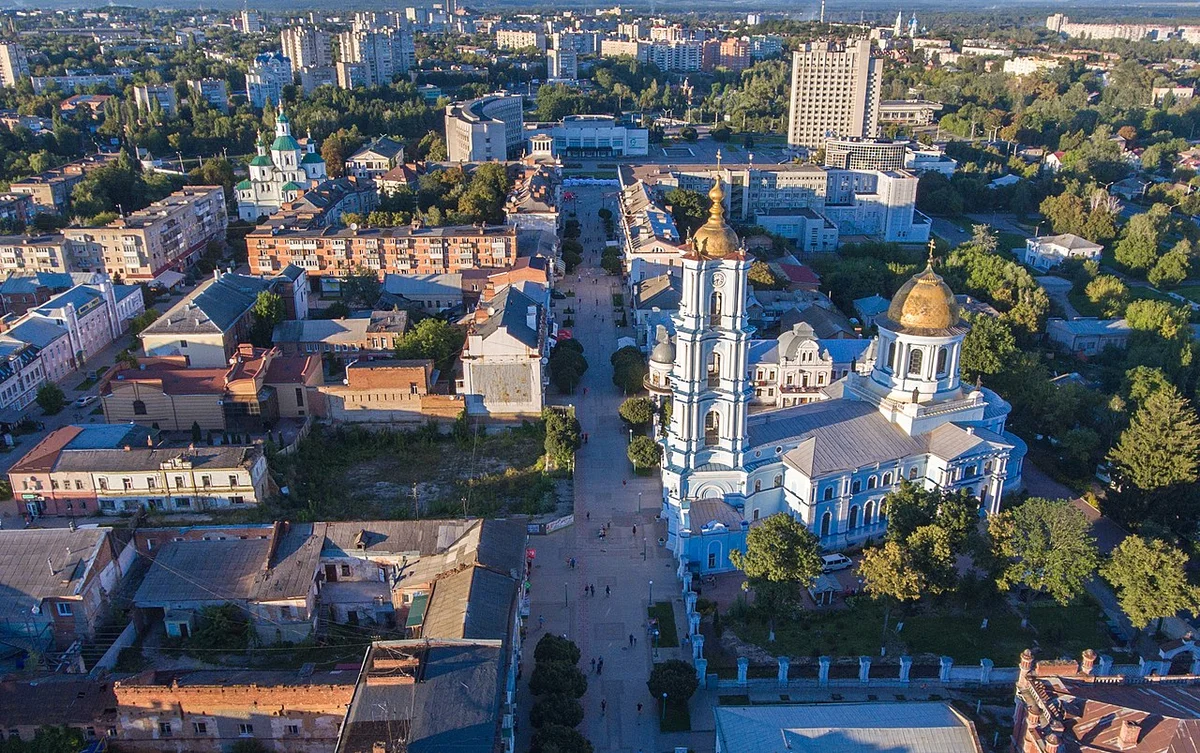 The Wealth and Estate of Kochubei: Noble Ukraine in the 19th Century