Rafting is an extreme rafting on an inflatable raft.
Rafting on the Zambezi River

For tourists and non-professional athletes, there are six categories of complexity - from the first, the simplest, to the sixth, the most difficult. There are, of course, very dangerous routes, but this is already the fate of professional rafters, where they entertain themselves at their own peril and risk. Rafting on the Zambez river is considered to be the most difficult commercial rafting: on our route there were four thresholds of the fifth category and one sixth. The latter is not allowed to beginners and unprepared tourists, so we went around it by land. However, this precaution still does not insure us from extreme bathing ...

Before you started with us, we had a briefing. According to the expressions of people you can see that everyone was skeptical of the instructor's advice on what to do in case of a fall overboard. Arina's girl, who was sitting next to me, asked: "Why are they telling this?" Are we really able to roll over? & Quot; I said that these tips, as contraindications to tablets - can theoretically be, but are extremely rare

After the briefing, we took all the things and gave them a helmet, an oar and a life jacket

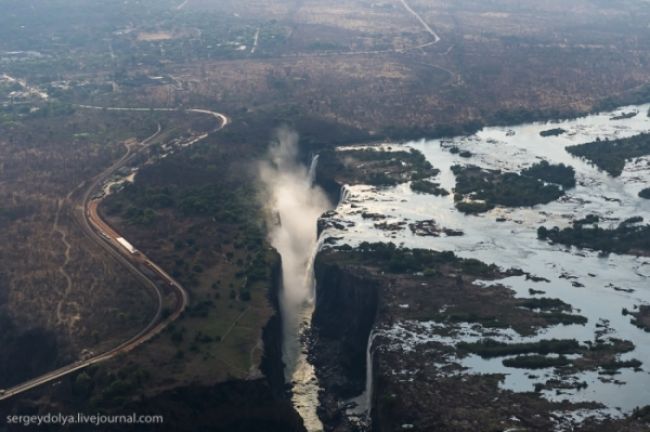
Our rafting started under the Victoria Falls, in front of the bridge that connects Zambia and Zimbabwe. We went down to the water for a long time, and then climbed a long vertical wall to the rafts. Having settled on them, we used to float upstream and look at the waterfall. Then we sailed to a quiet place, where our helmsman suggested that everyone jump out of the rafts into the water. Nobody was ready for such a proposal, all refused, and the peasant jumped off himself, letting us know that there will be no alloy until we bathe. I had to jump, which was quite delicate, considering that the Zambez live crocodiles. And although they explained to us that they live upstream, we swam with our legs pressed. After everyone jumped out of the raft, the instructor climbed onto the raft and began dragging everyone back, explaining how to behave in this case. We trained and, guarded by such a serious attitude towards security, came out on an alloy

Four rescuers on kayaks accompanied us. They made sure that no one fell, and if this happened, they raked to the sinking and returned to their place

And falling, by the way, often ...

In our group there were two rafts - on one we sat, on the second company of Australians

I rowed on the raft in the first row

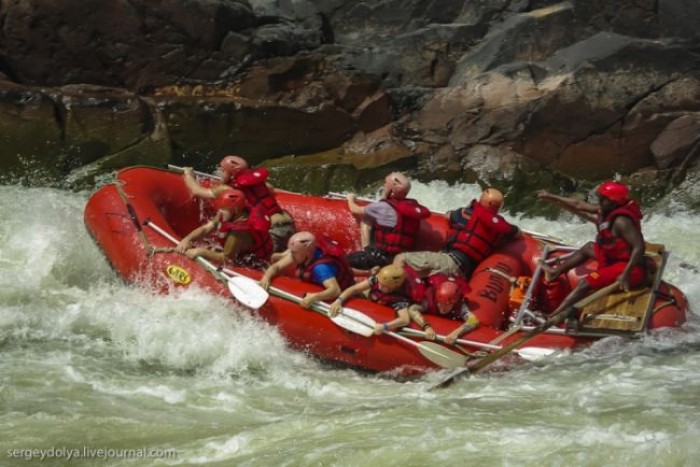
There may be a question - why row if the river is already carrying us? The fact is that the maneuverability and control of the raft depend on the speed relative to the flow, therefore on the approaches to the threshold it is necessary to row with maximum force. What we are doing in this photo

And during the passage of the threshold, on the contrary, you need to remove the oars and hide. At these moments, the pilot shouted to us "Down!", We crouched and clung to the rope around the raft:

The most important thing in this case is not to lose the paddle:

Well, do not fly out of the raft, of course:

After the vigorous shaking the threshold ends, and we safely go further:

And this is an example of an unsuccessful passage of the threshold, which the Australians demonstrated. The girl did not hold on tightly to the rope and flew overboard. Note that her neighbor, although in the raft, is immersed in water with her head:

After the threshold, everyone came to their senses and rejoiced:

We performed the & quot; Give five! & quot; on the rafting style, using oars instead of palms:

Another threshold is approaching and everyone adds a move:

A couple of frames about how we were caressed by the water element:


We had the opportunity to bypass the last threshold of the fifth category, but we, already past three such and zamaterevshie, decided not to back down:

I was the first to get into the distribution and met a wave that lifted the raft and turned it sideways:

After me, the rest of the crew left the raft:

It was a very terrible moment: you try to come to the surface to breathe, but since the "surface" at the doorstep is very conditional, floundering and slurping water. Even a waistcoat does not save:

Fortunately, this place was deep enough, and no one hit the stones. We with the helmsman climbed onto the raft, tied the rope to the port side and turned the raft over. All climbed back, frightened and with eyes for five cents:

The last threshold was the fourth category, we passed it more or less normally. And the boat that was following us overturned:

It was a very memorable rafting and very hard. Those who will be in Zambia or Zimbabwe and are not afraid of such adventures, I advise you to try:

Stay Tuned!