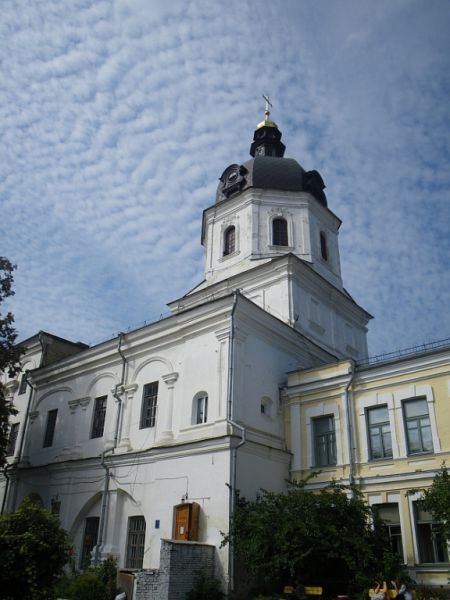
The Annunciation Church of the Kiev-Mohyla Academy, Kiev
The church served as a venue for solemn meetings, it held elections for positions in the academy. The Annunciation church was named so, because the conception of St. Anna and the Annunciation of the Mother of God were always great holidays on the territory of the Academy. They were celebrated with special solemnity and greatness. In the written mentions of 1673 the first Epiphany Church was indicated, which was wooden. Both churches are represented as deserted and abandoned. But there are other sources that say that at that time a church for solemn events was not a wooden church, but a stone Borisoglebsky temple. Later, they converted the refectory from the academy. When they began to build a stone Epiphany Church, it was decided to attach a second floor to the refectory. It was here that the Annunciation Church was moved. The work was carried out from 1690 to 1695.
Hetman Ivan Mazepa laid the foundation for the construction of the academic building, but by 1703 he had not graduated. In 1731, Rafail Zaborovsky became the archbishop in Kiev, who set himself the task of finishing the building of the building. He invited the famous architect I. Shedel to lead the project. Works moved on, by 1740 the temple was almost finished, but there were problems. The government did not encourage the construction of new temples, despite this, a permit for the continuation of the construction work was still received. The Annunciation Church was consecrated on November 1, 1740.
In 1811, the fire damaged the church, it was repaired only by 1824. During the Second World War, the dome was destroyed. During the Soviet era, the church building was used as one of the branches of the Central Scientific Library. After the formation of independent Ukraine, the temple was transferred back to the Academy and since 1997 the Congregational Church reopened. It takes the parishioners and students of the academy.