The Beginning of the Recording Era: Thomas Edison Obtained a Patent for the Phonograph on February 19, 18782 photos
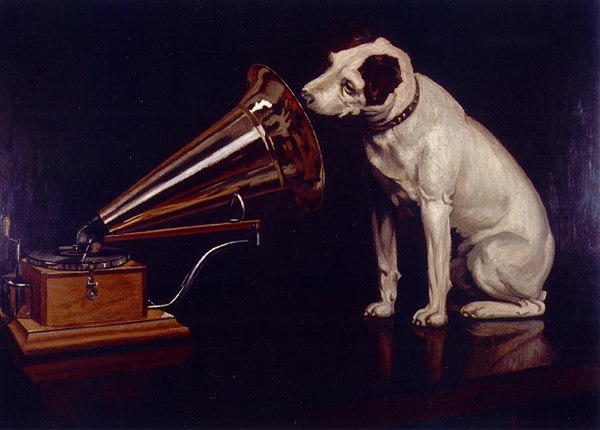
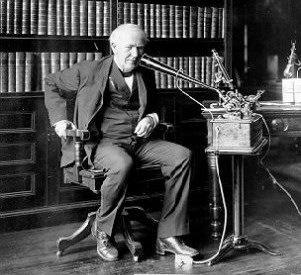
Records. The main merit of this device was that the sound recorded on foil could be reproduced. The initial recordings were simply indentations made on the surface of the foil by a moving needle. The foil was placed on a cylinder that rotated during sound playback. The device cost $18. Its public demonstration immediately made Edison famous. To many, the reproduction of sound seemed like magic, which is why some called Edison the ‘magician of Menlo Park.’ Edison himself was so amazed by this discovery that he said, ‘I have never been so stunned in my life. I have always feared things that worked from the first try.’
Successful demonstrations of this device took place in the same year in the United States and Europe. In 1879, the phonograph was also demonstrated in Russia. Over the following 40 years, Edison continuously improved his invention, obtaining an additional 80 patents. One of Edison’s greatest achievements was realizing that he could preserve the voices of great people of his time by sending the first batch of phonographs to renowned elderly individuals of his era. Thanks to this, in Russia, at the Literary Museum, one can hear the voice of Leo Nikolaevich Tolstoy.
Find the Best Professionals for Your Project
Expert repair, construction, and renovation specialists ready to help you right now
Recommended Galleries
Recommended articles




More Galleries
 Early morning in San Francisco, USA
 Alamo Square in San Francisco.
 Amazing night sky
 Cottage near Bristol, England
 The Cutest Friends – Daisy and Hannah
 The New Yorker Covers with Meaning: On the Borderline between Folklore and Current Events, These Covers Have Always Provoked Strong Reactions in Society and Been Subject to Criticists' Debate,</i><i>the world-famous literary and journalistic weekly</i><i> The New Yorker first published</i><i> these covers in</i><i> 1925.</i><i></i>\n "home_text": "<p>The world-famous literary and journalistic weekly</i><i> The New Yorker was first published</i><i> on February 21, 1925,</i><i>and it was aimed at
 Chung Mong-Ko: South Korean Billionaire, Entrepreneur, and Former Chairman of Hyundai Motor Group
 Who Invented Cured Salmon Under a Fur Coat?
 Eugene Valeryevich Grishkovets was born in the city of Kemerovo on February 17, 1967. In the ninth grade, he happened to attend a pantomime performance in Tomsk and became forever fascinated with theater. He then began attending theater workshops. After graduating from the Faculty of Philology at Kemerovo University, in 1991, Grishkovets founded a theater called "Loza" and produced ten plays within seven years. In 1999, he received the "Antibuker" award for his drafts of the plays "Notes of a Ru
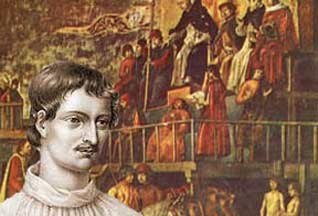 Filippo Bruno was born into a soldier’s family near Naples in 1548. In 1565, at the age of 17, Filippo Bruno entered a Dominican monastery, where he was given the name Jordanos. While studying science and reading the works of Nicolaus Copernicus, Jordanos Bruno came to the conclusion"</p>\n{\n "home_text": "<p>That the Church’s natural scientific views were incorrect. Jordanos began to publicly participate in debates across Europe, exposing the Church’s ignorance. Upon returning to Italy in 159
 Evening Venice is reflected in the water that approaches the buildings.
 In the ancient temple of Ta Prohm, Cambodia