The Baby Carriage of Little Bertha2 photos
The Baby Carriage of Little BerthaOn the eve of 1879, the young couple Karl and Bertha Benz tried in vain to start the "imprudent" engine designed by Karl. After dinner, Bertha said to Karl, \"We should try our luck one more time in the workshop. I have a feeling that something is drawing me there."\" They returned to the stubborn engine, adjusted it once more – and it finally started! As they welcomed the New Year, Karl and Bertha skipped the traditional dinner party, as they were already living in pure bliss. Karl’s father was a steam locomotive engineer. Perhaps that was why, whenever Karl drew locomotives as a child, they always looked like speeding trains. When he worked at a bridge construction company in Mannheim, he met the energetic Bertha Ringent. In 1871, the couple got engaged, and their family motto became \"Faith, hope, and struggle\".
A year earlier, Karl Benz had jointly founded his own factory with investors and began working on developing a two-stroke internal combustion engine. The experiments required significant investment, but for a long time, there was no result. The Benz family’s capital was dwindling quickly, and they were on the brink of poverty. Karl was ready to give up on the project when his wife’s perseverance convinced him otherwise. Her faith proved to be justified: the engine began to be produced in series soon after, and the company’s fortunes improved. Karl became completely obsessed with the idea of motor vehicles, but his partners were reluctant to \"waste money\". So Karl withdrew from the partnership and, together with his only assistant, Rosa, started a new factory.
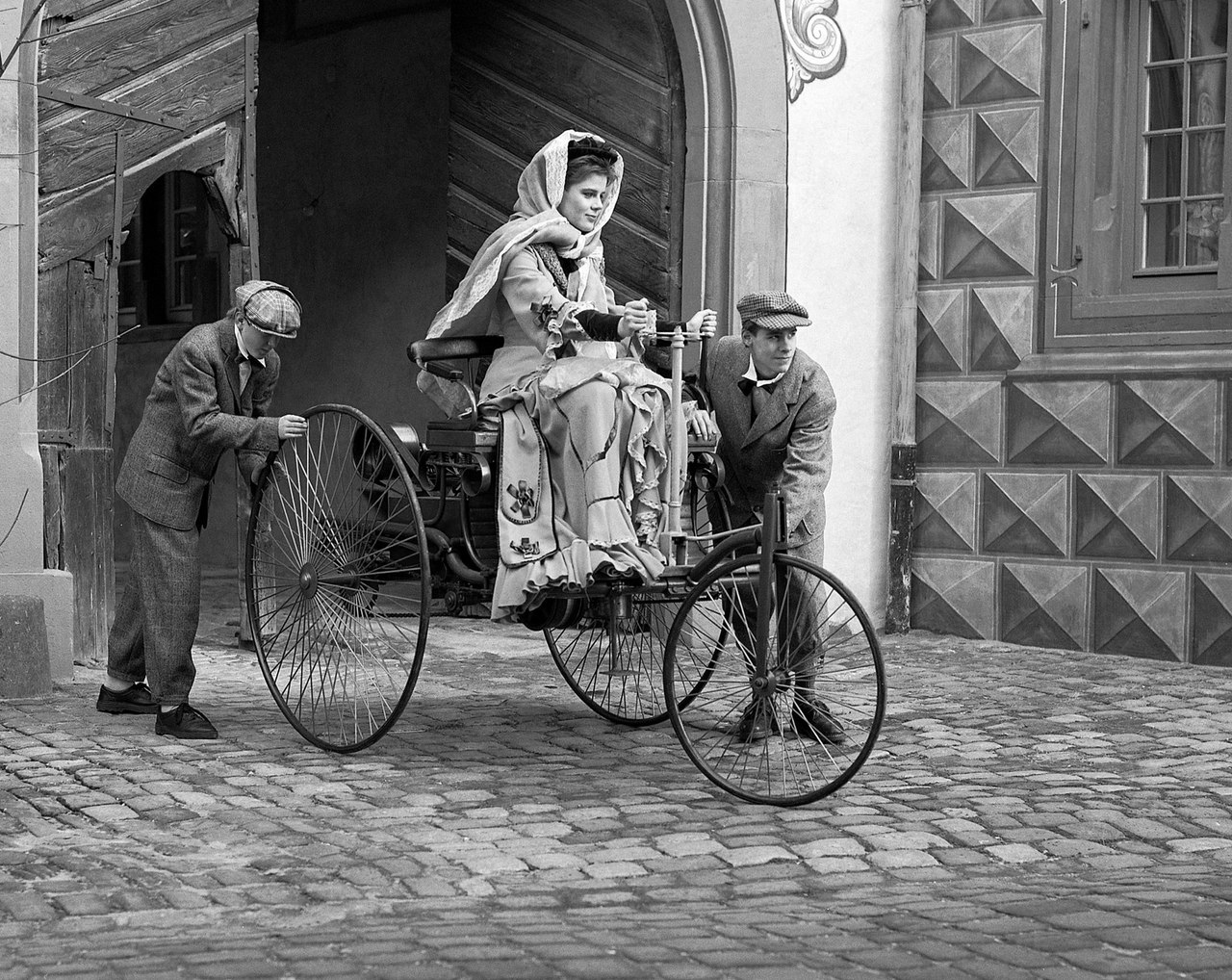
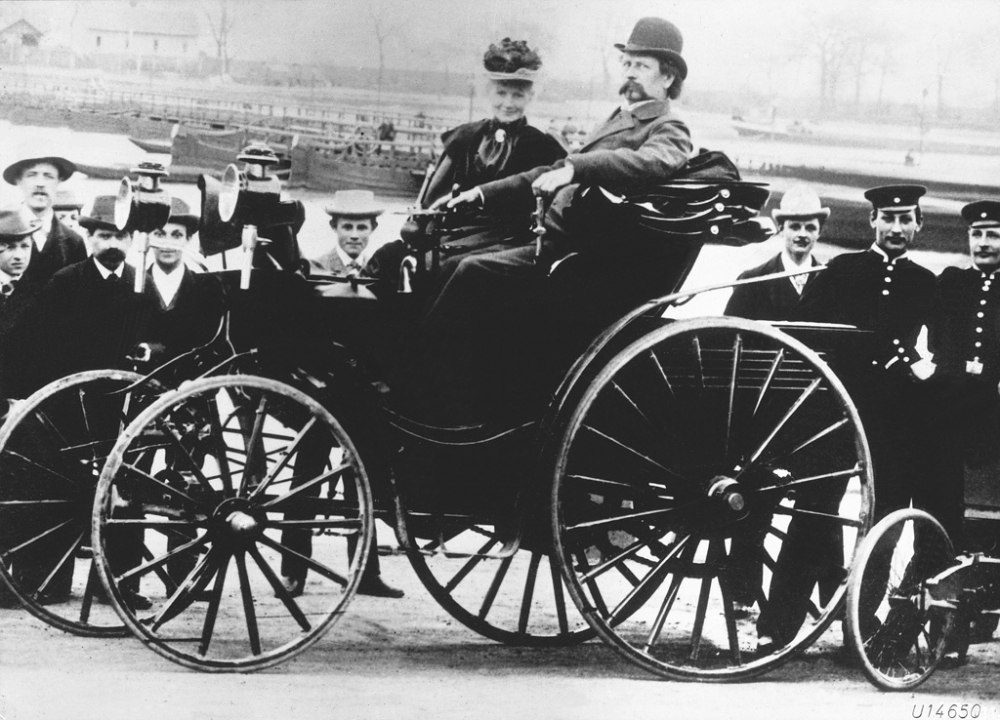
Now he could devote much more attention to designing the essential components of future automobiles: the differential, the high-voltage coil for the electric ignition system, and the carburetor – innovations that would soon become standard equipment in all cars around the world. In the spring of 1885, Karl began testing the first model. The vehicle often needed repairs outdoors just to make it back home. Some people mocked the inventor, while others sympathized with him; only one person never lost faith in Karl’s success – his loyal Bertha. By the end of the year, Karl’s creation, which he called \"a bicycle\", had truly become a motor vehicle. On January 29, 1886, he was granted a patent for the \"vehicle powered by a gas engine\“. The following spring, the inventor tested the vehicle on a deserted road around Mannheim. Two years later, he built several more three-seater cars. In one version, the third seat was located in front of the driver, and in the other, it was behind him, allowing the passenger to face the driver. These vehicles were more reliable than the initial model: they had stronger wooden wheels, a sturdier frame, and a more powerful engine that produced up to 2 horsepower. Karl was able to start mass-producing these cars, but sales were sluggish until something unexpected happened that turned the situation around.
Find the Best Professionals for Your Project
Expert repair, construction, and renovation specialists ready to help you right now
Recommended Galleries
Recommended articles



More Galleries
 Giant Waterfalls in the Icebergs of Svalbard National Park
 Paramount Pictures President Gail Berman Was Born Around 1956 in the U.S.
 The History of Brabus Brand
 10 Key Names in the Fashion Industry of the 20th Century
 On This Day 75 Years Ago, Vladimir Vyssotsky Was Born
 89 Years Ago, Petrograd Was Renamed Leningrad: Russia’s Most Beautiful City with Federal Importance, a Heroic City, and a Center of Science and Culture, as Well as a Major Sea Port
 Best Nature Photos of 2012
 Interesting Facts about the Eiffel Tower
 A Tour Through History: Soviet Cameras
 Lewis Carroll (whose real name was Charles Lutwidge Dodgson) was born on January 27, 1832, into the family of a parish priest in Cheshire. At the age of 12, he enrolled in a private school near Richmond and a year later continued his education at Rugby School. In 1851, Carroll...
 With the blessing of Tsar Alexander I, in July 1819, the first Russian Antarctic expedition set sail from Kronshadt. Its leader was Captain Second Rank Faddey Faddeevich Bellingshausen, who also commanded the three-masted schooner *Vostok*.</p>\n "home_text": "<p>Tenent Mikhail Petrovich Lazarev served as captain of the schooner *Mirny*. The task assigned to these experienced sailors was extremely challenging: they had to advance as close as possible to the South Pole at any cost, while “discov
 Russia's Day of Military Glory: The Day the Blockade of Leningrad was Lifted (1944)