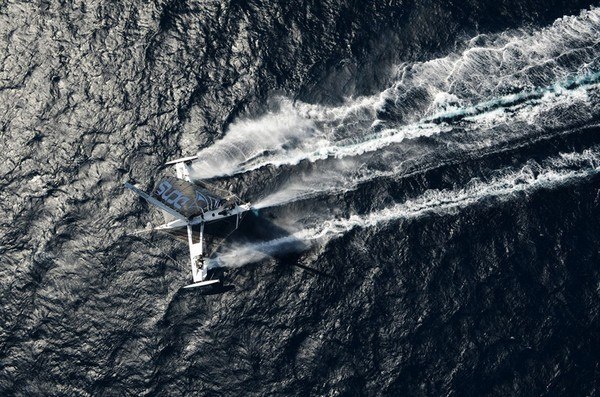
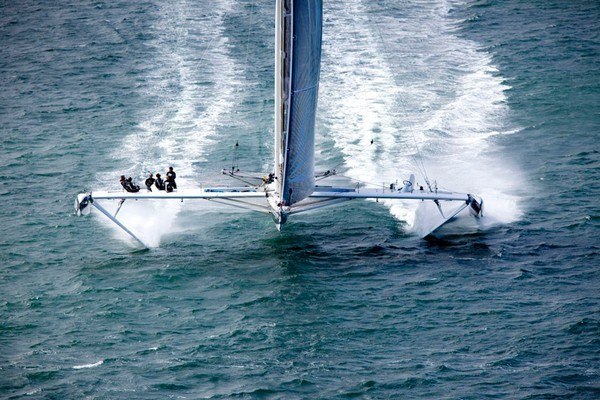
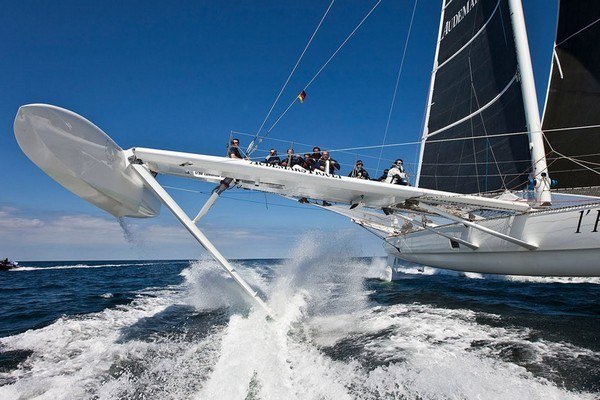
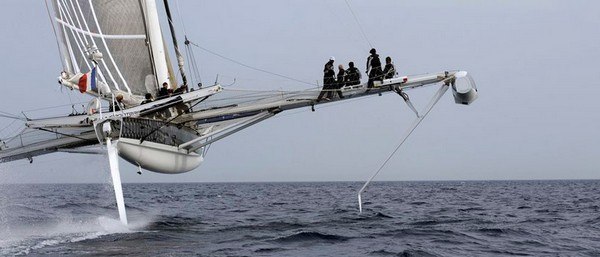
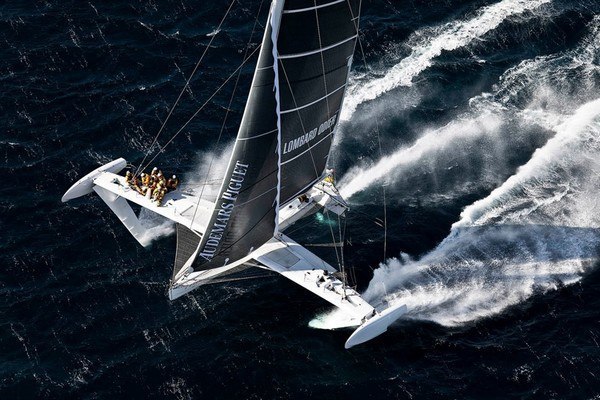
The Hydroptere is considered the fastest sailing ship in the world.5 photos
Although sailboats are currently going through a period of significant decline, new developments in this field continue to emerge, enabling modern sailing vessels to be faster, higher, and more powerful than their predecessors. One example is the “flying” ship Hydroptere – the fastest sailboat in the world! Hydroptere was created by a group of French engineers to demonstrate the excellent prospects of sailboats as means of water transportation. This vessel can reach speeds of up to 55.5 knots, which is equivalent to 103 kilometers per hour. Moreover, it does not move across the water’s surface but rather flies above it. The faster Hydroptere travels, the higher it rises above the surface, thanks to its underwater wings. As a result, the area of its hull that comes into contact with the water is reduced to just two square meters. Since its inception, the Hydroptere has continuously set new speed records, both on short and long distances. Its new goal is to cover the distance between Los Angeles and Honolulu, the capital of Hawaii, as quickly as possible. Needless to say, the Hydroptere does not rely on either electric motors or internal combustion engines; its only source of power is the wind. The very existence of the Hydroptere serves as a clear proof that sails should not be dismissed as mere relics of history–they have a promising future ahead of them!
Find the Best Professionals for Your Project
Expert repair, construction, and renovation specialists ready to help you right now
Recommended Galleries

Paintings by "the Russian Salvador Dalí" – Vladimir Kusha.

17-year-old boy Sam Burns died in the United States from a rare disease that causes the body to age prematurely.

10 Famous Cemeteries. There are many cemeteries around the world that function as sort of museums in their own right.

Photorealistic portraits by Rubén Belónso.
Recommended articles




More Galleries
- Paintings by "the Russian Salvador Dalí" – Vladimir Kusha.
- 17-year-old boy Sam Burns died in the United States from a rare disease that causes the body to age prematurely.
- 10 Famous Cemeteries. There are many cemeteries around the world that function as sort of museums in their own right.
- Photorealistic portraits by Rubén Belónso.
 Collection of incredible photographs depicting nuclear explosions.
 Sarah Mercy from Chicago, a 33-year-old mother of two children, claims to have the largest buttocks in the world and takes immense pride in that, as well as in her full-bodied figure.
 The narrowest residential building in the world is located in the United Kingdom.
 Both giraffes and okapis have very long tongues.
 The monument to the sleepwalker scares the girls.
 Landscape artist Dmitri Levin.
 Polish artist Krzysztof Lukasiewicz.
 Surrealist artist Mihai Criste.