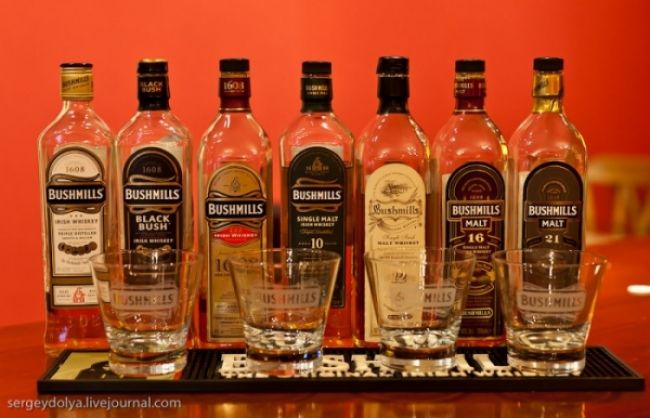
I wurde eingeladen, an einer Pressereise in das Land des Whiskys teilzunehmen – ins Land des irischen Whiskys...
Wie Whisky hergestellt wird
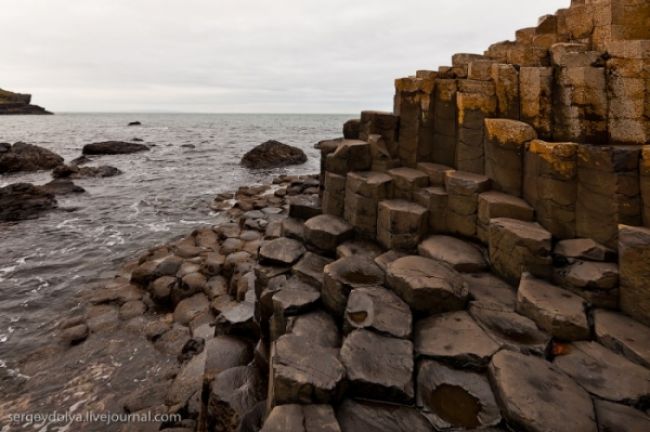
For three days, the weather remained overcast. But precisely because of this, I was able to concentrate fully on observing the entire process of making whisky and tasting its results. Since I have a great fondness for whisky and hold it in high regard, I made every effort to capture everything I saw and experienced through my sense of smell and taste in photographs. The distillery I visited is called Bushmills, named after the village where it is located. Incidentally, just 2 kilometers away from there lies the famous Giant’s Trail… But rather than going into details about the manufacturing processes that have already been extensively discussed, I will simply quote some text from Wikipedia.
The production process consists of the following main stages:
1.Preparation of barley malt or malting of barley. Barley is carefully selected, cleaned, and dried. Then it is soaked and spread out in layers 5 to 7 centimeters thick on the floor of the malting house to germinate over a period of 7 to 10 days. After germination, the grains are dried again. If the barley does not germinate, the resulting whisky is called grain whisky. In its pure form, it is hardly ever sold directly; instead, it is used in blends.
2. Drying of the malt. In Scotland, the malt is dried using hot smoke generated by burning peat, wood coal, and beech chips, resulting in what is known as „smoked grain“. This process gives the final product a distinctive smoky, iodine-rich, peaty flavor that distinguishes Scottish whisky from all other kinds. In Ireland, smoking is not used in the malting process.
3. Production of wort. The malt is ground into flour and mixed with hot water, then left to stand for 8 to 12 hours. This reaction produces a sweet liquid called wort. 4. Fermentation. Yeast is added to the cooled wort, and over the course of two days, it ferments at a temperature of 35 to 37 degrees Celsius. As a result of this fermentation process, a weak alcoholic beverage similar to beer is produced, with an alcohol content of around 5 percent. These first two steps are common to the production of many alcoholic beverages and are not specific to whisky alone.5. Distillation. The wort is distilled twice (or sometimes three times) in copper distillers called pot stills, which have the shape of a retort. In the first distillation apparatus, called a wash still, a liquid with an alcohol content of 25 to 30 percent is produced. This liquid is then transferred into a second distiller, called a spirits still, with a capacity of 6 to 21 thousand liters, where it is distilled once more. The final product of this second distillation process is whisky with an alcohol strength of up to 70 percent. During this second distillation, two portions of the distillate are separated: the „head“ and the „tail“. These parts are removed at the beginning and end of the distillation process, while only the middle fraction is retained. The remaining portions are added back into the liquid obtained after the first distillation. The design of these distillation apparatuses has a significant impact on the final flavor of the whisky. Each distillery uses pot stills with unique shapes and capacities; it is believed that taller and narrower distillers produce whisky that is lighter in flavor than those that are shorter and wider. When old distillers are replaced, new ones are made to exactly replicate their original design, down to the smallest details such as bumps and indentations, in order to preserve the same flavor. The resulting spirit is then diluted with water to reach an alcohol content of 50 to 63.5 percent. 6. Aging. Whisky is aged in oak barrels. Spanish oak barrels, originally used for storing sherry, are considered the most suitable for this purpose. This practice originated in the 18th century as a way to reuse barrels that had previously been used to transport wine from Spain. It has proven to be an extremely successful approach. If whisky is aged solely in such barrels, the manufacturer will indicate this as an additional testament to its high quality. Due to the limited availability of these barrels, alternative options include using American white oak barrels or those that have previously contained bourbon or been specially treated with cheap sherry. It is during the aging process in the barrels that whisky develops its distinctive color and flavor characteristics. 7. Blending. To create blended whiskies, different types of malted barley and grain whiskies, each with a distinct aging time, are mixed together. At least three years of aging is required for each type of whisky used in the blend. After this, they are combined and aged for several more months. Some recipes have been used for hundreds of years, but manufacturers continue to develop new blends or modify existing ones in response to market demands. The purpose of blending is to combine the advantages of different types of whiskies to produce a final product of superior quality. The first blended whisky to gain widespread recognition was Old Vatted Glenlivet, which was developed by Andrew Usher in 1853. In the United Kingdom, the production of blended whiskies is regulated by law since 1860. The person responsible for blending the whiskies plays a crucial role in creating a unique and consistent flavor profile. 8. Bottling. Before bottling, whisky is filtered through paper membranes at a temperature of between 2 and 10 degrees Celsius and then diluted with spring water to reach the desired alcohol content. If a blended whisky is labeled with an indication of its aging time, this figure refers to the youngest component in the blend. If a large proportion of the whisky in the blend is aged for 12 years or longer, it will be labeled as „De luxe“. This practice ensures that consumers can accurately understand the aging process involved in the production of this whisky. 9. Other interesting facts. During our visit to the distillery, we saw a device where barley malt was mixed with hot water and then pressed to extract all the liquid. A special bridge connected the distillery to a small island nearby. Walking on that bridge was a true pleasure. 10. Conclusion. Summary of the visited distillery and its production process.