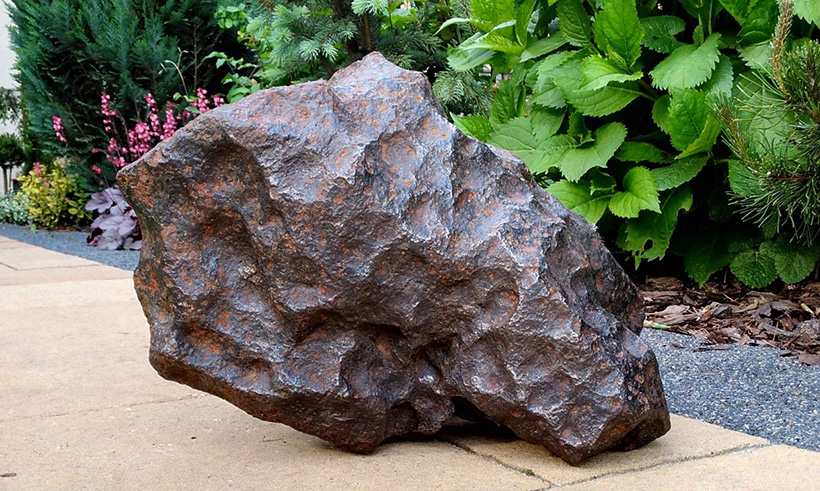
In the northern part of Argentina there is a terrain that the ancient Indians called Campo del Cielo, that is, the "heavenly field". According to legend, in this area, mysterious metal blocks often fell from the sky, which subsequently gave the name to this district.
Meteorite Field in Argentina
 Data on Campo del Cielo are preserved in old Spanish chronicles. In the 16th century the conquistadors found huge blocks of iron there and used them to produce swords and metal tips for spears. Especially in this succeeded Herman de Miraville, who in 1576 among the marshy lowlands accidentally discovered a huge batch of pure iron. Later he came to this place several times and chipped pieces of iron, which he used for his needs.

The age of meteorites is mainly determined by the depth of their occurrence in the layers of the earth's crust, or more precisely - by the tracks of these layers on the walls of the crater formed from the fall of the celestial body. It is believed that the age of the meteorite Campo del Cielo is about 4-6 thousand years. It is the second of the largest meteorites in the world ever found (after the Hoba meteorite).
In 1783, the head of one of the Argentine provinces Don Rubin de Selis, relying on the documents of the Spaniards, organized an expedition to the iron boulder. After a long search, this block was found. According to Rubin de Selisa, her weight was about fifteen tons. Despite the fact that later such expeditions were carried out repeatedly, because of the lack of documents with which to find this place, attempts to find the iron block again were unsuccessful.

Twenty years after the expedition of the prefect of Don Rubin de Celis in the area of Campo del Cielo, a meteorite was found, the weight of which was almost a ton. In 181, the largest piece of this meteorite weighing 635 kilograms was taken to the Argentine capital of Buenos Aires.
Soon a piece of this meteorite was bought by an Englishman Woodbine Darish and gave it to the British Museum. Currently, this piece of space iron is installed on the pedestal in front of the museum entrance. Previously, a part of the surface of the meteorite from Campo del Cielo was polished, so that the visitors of the museum had the opportunity to see the structure of the metal as "Widmannstätten figures", which testify to the extraterrestrial origin of this meteorite.

In the vicinity of Campo del Cielo, today fragments of meteorites from pure iron are found. Their weight varies from several kilograms to tens of tons. In 1980, in this area near the small town of Gansedo was found a fragment of a meteorite, which weighed 33 tons of 400 kilograms. Especially for studying the meteorite in Gandedo came the American scientist Robert Hug, who wanted to buy it and take it to the US, but the Argentine authorities did not give permission to do so.
At present, the meteorite found in Gansedo is the second largest meteorite ever found on Earth. The largest meteorite that fell on our planet is the Hoba meteorite, which weighs about 60 tons. The fact that a large number of meteorites was found in the Campo del Cielo region at different times suggests that a so-called "meteor shower" was observed earlier in the area. The proof is twenty six craters on the territory of more than 18 kilometers and an average width of about three kilometers. The largest crater called Laguna Negra has a depth of more than 5 meters and 115 meters in diameter.

According to experts, stones hit the ground at a speed of 14,400 km/h. Some meteorites have penetrated deep holes in the surface. For example, a 14-ton block created a tunnel with a length of 25 meters and a depth of about 8 meters. Before we part at the moment of entering the atmosphere, the asteroid weighed about 600 tons.
In 1961, Professor Cassidy from Columbia University came to Campo del Cielo, who at that time was the world's largest meteorite specialist. The scientist organized an expedition that discovered a large number of hexaderites, that is meteorites of small size, consisting of metal. These meteorites consisted of chemically pure iron, the proportion of which reached 96%. In addition, they contained a small amount of nickel, cobalt and phosphorus. The meteorites that were found in Campo del Cielo before that time also had the same chemical composition. It is for this reason that a scientist from Columbia University concluded that all these meteorites are fragments of one celestial body.

But Professor Kessidi was more struck by the fact that meteorites in Campo del Cielo were found at a distance of seventeen kilometers, while during the explosion of a large meteorite in the Earth's atmosphere, its debris scattered in the shape of an ellipse as much as 1,600 meters.
New expeditions organized for a more detailed study of Campo del Cielo revealed new fragments of meteorites even on the Pacific coast, and were also found thousands of kilometers from Argentina in Australia. In 1937, near the city of Hanbury, meteorites were found, which were located in an ancient crater with a depth of about 8 meters and a diameter of 175 meters. The largest of the meteorites found weighed 82 kilograms.

In 1969, an analysis was conducted to determine the chemical composition of the meteorite found near Hanbury, which showed that the meteorites found in Australia are almost completely identical to the meteorites found in Argentina. The area lying around the city of Hanbury is known for its large number of ancient craters, the largest of which reaches a diameter of 200 meters. Usually, such craters have a relatively small diameter, rarely exceeding 18 meters.
Since the mid-30s of the XX century, excavations have begun here, as a result of which more than 800 fragments of the meteorite, which consisted of pure iron, were discovered. Also near Hanbury were found four pieces of one large meteorite, the weight of which was 200 kilograms. Analyzing meteorites found in Argentina and Australia, Professor Kessidi concluded that several millennia ago a huge meteorite was rotating around the Earth around the Earth, gradually approaching the planet under the force of gravity. The meteorite could also be the second satellite of our planet.

This process could last more than a thousand years, but eventually this heavenly body approached our planet so much that it crossed the Roche border, entered the Earth's atmosphere and broke into fragments of different mass and magnitude. It was parts of this giant meteorite that were discovered in Campo del Cielo and Hanbury. With the help of radiocarbon analysis it was possible to determine the approximate date of the catastrophe - 5 800 years ago.
On the basis of these data, it can be concluded that the fall of a giant meteorite to the Earth occurred already during the existence of ancient civilizations, which left after themselves literary monuments containing a description of the catastrophe. It was in these descriptions that we found references to the second natural satellite of the Earth and the catastrophe that was caused by its fall. The Sumerians, writing on clay tablets, were the goddess Innan, who crossed the sky and emitted a frightening glow.

In ancient Greeks, the myth of Phaeton is a confirmation of the fall of a giant meteorite. The mysterious heavenly body, which was noticeable in the sky even in the sunlight, was also mentioned in the myths and legends of Babylon, Ancient Egypt and Scandinavia, as well as among the peoples and tribes of Oceania. The theme of the fall of the giant meteorite on Earth was reflected in the myths of all one hundred and thirty Indian tribes of Central and South America.
As noted by the American astronomer Pappers, there is nothing surprising in the fact that the description of the second natural satellite of the Earth and its fall found its mention among tribes and nationalities living at such great distances from each other. The fact is that metallic meteorites reflect from themselves sunlight, so they shine very brightly and are clearly visible in the sky even in the daytime. At the same time, the luminosity of a metallic meteorite, which is called a bolide, exceeds in its brightness the luminosity of the moon.

Due to the fact that the metal meteorite moved in an elliptical orbit, at certain periods it passed very close to the Earth's atmosphere. At this time the car was in contact with the upper layers of the atmosphere and was very hot. The glitter of his glow was visible even in the light of day. As the meteor moved away from our planet and entered the icy cold of the cosmos, it cooled down. It is the constant change in the temperature of the car, according to Paper, and led to the destruction of the meteorite.
The fragments and parts of the meteorite were found in a large area from South America to Australia. This fact allows scientists to put forward a hypothesis that the car has already split in its orbit, and then entered the earth's atmosphere in the form of a meteor shower. The largest pieces of the meteorite fell into the waters of the Pacific Ocean, thus causing waves of unprecedented dimensions that had bypassed the Earth.

In the myths of the Indians living in the Amazon valley, it is described that the stars showered from heaven, the earth was enveloped in gloom and the rain began, which flooded everything. In one of the Brazilian legends it is said that the water rose to such a height that the land was not visible, and the gloom and rain did not stop. Similar events are also described in the fifth book of the code of the Maya Indians, where it is said that the world collapsed, stars fell from the sky, while striking the sky with a fiery trail, while the earth was covered with ash and shaken from the tremors.
All these myths and legends describe the events that accompanied the catastrophe - floods, earthquakes and volcanic eruptions. Scientists believe that the epicenter of events related to the fall of the meteorite was in the Southern hemisphere of the Earth. Many researchers suggest that the events that followed the fall of the meteorite on Earth were vividly described in the biblical myth of the Flood.