Attention! We are buying watermelons!
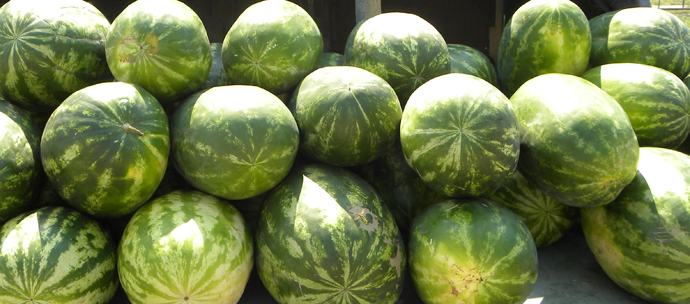
The main reason for our experiment was the news that the August harvest of watermelons would not be possible—all the melon fields had been destroyed by the scorching sun. “Either buy watermelons now, or forget about them until next year,” we decided, and so we went to the management with the request to support our efforts financially. Moreover, Mr. Tagaev himself, the head of the consumer market department, stated that starting in mid-July, melons could be safely consumed. According to him, 90% of the stores selling melons and watermelons at that time had all the necessary documents proving the quality of their products. Trusting Tagaev and his team, we decided not to delve into the issue of quality and instead focused on the taste of July-watermelons. At the same time, we wanted to test the effectiveness of those guidelines titled “How to Choose the Sweetest, Juiciest, and Sweetest Fruit.”
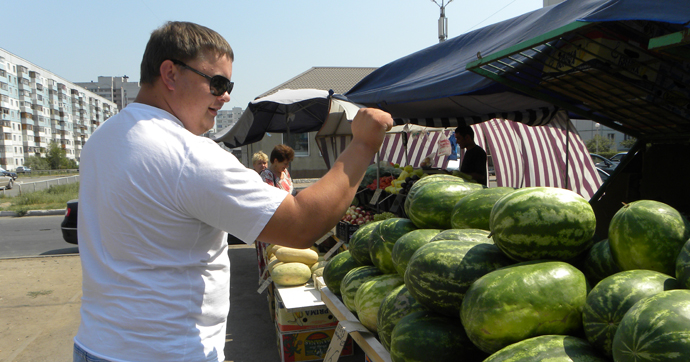

Criterion 1: Place of origin of the watermelon – Kamyshin, Volgograd, Astrakhan. Indeed, the sweetest watermelons come from the Volgograd region; those from Astrakhan are considered slightly less sweet. We were lucky—the stand we chose sold only Volgograd-watermelons. “This watermelon is very sweet,” read the confident label on the price tag.
Criterion 2: Size matters. Moderation is key here—avoid both too small and too large fruits; the perfect one should be of medium size.
Criterion 3: The lighter it is, the sweeter it is.The larger and lighter the watermelon, the more ripe it is. To check its ripeness, you can throw it into water—if it floats, it’s good. Unfortunately, our seller didn’t have a container of water, so we had to rely on our own judgment.
Criterion 4: A resonant sound when tapped. When you tap a ripe watermelon, it should make a clear, resonant sound, not a dull one. We honestly “tapped” dozens of watermelons, creating a sort of summer symphony with their sounds.

Criterion 5: A green stem.If the stem of a watermelon is green, it means it was harvested before it was fully ripe. Most of the watermelons we saw had fresh, firm stems, which led us to doubt the claims that this year’s watermelons had reached their peak ripeness in early July. It was likely that panicked fruit growers had done this to avoid losing their August harvest.
Criterion 6: A bright, shiny rind.A ripe watermelon has a hard, shiny rind that is difficult to pierce with a fingernail. This happens because once the watermelon leaves the vine, it can no longer absorb moisture, causing its rind to harden. The stripes on the rind should be very distinct.
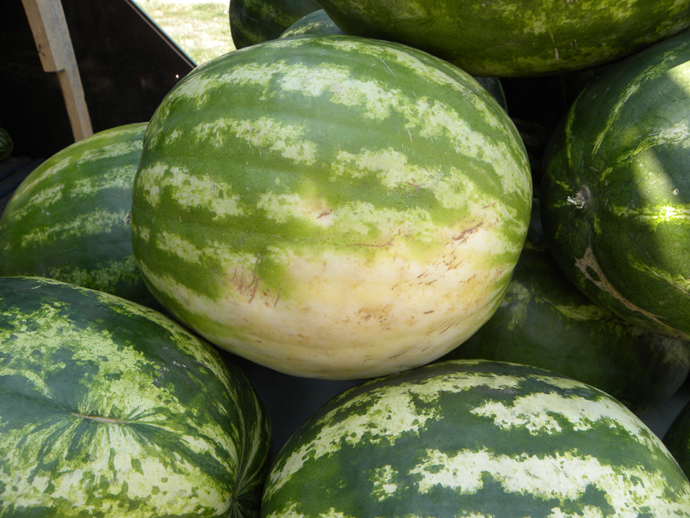
Criterion 7: The “birth mark” on the watermelon.
The side of a watermelon should have a light yellow-orange spot. Non-professionals might think this is a sign of poor quality, but true connoisseurs insist that it’s essential. As the watermelon ripens, it stops producing chlorophyll, which gives it its green color and helps it absorb sunlight. The appearance of this spot indicates that the watermelon is ripe.Criterion 8: “Girls” vs. “boys.”
Watermelons are hermaphroditic fruits. The “male” variety has a bulging base and a small ring on top, while the “female” variety has a flatter base and a wider ring. “Female” watermelons are considered sweeter, as they contain fewer seeds and more sugar.After carefully examining all these criteria, we began our search for the perfect watermelon that met all eight requirements. This took some effort from us and the seller—fortunately, he was also eager to help and joined in the selection process. “Too big… The stripes are too pale… The spot doesn’t look right… The stem is too green… It’s a ‘male’ watermelon; we need a ‘female.’ The sound it makes is dull…” We kept insisting. Finally, Alexander exclaimed, “Oh, this one is perfect!” The seller nodded in agreement and weighed our ideal watermelon. It weighed 107 rubles, but they only allowed us to pay 100 rubles, saying the difference was a thank-you for all the fun we brought them.
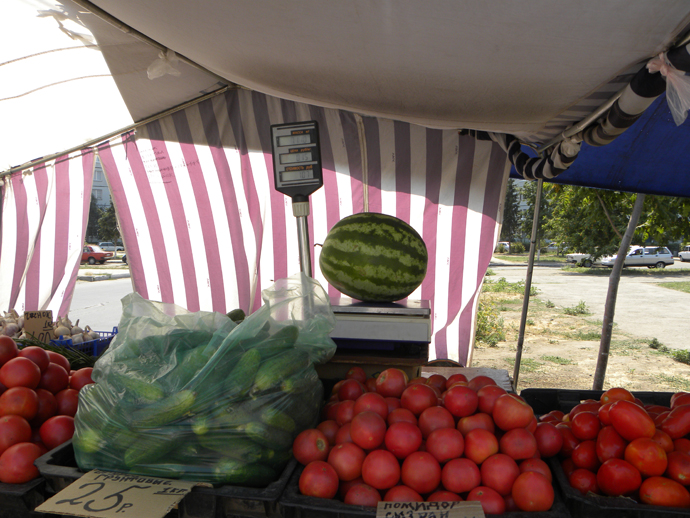
Result:The watermelon didn’t live up to our expectations. After bringing it to the office, we handed it over to the most practical person in our editorial team—a man who taught us how to cut a watermelon properly. Unfortunately, it wasn’t a masterpiece of melon-growing. It was pink, watery, and not particularly sweet. We came to two conclusions: either those guidelines were completely useless, and we should rely solely on our intuition and experience when choosing watermelons, or the watermelon season hadn’t actually begun yet, despite what the agronomists said.

Nevertheless, our less-than-ideal watermelon was enjoyed by everyone in the PRO-OTDYH team. While those still interested were discussing the current watermelon situation, we already had plans for another experiment… But that’s another story for another time...
PRO-OTDYH
Find the Best Professionals for Your Project
Expert repair, construction, and renovation specialists ready to help you right now