Observatory Mount John in New Zealand. Today we will talk about astronomy. Not far from the city of Tekapo is the main astronomical observatory of New Zealand.</p>
Articles
Virtual Travel

Observatory Mount John in New Zealand. Today we will talk about astronomy. Not far from the city of Tekapo is the main astronomical observatory of New Zealand.</p>

It is located at an altitude of one kilometer on Mount John, and so it is called - Mount John. The place is not chosen by chance: it is here that the percentage of clear clear nights is high during the year, and the sky is dark due to the absence of city light. The complex belongs to the University of Canterbury, however, it is used not only for scientific purposes - every year thousands of tourists come to Tekapo to look at the stars and the inverted moon of the Southern Hemisphere ...

We were at the observatory twice - once in the afternoon, and then at night. During the day he took several photographs of the astronomical complex

The very same tour took place at night. From 18:00 the entrance to the observatory is closed and it is possible to enter the territory only on official transport. This is done so that the light of car headlights is not blinded by scientists who work on telescopes. A bus with visitors rises along a serpentine without headlights. With the weather we were not very lucky - there was a full moon and the brightest moon lit up everything that could be. If there is a polar star in the Northern Hemisphere, which indicates the location of the pole, there is no such star in the Southern Hemisphere. How to get out of the situation? To the left of the pointer you can see four bright stars - this is the southern cross. Under it there are two more bright stars. If we draw a line between them and continue the line of the cross, the South Pole will be at the intersection of imaginary lines

The observatory has a special device for photographers - tracking mount. This is a platform that compensates for the rotation of the earth, which allows you to photograph stars at long exposures, avoiding blurring. And it, as you know, becomes noticeable on shutter speeds more than 15 seconds, depending on the lens you use for shooting (on the width you can make shutter speeds longer, and on the TV and 15 seconds there may be many). In this photo, the exposure is 1 minute. The idea should be to see the Milky Way, but because of the moonlight, it came out not so bright and clear

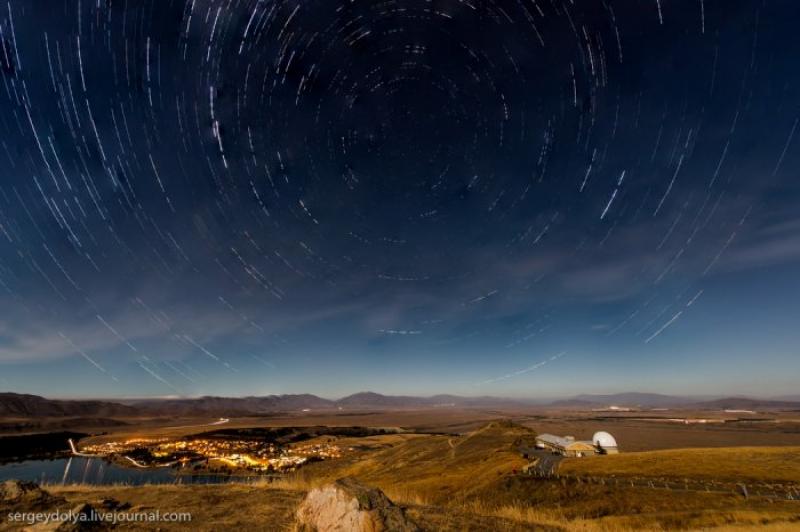
The night sky with Tekapo lights

Through the telescope you can take a picture of the moon. It does not look the same as we used to see it - for us, the inhabitants of the northern hemisphere, it seems turned upside down.

I had two cameras: one I set to shoot stars on long exposure, the second carried with me

In the astronomical complex 5 telescopes from 0.4 to 1.8 meters in diameter:

I aimed the camera at the south pole and put it on a long shutter speed (4 minutes) - it turned out to be the axis of rotation of the earth. Then he stacked 10 consecutive shots in one. It is a pity that there was a full moon and the stars turned pale:

Stay Tuned!

It is located at an altitude of one kilometer on Mount John, and thus is named Mount John. The site was chosen deliberately: it experiences a high number of clear, starry nights throughout the year, and the darkness of the sky is undisturbed by urban light. The facility is owned by the University of Canterbury, but it is not used solely for scientific purposes. Every year, thousands of tourists visit Tekapo to observe the stars and see the inverted moon of the Southern Hemisphere...

We visited the observatory twice – once during the day and once at night. During the day, I took some photos of the astronomical facilities.

The actual tour took place at night. Starting at 6 pm, access to the observatory was closed, and visitors could only enter the premises using official vehicles. This was done to prevent the light from car headlights from disturbing the scientists working at the telescopes. The bus carrying the tourists climbed a winding road without turning on its lights. Our weather conditions were not ideal: it was a full moon, and the bright light of the moon illuminated everything in the area.

{ "p1": "

The observatory is equipped with a special device for photographers – a tracking mount. This platform compensates for the rotation of the Earth, allowing long-exposure photography of stars without blurring. Blurring becomes noticeable after 15 seconds or more, depending on the lens used. With a wide-angle lens, longer exposures are possible, while a telephoto lens may result in blurred images even at shorter times.

", "p2": "

Night sky with the stars of Tekapo.

Night sky adorned with the twinkling lights of Tekapo.

", "p3": "

Through a telescope, the Moon can be photographed. It appears differently from how we are accustomed to seeing it – for those of us in the Northern Hemisphere, it looks upside down.

", "p4": "

I brought two cameras with me: one was used for long-exposure star photography, and the other was carried for general use.

", "p5": "

The astronomical complex boasts 5 telescopes, ranging in diameter from 0.4 to 1.8 meters.

", "p6": "

I focused my camera on the South Pole and set a long exposure time of 4 minutes. This allowed me to highlight the Earth’s axis of rotation. By combining 10 such consecutive images, I created a single composite image. It’s a shame that the full moon made the stars appear faint.

", "p7": "

Stay Tuned!

" }

Recommended articles

Find the Best Professionals for Your Project

Expert repair, construction, and renovation specialists ready to help you right now