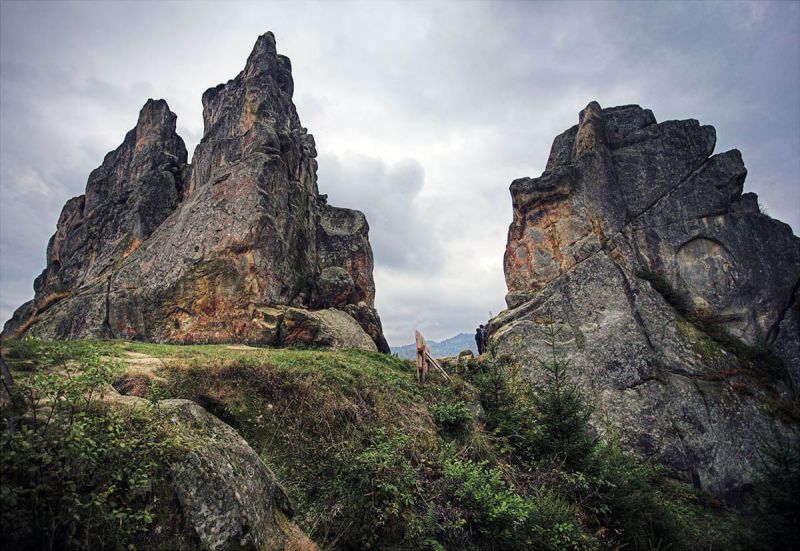
Uritsky rocks
In the 11-13 centuries there was an ancient fortress Tustan, which served as a defense against the Tatar-Mongol conquerors. Initially it was wooden, several times rebuilt, supplemented by stone buildings, and natural rocks served as its walls. Successful location contributed to the fact that the fortified city was the connecting link of trade routes as a control point to the Carpathian passes. It was a kind of border customs center between the Galicia-Volyn principality and Hungary, and later & ndash; The Polish Kingdom and Hungary.
The castle existed until the 16th century, then, losing the role of customs, fell into decay. Till now some of its remains have been preserved, grottos, wells, underground passages, wooden constructions of the 10th century cut down in the rocks: fragments of beams, boards with cuttings, shingles and much more. Also in the rocks were found leather goods, ceramics, glass, metal products: a cross, a finger ring with an engraved bird's drawing, a bronze mace of the 13th century, a sledge hammer, an ax, arrowheads and spears, etc. These and many other finds you will see in the museum history of the fortified city & la Toustan & raquo; in the village of Urich.
But most of all you will be impressed with petroglyphs & ndash; rock paintings. They confirm the existence of pagan cultures in these territories. Most petroglyphs & ndash; these are solar signs & ndash; symbols of the Sun, which was very revered by the ancients. Throughout the world, you can find these signs, but their meaning has not been fully deciphered yet, therefore they represent a special archaeological and historical value. Also you will see a two-meter image of a person's face, a rider on a horse or a wolf dancing a person, the wheel of Jupiter and many other images carved on rocks.
To see the Uritsk rocks, you can take advantage of the original "Carpathian tramway" rak. It is a fascinating tourist route, which runs along the old narrow-gauge railway, which once in the 19th century connected Bojkovschina and Austria-Hungary. The two-day tour begins and ends in Lviv, encompassing the most interesting places: the Museum of the State Historical and Cultural Reserve Tustan, Uritskie Rocks, the Goshevsky Monastery on Yasnaya Gora, an excursion by the narrow-gauge railway of the Mizunskaya branch, etc.
Find the Best Professionals for Your Project
Expert repair, construction, and renovation specialists ready to help you right now