A Dream Named Panamera
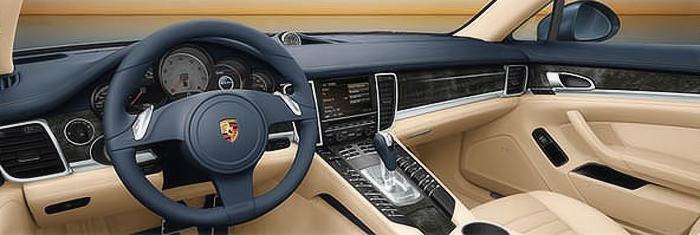
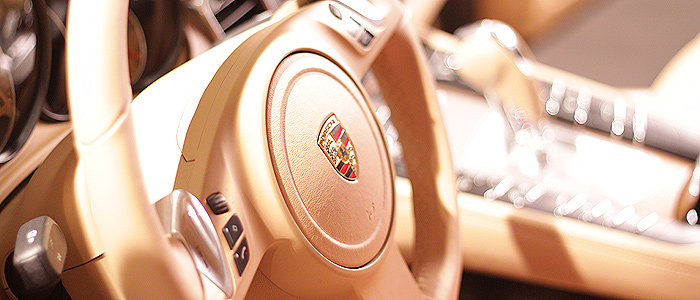
In the interior design of the Panamera, one can clearly see Porsche’s signature style: there is no excess in the decorative elements of the front panel or the instrument cluster. The interior is crafted using materials of the highest quality. Critics have noted that only the controls on the main console fail to match the overall standard of refinement. Natural leather is used for the interior seating, while the specific colors and finishing options are up to the customer’s preference.
The information and entertainment features, as well as the comfort amenities offered in the Panamera’s interior, are in line with the price of a vehicle in this class. If your requirements are even more extensive, be prepared to spend several tens of thousands of dollars to customize the car further from the range of available options. For example, you can opt for rear seats with ventilation, adjustable seating positions, and heating.
As for the technical specifications of the Porsche Panamera, engineers are still in the process of finalizing them. For now, there are only two versions available regarding the powertrain options. The first version features a 32-valve, non-turbocharged V8 engine – which bears some similarities to the Cayenne’s powerplant. The second version is equipped with a bi-turbocharging system.
The Panamera’s engine is a full-metal construction with a displacement of 4,806 milliliters. Gasoline is directly injected into the combustion chamber. With a compression ratio of 12.5, this engine can generate 400 horsepower at 6,500 revolutions per minute, and its maximum torque reaches 500 Newton-meters. It’s worth noting that the turbocharged V8 version can achieve 500 horsepower at just 6,000 revolutions per minute, while its torque is an impressive 700 Newton-meters. The non-turbocharged V8 is paired either with a manual 6-speed gearbox or with ZF’s 7-speed “robotized” PDK dual-clutch transmission, which allows seamless gear shifts without any interruption in power delivery.
The Panamera features rear-wheel drive as standard, but a 4WD system is also available. There is no traditional center differential; instead, the front axle is automatically connected to the rear axle via an electronically controlled multi-disc clutch, similar to the xDrive system used in BMW vehicles. The Turbo version comes standard with the 4WD system.
Porsche has equipped the Panamera with top-quality suspension components. Upon request, customers can opt for pneumatic shock absorbers that provide a smoother and more stable ride, reducing body roll during turns. At a speed of 30 kilometers per hour, pressing a button raises the vehicle’s chassis by 20 millimeters, allowing it to navigate uneven terrain without getting caught on bumps.
When driving at higher speeds, the chassis drops by 2.5 millimeters, making the car more responsive and easier to handle. The PASM electronic suspension system, with Normal, Sport, and Sport Plus settings, allows drivers to adjust the damping according to road conditions and personal preferences. The PDCC dynamic stability control system, combined with the pneumatic suspension, further enhance the Panamera’s driving performance.
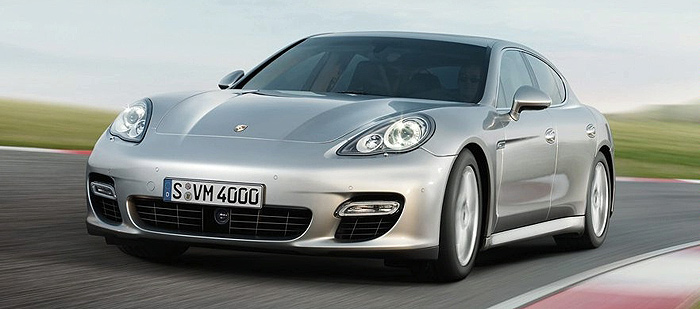
Both the front and rear wheels of the Panamera are equipped with 18-inch light-alloy rims, but different sizes of tires are used. The Turbo version comes with 19-inch wheels, and 20-inch tires are also available as an option. The front brake discs measure 360 millimeters in diameter, while the rear ones are 330 millimeters. For an extra fee, ceramic brake discs can be installed, which would further complement the car’s high-performance capabilities.
The dimensions of the Porsche Panamera are as follows: length – 4,970 millimeters, width – 1,931 millimeters, height – 1,418 millimeters, wheelbase – 2,920 millimeters, and track width – 1,658/1,662 millimeters. The body and structural framework are made of ordinary sheet steel. Probably, if aluminum alloys had been used instead, the car would have performed even better, but it would also have been significantly more expensive.
The Panamera boasts excellent aerodynamics, with a drag coefficient of just 0.29. Its outstanding handling qualities are also thanks to features such as the Venturi exhaust system, which helps keep the vehicle close to the road surface at high speeds, the retractable spoiler at the rear, and various advanced aerodynamic designs.
The weight of the Porsche Panamera S model with manual transmission and rear-wheel drive is 1,855 kilograms. The test version of the car weighed 1,865 kilograms, with the front and rear axles bearing 53% and 47% of the total weight, respectively. The more powerful Panamera 4S model weighs 1,925 kilograms, with a weight distribution of 53.4% and 46.6% between the front and rear axles. The Porsche Panamera Turbo can accelerate from 0 to 100 kilometers per hour in just 4.2 seconds, and its top speed is 303 kilometers per hour. Its fuel consumption is 12.2 liters per 100 kilometers.
Find the Best Professionals for Your Project
Expert repair, construction, and renovation specialists ready to help you right now
Recommended articles
More articles:
 10 of the Best Domestic Films
 What stands out about last football season?
 NEW RELEASES IN THE THEATRES: September 9th
 AUTUMN: 15 DISTINCT CHARACTERISTICS
 Next in the program...
 DRIENDS! How many meanings are contained in that word...
 Internet myths claim that beauty is a terrifying force.
 Affordable Vacation