I was invited to participate in a press tour to the country of whiskey. Irish whiskey ...
How do whiskey

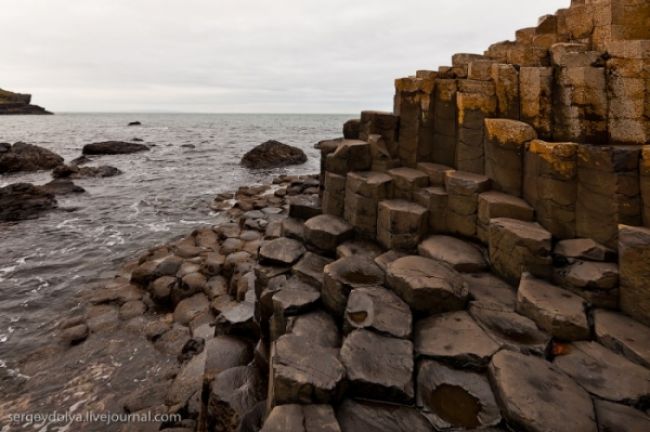
The weather was dull for 3 days. But the better I was able to concentrate on contemplating the process of making and eating its fruits. And since I very much love and respect whiskey, I tried to capture everything I saw and felt with my own sense of smell and taste in the photo. The distillery where I visited is called Bushmills by the name of the village in which it is located. By the way, 2 kilometers away from it is the famous Velikan Trail ... In order not to reinvent the wheel and not to talk about the production technologies, which already have already been said enough, I will quote an excerpt from Wikipedia.
The production process consists of the following basic stages:
1.Preparation of barley malt, or the addition of barley.Barley is carefully sorted, cleaned and dried. Then it is soaked and sprinkled with a layer of 5? 7 cm on the floor of the malt for germination for 7? 10 days. The sprouted grain (malt) enters the drying stage. If the grain is not germinated, the whiskey obtained is called grain. In its pure form, it is almost not available for sale, but is used for blending.
2. Drying the malt.In Scotland, malt is dried with hot smoke from the combustion of peat, charcoal and beech shavings, thus obtaining a & laquo; smoked grain & raquo ;. As a result, the finished product has a characteristic smoky iodide-peat flavor, which distinguishes Scotch whiskey from all the others. In Ireland smoke for malt drying is not used.
3. Getting the wort.The malt is grinded, grilling, mixed with hot water and aged for 8-12 hours, resulting in a sweet liquid (wort).
4. Fermentation.Yeast is added to the cooled wort, and fermentation is carried out for two days at a temperature of 35 ° C to 37 ° C. As a result of fermentation, a weak alcoholic beverage is obtained, similar to a beer (wash) with a strength of about 5%. The third and fourth stages are characteristic for the production of many spirits and for whiskey are not specific.5. Distillation.Braga is distilled two (sometimes three) times in copper stills (pot still), having the form of a retort. As a result of the distillation in the first machine (wash still) with a volume of 7 * 23 thousand liters, a liquid with a strength of 25 * 30% is obtained, bearing the name of 'weak wine' & raquo; (low wines). It enters the second apparatus (spirits still), having a volume of 6 * 21,000 liters, and is distilled one more time. The second distillation product is whiskey with a strength of up to 70%. During the second distillation, separate the & raquo; and "tail", i.e. those portions of the distillate that exit the apparatus at the beginning and end of the distillation process, and only the middle fraction is withdrawn. The remaining & laquo; head & raquo; and the & lt;/RTI & gt; tail & lt; is added to the low wines and again sent to distillation. The shape of distillers strongly influences the final taste of whiskey. Each distillery has pot stills of its own shape and capacity. It is believed that high and narrow distillation apparatusYou give whiskey lighter and thinner than small and broad. When old machines are replaced, new ones are manufactured, accurately reproducing the shape of old ones, down to defects (bumps and dents) to preserve the taste of the whiskey produced. The resulting alcohol is diluted with water to a strength of 50-65% vol.
6. Excerpt.Produced in oak barrels. The most suitable are Spanish barrels from sherry. This element of technology appeared in the XVIII century. with the aim of re-using barrels in which wine was imported from Spain, and proved to be extremely successful. If the whiskey is aged only in such barrels, the manufacturer reports this as an additional evidence of a high quality drink. Since such barrels are not enough, use barrels from American white oak, previously containing bourbon or specially processed with cheap sherry. It is at the stage of barrel aging that the whiskey acquires characteristic color and flavor characteristics: it darkens, becomes softer, gets an additional flavor.
7. Blending.To obtain mixed whiskey (Blended whiskey) mix different varieties of malt (from 15 to 50 varieties) and cereal (3? 4 grain grain whiskey) whiskey for different periods of aging (at least 3 years). Then they are combined and kept for several more months. Some recipes are hundreds of years old, but manufacturers are developing new ones or modifying old ones in accordance with market requirements. The idea of blending is to use cheap grain whiskey, to obtain a product of standard quality and to combine the best properties of different malt whiskeys in one ready-made drink. The first mixed whiskey, widely distributed, Old Vatted Glenlivet, was developed by Andrew Usher in 1853. The production of mixed whiskey in the UK is regulated by law from 1860 on. The master blender is a complex task of mixing varieties of malt and grain whiskey, not only to create a unique blend, but also aKeep his consistency from year to year. Each master selected for blending whiskey should be tasted immediately after distillation, as well as during its maturation in barrels. There are two types of blending:
* Different varieties of malt and grain whiskey are mixed in special vessels, where they are kept for 24 hours. Then this mixture is placed in barrels and after a few weeks bottled. This results in a cheap whiskey;
* * select different varieties of malt whiskey, then in special vessels mixed with grain whiskey. In order to improve the quality of the blend, it is aged for 6 m 8 months in oak barrels. This period is called a "wedding". This produces a more expensive high-quality whiskey.
8. Filling.Before bottling whiskey is filtered through paper membranes at a temperature of 2 to 10 ° C and diluted with spring water to the required strength. If the bottle of mixed whiskey indicates the period of its aging, it refers to the age of the youngest whiskey entering the blend. If the blend is large share of old (from 12 years old) malt whiskey, then in the name of the whiskey there is the word De luxe. In this vat get must. The knives cut the malt flour mixed with hot water and squeeze all the water (wort)

Inside the process of fermentation

The most fascinating attraction, the finale of which is & ndash; alcoholic knockout. Slowly lowering his head into the vat, you absolutely do not expect the lightning smell of alcohol. It's simply impossible to describe my feelings

Copper distillers (pot still), having the form of a retort. Distillation in Ireland occurs 3 times in contrast to Scotland, where they are lazy and do just 2. The constructions somehow reminded the story of Hauf about the glassblower from the 'Cold Heart'

The number 2 on the machine means that it is intended for the second distillation. Inside it is a spiral, and the principle of action completely resembles the work of an electric kettle

Most of all we were all interested in a pipe with a white inscription, which we dubbed & laquo; alcohol pipe & raquo ;. It's strange, but to dig a hole and stay there we were not allowed to live

Barrels. There are many barrels. In total 3 barrels are used. Each of these barrels, which previously contained "Bourbon & raquo; from Kentucky, can only be used 3 times. And there is such a pack as much as $ 100 apiece. They have only 200,000 barrels. A produce whiskey 6.5 million liters per year

Each barrel is fired. The drink in it keeps the ability to breathe. The smallest pores in the tree allow oxygen to penetrate inside, oxidizing ethanol. So whiskey and gets its wonderful taste

As a sign of staying at the distillery, we all signed on to the barrel. After 5 years, it & quot; ripens & quot; Excellent whiskey, for which I will once again come to Bushmills

There is also my signature. The question mark was attributed to Azamat without my knowledge & hellip;

Tara, driven by the strength of one person, is sent to the warehouse, where it will spend the next few years:

That's what the workshop looks like. On the screw conveyor, the corrugated container is lowered from above:

A fascinating process of bottle movement:

Sparkling amber of whiskey:

Please note that all workers in European industries use ear plugs. Obligatory condition of labor protection:

A ready drink, poured into barrels. Believe me, there's a lot of it:

Local & laquopanorama & raquo ;. This probe needs to be scooped up and, without straining, pour the whiskey into the cooked glass. Probe length & ndash; 1 meter & hellip;

In the hands of the girl this process looks extraordinarily beautiful. However, she poured out whiskey. And I, thanks to my natural prudence (and modesty), guessed to intercept the probe and did not spill a drop:

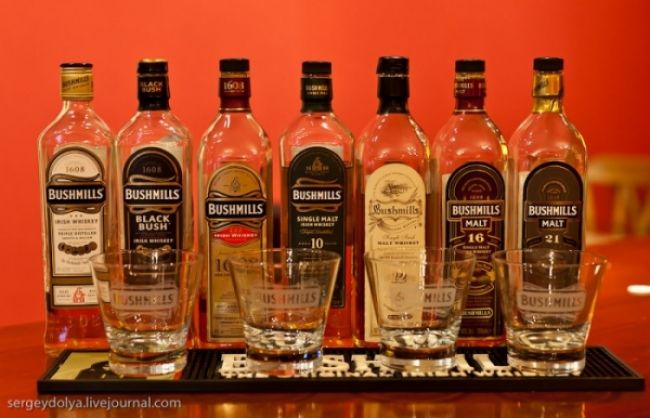
All the distillery produced by the distillery

Everything is ready for tasting. Covers & ndash; glass, holding the aroma inside the glass:

Master Blender or & quot; Chief Manufacturing Engineer & quot; told how to properly drink whiskey. The most important rule: to have fun and it does not matter if you get it by mixing whiskey with cola or apple juice, whether you add ice or water to it. The most important thing is that you like:

The tasting was as follows: We first chattered whiskey in a glass, watched it flow down the walls back down, sniffed, took a sip and savored. The Blender Master also listened & quot; whiskey:

Before each tasting, he uttered a toast like these: When you drink - you get tired,When you get tired - you fall asleep, When you sleep - you do not sin,When you do not sin - you get into paradise. So let's drink to getting to paradise! Or: Let's drink to our wives and girlfriends! And for that they never met! After the first sip, we diluted the whiskey with a little water. It was possible to observe how the water is beautifully mixed in a glass. Water is added in order to & quot; break & quot; The surface of the whiskey and fill the glass with its fragrance:

Every time on tastings I am amazed how the masters beautifully describe the taste of the drink. They manage to find in it shades of raisins, hints of nuts or something else, which is clearly not there. Listen and see for yourself: Nominal bottle of whiskey & ndash; my. As evidenced by the inscription on it. Managed to make a mistake in the name:

Concluding the alcoholic theme, I want to show 2 more drinks that we drank on the trip. & laquo; Harp & raquo; & ndash; a real Irish camp with a great taste:

Guinness Experiment & raquo; which will be conducted for 3 months. The company first released the camp and watched consumer demand. Sold only in Ireland. I liked:

The surrounding space pacifies. There is no anxiety in it. But at the same time it is a land for strong people. This is felt:

A small islet next to Bushmills, with which it is connected by a rope bridge

Go through it & ndash; sheer pleasure:

The old hut that was built on the island even before it was connected by a bridge:

Azamat, who organized this trip, tries to understand the essence of Ireland:

And even here they say that Irish whiskey is created to drink, and Scottish, to them to wash the car. They joke, probably, and maybe, really & hellip; Stay Tuned!