Fingal's Singing Cave5 photos
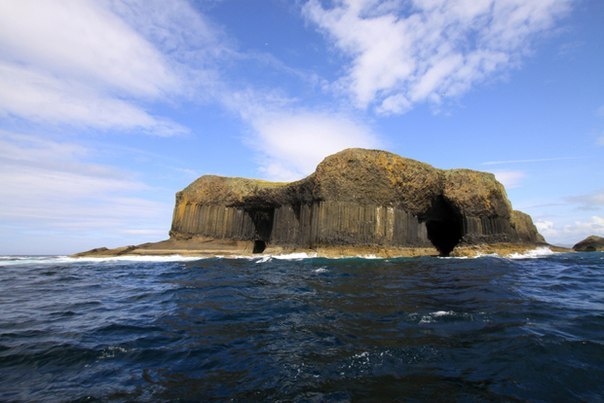
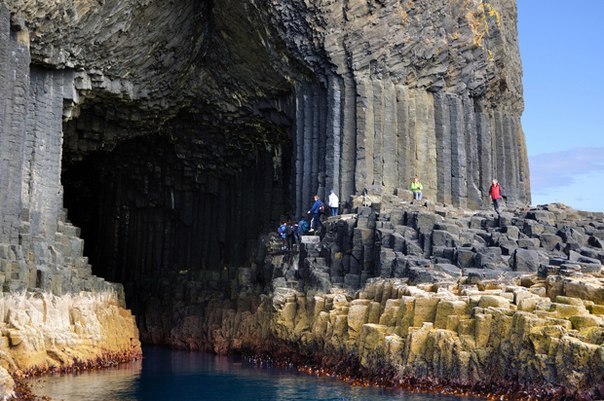
Staffa Island is the smallest island within the Inner Hebrides. It covers an area of just 33 hectares, and its highest point rises 42 meters above sea level. The island became famous in 1722 when the renowned English naturalist Joseph Banks (1743–1820) visited it and described Fingal’s Cave.
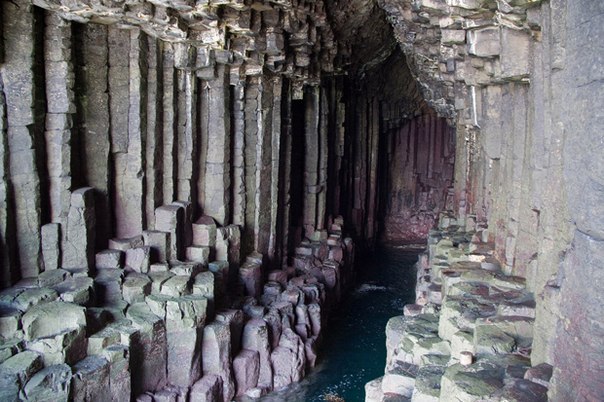
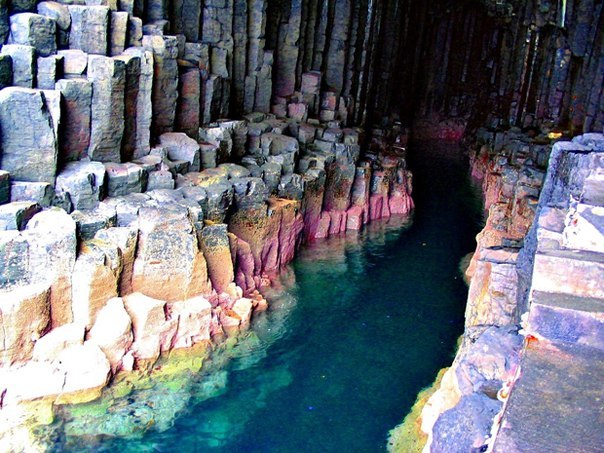
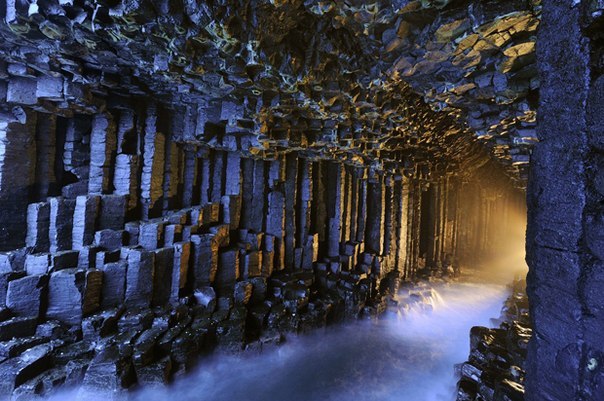
One of the most striking features of Staffa Island are its naturally formed basalt columns, which have incredibly regular shapes. Most of these columns are hexagonal, but there are also triangular and octagonal ones. Their unusual shape is the result of a long process of volcanic lava crystallization. The main chamber of Fingal’s Cave is 75 meters long, 20 meters wide, and 14 meters high. In Gaelic, this cave was called Uamh Binn, meaning “Cave of Melodies.” The Scottish poet James Macpherson gave it its current name in honor of the epic hero Fingal. According to Irish legends, the giant Fingal built a dam that connected Scotland and Ireland. A narrow path leads through Fingal’s Cave, flanked by magnificent basalt columns. The passage is so narrow that boats cannot pass through. The huge cave echoes the sounds of the waves, creating a truly singing environment that lives up to its ancient name “Uamh Binn” – “The Singing Cave.” After Joseph Banks described Fingal’s Cave in 1822, many notable figures visited it, including Queen Victoria, Walter Scott, William Wordsworth, John Keats, Alfred Tennyson, and Jules Verne. In 1932, the artist Joseph Turner painted a landscape depicting this famous cave.
When the composer Felix Mendelssohn (creator of the famous “Wedding March”) visited Fingal’s Cave in 1829, he was so inspired by the amazing echoes in its chambers that he composed an overture titled “Hebrides or Fingal’s Cave.” Fingal – a name that can be translated as “White Stranger” – is one of the favorite heroes of Celtic epic poetry. According to one legend, before facing the mighty giant Benandonner, Fingal built a huge dam and rested there before the battle. While he slept, the giant came looking for him and ended up in Fingal’s home. But Fingal’s wife, Unnah, deceived the giant by leading him to believe that the covered figure under the blanket was Fingal’s newborn son.
Find the Best Professionals for Your Project
Expert repair, construction, and renovation specialists ready to help you right now
Recommended Galleries
Recommended articles




More Galleries
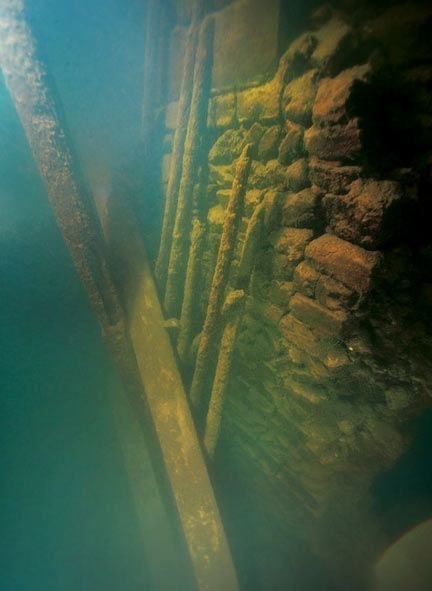 At the bottom of Qiandaohu Lake lie the ruins of a mysterious ancient city with a history spanning thousands of years
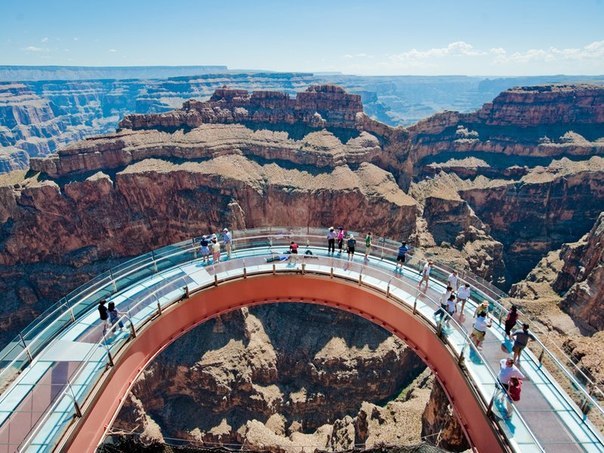 Skywalk
 10 Prehistoric Marine Monsters
 Remade Stories with Pop Heroes
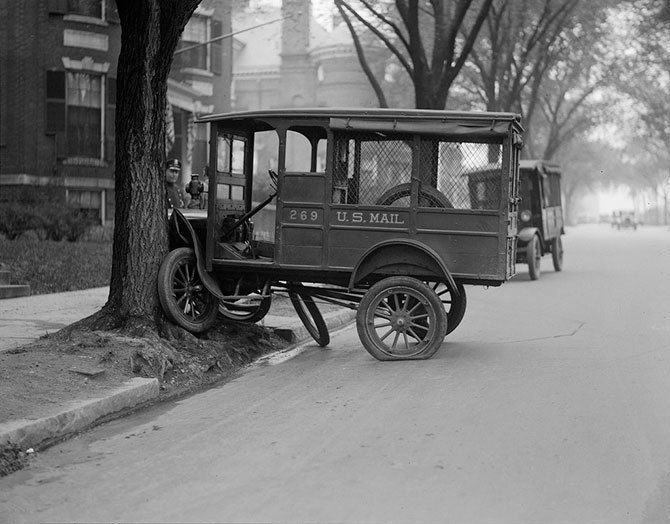 In the early 20th century, cars still resembled horse-drawn carriages and were devoid of any safety features. The speed of all vehicles did not exceed 30 km/h, and there were far fewer cars on the roads than today. However,</p>\n "home_text": "<p>even under such conditions, collisions and other traffic accidents were inevitable.</p><p>These photos were taken in the 1920s and 1930s in Boston, USA. As you can see, at that time, traffic accidents were a common occurrence, affecting perhaps an enti
 Northern Lights
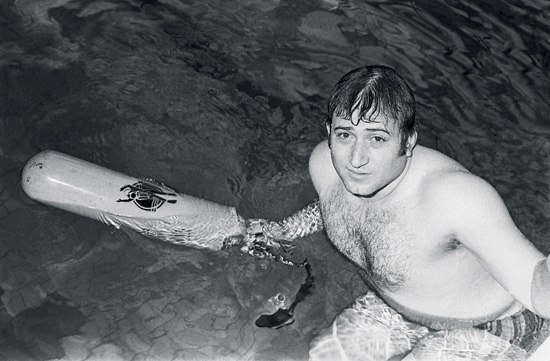 Shavarch Karapetyan: A Renowned Athlete with Many International Titles in Scuba Diving
 International Balloon Fiesta in Bristol
 Megacities from a Bird's Eye View
 The World's Most Dangerous Hotel for Climbers Has Opened in the Italian Alps
 Day and Night in One Frame
 Singapore Ranks First in the World for Death Penalties Per Capita