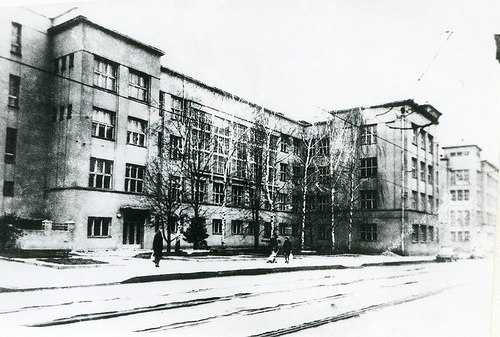
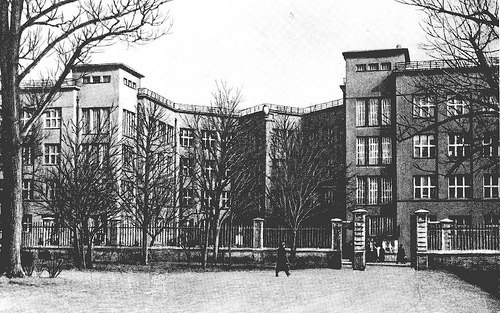
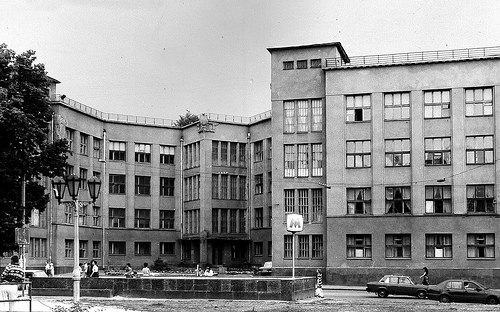
82 Pushkin Street, Institute of Medical Radiology. (1930). <br>Style: Constructive Art Deco.3 photos
82 Pushkinskaya Street. Institute of Medical Radiology. (1930).
Style: Constructive Art Deco.
The idea of establishing an academic radiological research institution in Kharkov was proposed by Dr. S.P. Grigoryev. In the spring of 1920, his proposal to organize a “Radiological Academy” was approved by the Ukrainian People’s Commissariat of Health. However, the premature death of the initiator delayed the establishment of the academy for some time.
The project was subsequently undertaken by a group of Kharkov radiologists and staff from the physics department. In May 1921, the Radiological Academy was granted a renovated building with eight apartments, and its development began in full swing: new departments were established—including a library with a capacity of 1,800 volumes, a museum featuring more than five thousand X-ray specimens, an anatomical specimens museum, as well as a inpatient ward and outpatient clinic.
In 1929, funding was allocated, and construction of the new institute began according to a design by architect V.A. Estrovich. The four-story building met all the requirements of a academic medical institution, featuring a large lecture hall for students, spacious offices, and recreation areas. A distinctive architectural feature were the variously designed windows.
V. Estrovich created an impressive composition for the central entrance, which protruded at an angle forward. The vertical volume of the entrance, set within a uniquely shaped curtain wall, was complemented by similarly shaped volumes located at its corners. This design successfully combined modern compositional techniques with classical elements, balancing architectural simplicity with rich spatial effects.
One of the best medical buildings in the city, it boasts an intriguing layout: geometrically precise forms on the Pushkinskaya Street side create a complex polygonal shape, flanked by two square towers. Its architecture reflects the Art Deco style popular at the time, blending functionalism with classical elements. Innovative construction methods were also employed, such as large-span cantilevered slabs made of monolithic reinforced concrete and prefabricated reinforced concrete structures for the auditorium.
vk.cc/YAELB
#1stolica_history
Style: Constructive Art Deco.
The idea of establishing an academic radiological research institution in Kharkov was proposed by Dr. S.P. Grigoryev. In the spring of 1920, his proposal to organize a “Radiological Academy” was approved by the Ukrainian People’s Commissariat of Health. However, the premature death of the initiator delayed the establishment of the academy for some time.
The project was subsequently undertaken by a group of Kharkov radiologists and staff from the physics department. In May 1921, the Radiological Academy was granted a renovated building with eight apartments, and its development began in full swing: new departments were established—including a library with a capacity of 1,800 volumes, a museum featuring more than five thousand X-ray specimens, an anatomical specimens museum, as well as a inpatient ward and outpatient clinic.
In 1929, funding was allocated, and construction of the new institute began according to a design by architect V.A. Estrovich. The four-story building met all the requirements of a academic medical institution, featuring a large lecture hall for students, spacious offices, and recreation areas. A distinctive architectural feature were the variously designed windows.
V. Estrovich created an impressive composition for the central entrance, which protruded at an angle forward. The vertical volume of the entrance, set within a uniquely shaped curtain wall, was complemented by similarly shaped volumes located at its corners. This design successfully combined modern compositional techniques with classical elements, balancing architectural simplicity with rich spatial effects.
One of the best medical buildings in the city, it boasts an intriguing layout: geometrically precise forms on the Pushkinskaya Street side create a complex polygonal shape, flanked by two square towers. Its architecture reflects the Art Deco style popular at the time, blending functionalism with classical elements. Innovative construction methods were also employed, such as large-span cantilevered slabs made of monolithic reinforced concrete and prefabricated reinforced concrete structures for the auditorium.
vk.cc/YAELB
#1stolica_history
Find the Best Professionals for Your Project
Expert repair, construction, and renovation specialists ready to help you right now
Recommended Galleries
Recommended articles



More Galleries
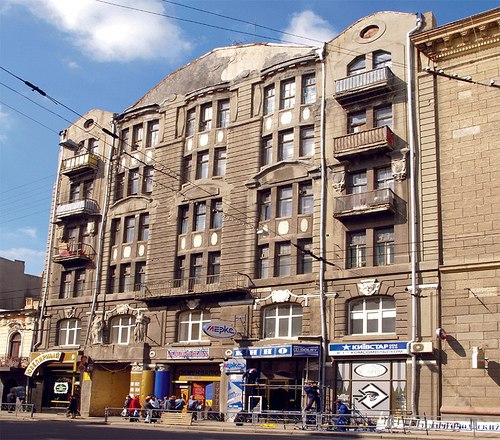 The former apartment building owned by Haritonov and the “Amper” cinema. Designed by architect A.I. Gorokhov (1913). Location: Sumskaya Street, 5.
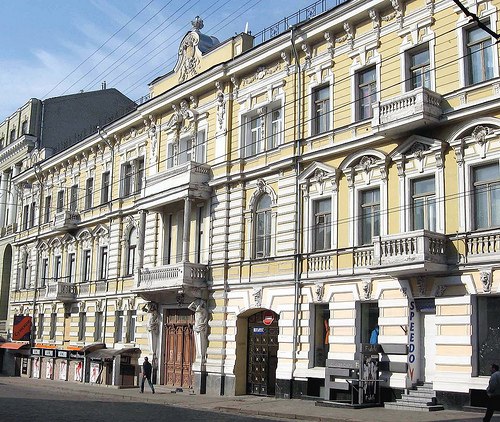 Former income-generating property of the “Life” Insurance Company.<br>(19 Sumskaya Street)
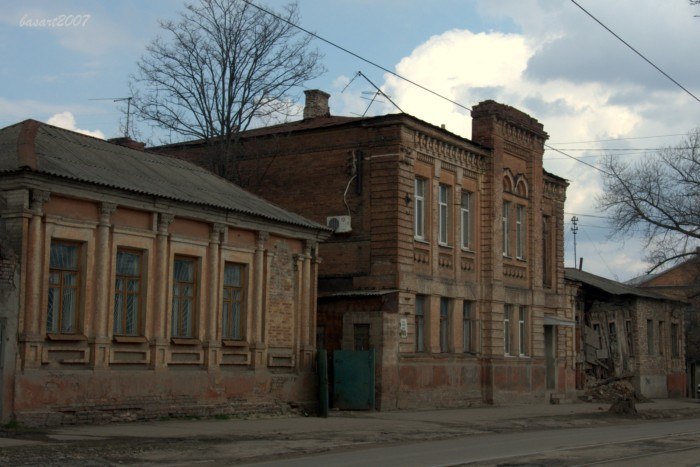 Vasily Krichevsky and Moskalievka
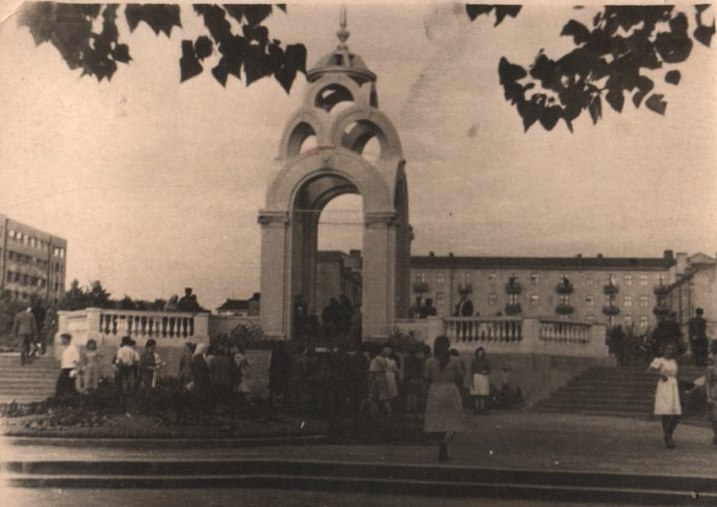 Glass Stream
 Vladimir Mayakovsky and Kharkov.
 Bursaatsky Slope
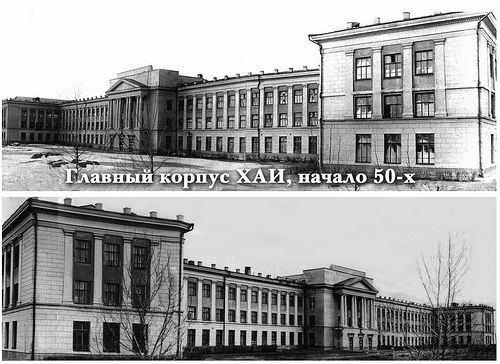 **Kiev and Aviation, as well as the History of Kharkiv Air University** <br>(Part 2) --- The city of Kiev, located in the heart of Eastern Europe, is a major transportation hub and a vital strategic location. Kiev has always been an important center of cultural, scientific, and technological development in Eastern Europe. It has played a pivotal role in the history of European aviation. Kiev itself is an impressive example of urban development. Modern infrastructure, advanced technology, and high-quality services provide excellent conditions for conducting various activities and operations. Kiev also plays a crucial role in ensuring the smooth operation of transport systems in Eastern Europe. Ukraine, as a whole, is an important country in the global context. Ukraine has a long history and rich cultural heritage, as well as a vibrant and dynamic economy. An active role in international affairs and a constant effort to improve its economic situation have enabled Ukraine to gain a significant position in the world community. The Air University of Kharkiv is one of the most prestigious institutions of higher education in Ukraine. It was founded in 1930 and has a long and distinguished history. Since its establishment, the University has played a vital role in the development of aviation technology in Ukraine and the region as a whole. Kharkiv itself is a beautiful and historic city with a rich cultural heritage. Kharkiv is located in the southern part of Ukraine, in the Kharkiv Oblast. Kharkiv Oblast is one of the most economically developed regions in the country. The Oblast is known for its high-quality education system and excellent facilities for scientific research. The Air University of Kharkiv is located in the city of Kharkiv. It occupies a prominent position in the urban landscape of the city. The university campus includes several buildings, including academic teaching facilities, research laboratories, and modern libraries. The Air University of Kh Kharkiv has always been committed to providing high-quality education and training. It is dedicated to ensuring that its students receive the best possible education and opportunities for career development. The university offers a wide range of courses and programs, allowing students to choose according to their interests and aspirations. The Air University of Kharkiv is an active participant in international academic activities and cooperation. It participates actively in various international organizations and forums. It also engages in various exchange programs and exchanges students with other universities around the world. --- ### Note: The above translation provides a complete and accurate rendition of the original text into English. All important details and information have been preserved, and no part of the source text has been omitted or left untranslated.
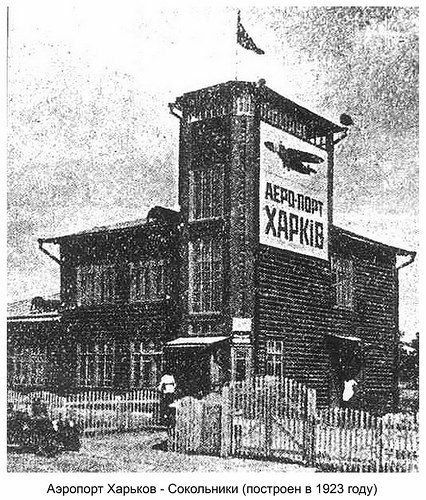 **Kiev and Aviation**<br>(Part 1)
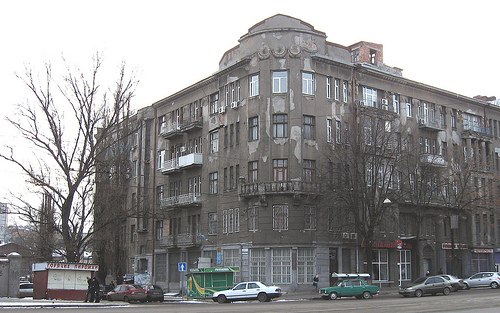 47/49 Poltavskiy Shlyakh.<br>Former Feldman Income House and private clinic (1918).
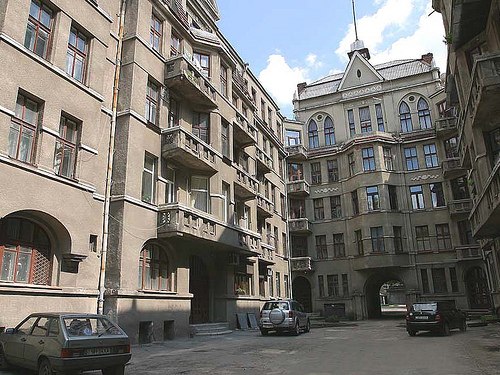 6 Artyom Street, “Red Banker” Residential Building (1928). <br>Designed in collaboration with architect Andrusenko. <br>Style: Decorative Art Deco.
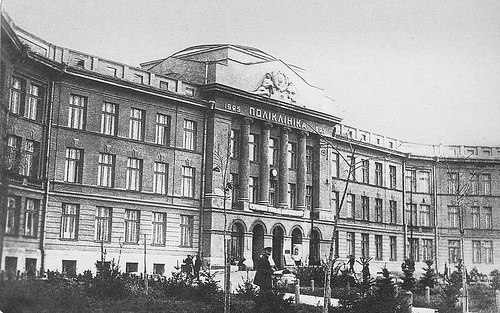 Moscow Street, 197
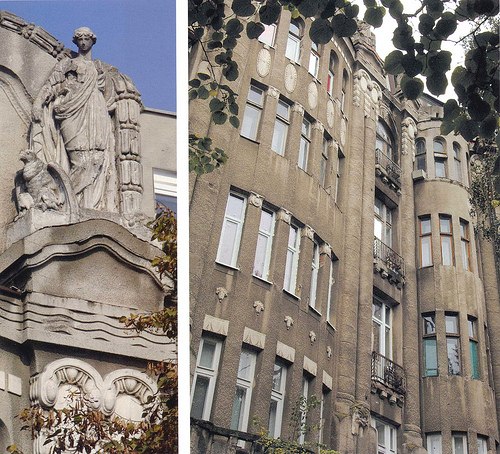 22a Poltavskiy Shlyakh. Former income-producing property owned by the Kats brothers (1914).